Off Court, Novak Djoković Takes a Significant Step

Novak Djoković is the most prominent Serbian citizen who has voiced his support for students who have been leading demonstrations since last November. How many people—at home or abroad—have heard his words?

The Background

Since the November 1, 2024 collapse of a concrete canopy outside the train station in Novi Sad, Serbia’s second city, students have been organizing regular meetings to commemorate the 15 lives lost as well as to call out the corruption they believe is behind the tragic accident. They have made a number of demands of the government, including the release of all documents relevant to the renovation of the train station and a 20% increase in funding for higher education. Universities have not held classes for months and students have organized sit-ins at faculty buildings as well as street protests.
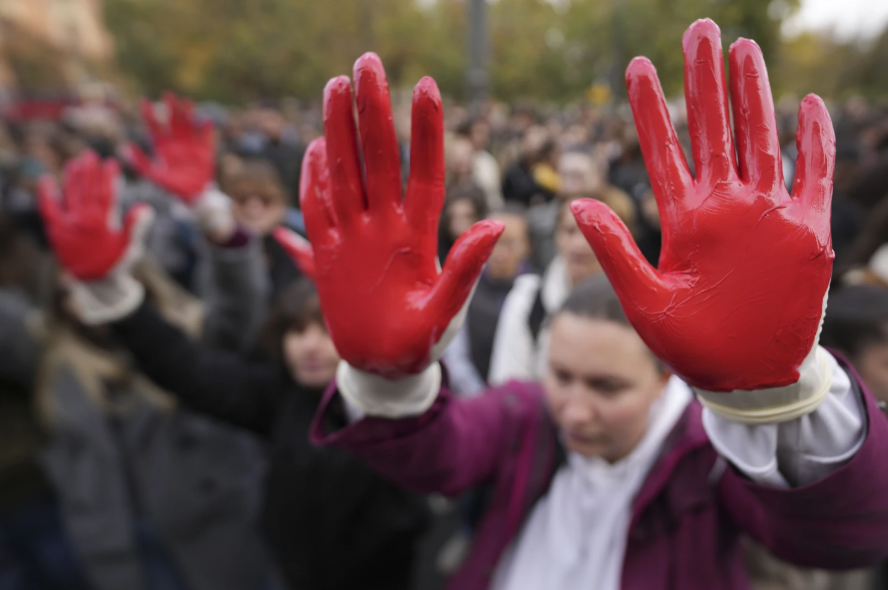
Painted red handprints and the slogan “corruption kills” have become symbols of the protests. (Source: AP Photo by Darko Vojinović)

Though the trigger for the protests—which have spread from Novi Sad and Belgrade to smaller cities and towns across the country—was quite specific, they quickly encompassed broadly-held sentiments: “For the students taking to the streets in their tens of thousands, the Novi Sad tragedy is emblematic of everything they believe is wrong in Serbia: widespread institutional corruption, a lack of accountability, and a technocratic class who are perceived to have risen only due to their ties to Vucic’s ruling Serbian Progressive Party” (Srpska napredna stranka, a.k.a. SNS, in Serbian). The government of President Aleksandar Vučić and his party, who have controlled Serbia for nearly 13 years, is in crisis as the student protests have galvanized citizens from all walks of life. On Friday, there was a general strike that slowed commerce and traffic in the capital to a standstill. And at a 24-hour blockade of one of Belgrade’s key intersections on Monday, students had backup from farmers on tractors, bikers, and white-coated medical staff. Professors, teachers, judges, actors, writers, and other professional and cultural groups have also signaled their support.
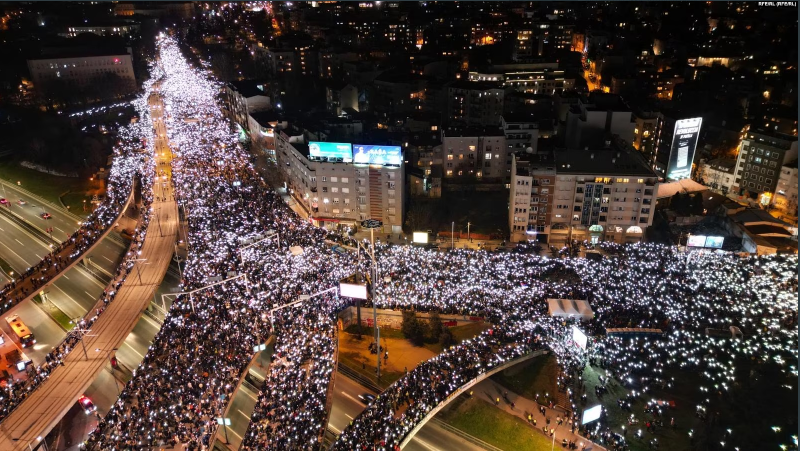
Blockade of “Autokomanda,” a key intersection leading into central Belgrade (Source: RFE)
More

The protest in photos

Vučić has suggested that the students are being funded by unidentified external actors who want to take down his government by force, and his rhetoric—by turns defensive, dismissive, defiant, and pleading—has likely contributed to acts of violence against the protestors. About two weeks ago, a student was injured when a car plowed through a crowded Belgrade street, an ugly incident that was caught on video; and on Monday, a handful of students in Novi Sad were beaten with baseball bats wielded by men who allegedly emerged from a SNS headquarters. Yesterday, only partly in response to the latter event, Prime Minister Miloš Vučević resigned, as did the mayor of Novi Sad, satisfying one of the students’ demands. With the prime minister’s resignation, the entire cabinet essentially collapses. What happens next is uncertain, although, “according to the Serbian Constitution, if parliament fails to elect a new government within 30 days of the prime minister’s resignation, the president is obliged to dissolve the National Assembly and schedule elections.” While opposition groups have called for the formation of a transitional government “made up of experts approved by the students,” the protestors themselves say they are not interested in “political power but accountability and justice within a corrupt system.” Those who can’t be on the streets and Serbs who reside abroad are refreshing their news feeds, exchanging frequent updates on messaging apps, posting photos of the protests on social media, and generally staying on alert.

Djoković Draws a Line

With a few notable exceptions over the course of his two-decade career, Djoković has generally been reluctant to make statements that his compatriots could perceive as political. (Why this is so is a complicated matter I’ll leave for another time. Anyone who can read Serbian or is willing to make do with an AI translation can consider the points raised here.) But over the last few years, beginning with environmental demonstrations in late 2021, his attitude has gradually changed. In the past month or so, after the student protests began, Djoković has seemed noticeably more willing to use his platform to address topics other than sports. As he told an interviewer last summer, for a cover story in the February issue of GQ magazine, “Tennis is still my biggest megaphone to the world.” This was among the reasons he listed for not yet hanging up his racquets, despite having completed his tennis bucket list with the gold medal in Paris.

On the other side of the world at the Australian Open, Djoković turned his megaphone toward home. After his third-round win over Tomáš Macháč, Novak wrote “for Sonja” and drew a heart on the camera, a dedication that would have come across loud and clear to anyone back home watching tennis and tracking the protests. Speaking with Serbian media, Novak explained the gesture. (The translations throughout are my own.)

It was addressed to Sonja [Ponjavić], who is currently in the hospital. I’m sending her support, and I hope that she recovers as quickly as possible. I was shocked, like everyone else, when I saw the video. I simply can’t believe that these kinds of things happen nowadays. I don’t know what clicks in a man’s head so that he’d do such a thing—to run over another person, not least a young woman, a student. Really. I don’t know what else to add, except, as always, to call for peace and understanding. I’m completely opposed to violence of every kind, and, unfortunately, it seems like there’s more and more of it on the streets. I hope it’ll stop soon.

Though these were his first words on the subject in a press conference, they weren’t Djoković’s first comment on current events in Serbia. In mid-December, he posted that he thinks it’s “important for [young people’s] voice to be heard.” Judging by the response on social media, some Serbs didn’t think he went far enough here, as this diplomatic statement neither mentioned the mass gatherings explicitly nor criticized the government. Given his reference to “educated youth,” however, the “with you” salutation is pretty clearly directed at protesting students.

However, his message from Melbourne’s Rod Laver Arena—one of the sport’s biggest stages—was an indication that Serbia’s favorite son had decided to make his statements on the subject more direct. (It’s worth noting that international media did not ask about this act, in stark contrast to the controversy that erupted when he wrote on a camera at Roland Garros in 2023. Since both messages were in Cyrillic, they required some deciphering; but activists on social media were happy to help when the subject was Kosovo and, thus, outrage was easy to generate.) After his fourth-round match, Djoković was asked a follow-up question—once again, in Serbian—related to his message on the camera. Specifically: does he follow the news from back home, or what’s happening around the world, when he’s competing at a tournament?

This time, his reply was much longer, even though he’d been asked a “yes or no” question and everyone in the room would have understood if he wanted to answer briefly and call it a day.

I follow what’s happening in Serbia—not quite everything, but I follow events a lot through social media. I can’t pretend that nothing is happening. . . Even though I’m in Australia, of course I’m upset by things like the situation that happened the other day with Sonja. I hope she recovers quickly and returns home. And that, unfortunately, isn’t the only instance of violence against students and young people. How can I put it? . . . This is a big loss for us as a society—Serbian [society], generally. So, my support is always with young people, and students, and all those to whom the future of our country belongs.

I mean, I can no longer consider myself a young man—I’m somewhere in middle age now—and I would like my children to also grow up in Serbia. I would like for young people from abroad to return to live in Serbia, and to feel that they have a society and an environment which they can enjoy and in which they can develop, and that it’s an environment that actually offers them everything that they need. So, that’s one thing I can say about that; and, of course, I always have been and always will be against violence of any kind. Really, I don’t know. I said this the other day and have nothing to add on that subject.

And in [the rest of] the world, what’s happening with wars, I have no comment on the fact that innocent people are constantly dying—they suffer the most. Honestly, sometimes I think: as an athlete, of course I want people from our country to support me, and I want them to feel, in some way, that what I do has value in their lives. . . . I am trying to be a good ambassador for Serbia in the world, and have been for many years. But, well, when these sorts of things happen, these kinds of tragedies—like Ribnikar or Novi Sad or everything that has happened in the last few years—then truly everything else, including sports and what I’m doing, falls into the shadows. It’s irrelevant compared to human life and to the struggle for some basic rights. That’s all I can tell you.

There is a lot in this statement one could unpack, like the tension Djoković appears to feel between his role as an informal ambassador and any criticism he might wish to make about the state of things in Serbia. But I’ll offer just three interpretations here. First, violence against young people—particularly the mass shooting at a Belgrade elementary school (OOS “Vladislav Ribnikar”) in May 2023—has almost certainly contributed to Novak’s new outspokenness. Second, both his age and his parenthood have shaped his thinking: he wants his kids, now 7 and 10 years old, to “also grow up in Serbia,” like he did, but it’s not certain that they will—not merely because they have the resources to live elsewhere but specifically because Serbia may not provide what they need to thrive. Third, while the exodus from Serbia over recent decades (essentially, since the breakup of Yugoslavia) saddens him, he understands it.

For more on “brain drain” from the Western Balkans, see below.

Research indicates that “young people leave these countries not only because of low salaries and economic issues but also because of corruption, crime, political instability and lack of security.”

To put this last point in context, I turn to Radio Free Europe: “For young Serbs, staying in their homeland is not easy, despite their love for their country. Youth unemployment is high, and many young people feel there is no other option than to find work abroad. According to a 2019 UNDP report, ‘Serbia is among the world’s 10 fastest-shrinking populations due to its low birth rates, high out-migration, and low immigration.'” These comments suggest that Djoković has a lot on his mind, including how he can best contribute to a brighter future for not only the children in his family but also the nation’s youth, more broadly. The work of his foundation, which focuses on early childhood education and has also been offering parenting workshops of late, is already making a difference. But is there more he could be doing? (I hasten to add that this is less my question than one I gather Novak is asking himself.)

Meanwhile, Back in Belgrade

What happened next may surprise and even shock some of you, though, unfortunately, it’s standard operating procedure in Vučić’s Serbia. That is: most regime-affiliated media didn’t report on Novak’s comments—not even those outlets which had sent journalists to Melbourne to cover his Australian Open campaign. They didn’t show his message to Sonja and they didn’t publish his lengthy follow-up observations, which were among the most revealing he’s ever made about contemporary Serbian society. Unlike the mostly-anonymous protestors—whom Vučić, other members of his party, and the media they control feel free to demonize—Novak Djoković is both a well-known figure and a wildly popular one. He also has a direct line for communicating with millions of people, irrespective of whether he’s giving an official press conference. Like the 20-somethings leading the protests, Djoković is accustomed to self-publishing when he feels the need: “The students haven’t just grown up with Vucic; they’ve also grown up with the Internet. Their flair for digital innovation and social media has enabled them to bypass state-controlled media and spread their message far and wide.” So, it isn’t easy to keep what he’s saying from his fellow citizens.
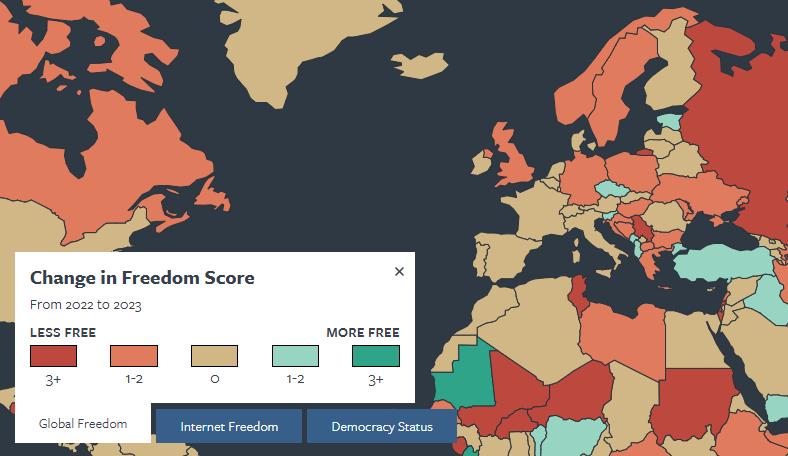
According to Freedom House, Serbia is the only country in Europe other than Russia experiencing a major downward trend in terms of political rights and civil liberties, with the SNS “putting pressure on independent media, the political opposition, and civil society organizations.”

Nevertheless, members of the SNS are trying—through outright media control as well as the sort of “radical self-censorship” that has become common under Vučić’s increasingly authoritarian rule—to limit the reach of Novak’s voice. (Click these links if you want to learn about Vučić’s formative experience as the Minister of Information in the final, desperate years of Slobodan Milošević’s regime or about challenges to press freedom in Serbia.) A colleague, whom I won’t identify out of an abundance of caution, confirmed to me that he didn’t submit Novak’s protest comments because, simply, “Nothing of the sort gets published” by his SNS-controlled employer. Journalists working for such outlets are aware which subjects are forbidden and don’t even try to post these stories, as they know higher-ups will delete the material and they’ll likely lose their job.

Because Djoković made these comments in Serbian, they also didn’t get picked up by international media at the Australian Open. For this to happen, one of the Serbian reporters on site would have had to translate (and somehow circulate) Novak’s statement while also working on deadline to produce multiple articles a day. In any case, his comments weren’t sports-related; so, it’s doubtful any of the tennis beat reporters would have been able to do much with them. Thus, between the suppression of these comments at home and the lack of coverage abroad, it’s unlikely word of them has spread very far.

Acknowledgment

I’d be remiss if I didn’t mention that today’s New York Times features an article that mentions Djokoviċ in this context, the first I’ve seen in international coverage of the protests.

Serbia is a small country, with a population smaller than New York City’s, and most people in the world are unfamiliar with it. Unless there’s a natural disaster, heightened tension with Kosovo, or the Serbian men’s basketball team is threatening to upset the Americans at the Olympics, it’s not often in the international news—not since the Yugoslav wars of the 1990s, that is.

Sidebar

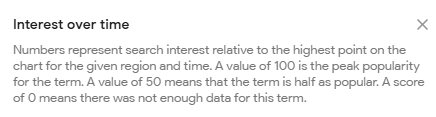
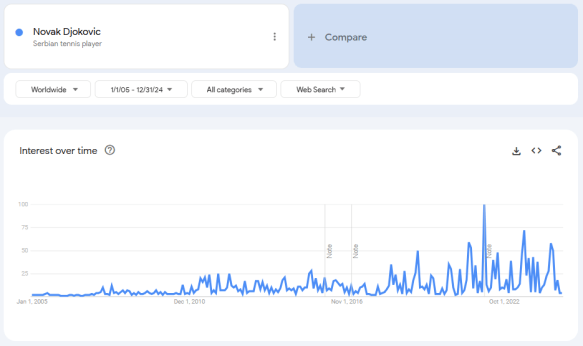
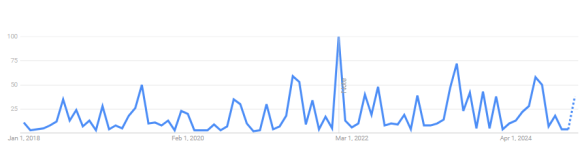
Out of curiosity, I looked on Google Trends to see whether Djoković got more global attention when he won the gold medal in Paris last summer or when he was detained and deported by the Australian government. The results were as I expected: there was far more interest in the January 2022 controversy than in any of his major titles. The five next-highest peaks (visible in the second slide) were during Wimbledon 2023, Roland Garros 2021, the 2024 Olympic Games, Wimbledon 2021, and Wimbledon 2019.
Still, what’s going on in Serbia right now is a big deal for the region. Something like this hasn’t happened for nearly a quarter-century. And the fact that the most recognizable Serb in the world went out on a limb to say something about it—and the Serbian government doesn’t want its own citizens to know—is arguably of much more significance than his having to pull out of a semifinal match at the Australian Open due to injury. Hopefully, Novak’s torn adductor muscle will be healed by the time the clay season rolls around, if not before. When—and how—the current crisis in Serbia will end is much less certain.

Postscript

On Friday, 31 January, Djoković made his first public appearance in Belgrade since returning from Australia a few days prior. At a basketball game between Belgrade rivals Crvena Zvezda and Partizan, he and his wife both sported custom-made sweatshirts expressing their support for students. (The phrase is a riff on the “dreamers are champions” theme from the collaboration between French designer Millinsky and Novak’s foundation.) In the video below, a reporter asks Novak to explain the meaning for those who don’t speak English, to which he replies, “They know—they know very well.” The media coverage of the game combined with a short statement in English more or less guarantees that this message, unlike the ones I discuss above, will be understood around the globe.
Faces in the Crowd: Australian Open Edition

Last January, at the height of the Djoković debacle in Australia, I made the Twitter acquaintance of an American Novak fan named Claire (a.k.a. @luvinthetennis). Almost immediately, I was struck by how substantive and articulate her tweets were, including long threads about how the international media was—and, ideally, should be—covering the story. So, it didn’t come as a complete surprise when I eventually learned that Claire is a writer. (I’ll leave it to her to decide when and how to introduce herself more fully.) Like many fans I’ve met at tournaments, Claire doesn’t fit the stereotype of “Nole Fam” that has developed over the past decade, especially online—and this is one reason why I was interested in her personal path to fandom.

When I found out that, like me, Claire and her husband Pat would be traveling to Melbourne for this year’s Australian Open, I made a point of meeting them. We chatted a few times around the grounds before Claire and I found a shady spot to talk before the men’s singles final. She and Pat had arrived as the gates opened that Sunday to score seats outside Rod Laver Arena, so they could get the full Garden Square experience.

Before focusing on her Novak fandom, I asked Claire about her relationship to tennis in general. She told me she’d started watching the sport as a child, during the later years of the Evert-Navratilova rivalry. “I was the only person in the family who cared about tennis at all,” she noted, “and I remember being extremely young and just staring at the screen and sort of figuring out how scoring works. And, little by little, I just fell in love with what they were doing. I was a big Martina fan.” She kept watching as new players arrived on the scene, eventually becoming an Agassi fan: “that’s when I became a devoted fan and I started really following it. And I loved him. I loved his career: up and down, lots of drama and fun. Then he retired and I actually wasn’t interested in anyone else who was playing. I was also a huge Monica Seles fan, by the way; but then I stopped watching the women play [after] the stabbing.”

As for Djoković, Claire admits she “didn’t even know that Novak existed” until the summer he first ascended to the men’s #1 spot. “I was visiting a friend one day,” she recounted, “and that friend had the US Open on. It was 2011 and I saw Novak playing. I was talking to my friend, with the [tv] sound off, and I kept getting diverted because I loved the tennis. I was saying, ‘His tennis reminds me of Agassi’s tennis’: the precision shots, the baselining, the crisp returns. But he’s such a different player. He has so much passion just rolling off of him—and I love that about him. So, in the end, I started staring at the screen, and my friend and I watched the rest of the match. I know that a fan was born then and I’ve been following him ever since.”

However, like many Americans, it was challenging for Claire to be more than a casual fan due to the fragmented way tennis is broadcast in the US: “I don’t tend to pay for extra channels…. So, I would only see the majors.” Two more recent events contributed to Claire’s becoming a “really huge Novak fan.” First, significant personal losses in 2019; then, the start of the pandemic in 2020. “I was stuck at home, and I had some other big things going on in my life that were difficult and painful to work through. I needed a good distraction,” she said.

In fact, it was Djoković’s default at the 2020 US Open that seems to have transformed her fandom from a pastime into something more like a project. Claire “was shocked at the vitriol he got for” hitting a line judge with an errant ball, “since he obviously did not do it on purpose”; and she felt motivated to try “to figure out why” he was getting such a reaction.

I’ll let Claire take it from here. (What follows is an edited version of our conversation; though I made minor changes for clarity, I mostly cut for length.)

C: The more I looked into it—the more I would dig and watch previous matches, would see some press conferences with him—I started to realize how misrepresented [Novak] has been in the press. And that really annoyed me because the more I watched those pressers, the more I really liked this guy. I was only into his tennis [at first] and I didn’t care that he broke a racquet—I love to see passion on the tennis court. But I actually fell in love with him as a person once I started to dig deep and see who he was.

So, I just got more and more devoted to him, watching all these old matches. It was a great distraction during the pandemic—and I really needed it. Then, I followed his 2021 calendar Grand Slam race. I was so devastated with the loss in the US Open final; but it was a great season and I was excited to start again. And here comes 2022 Australian Open! We all know what happened there…

I was completely devastated by that and I realized I had really connected with him. And, again, a lot of things had been happening in my life: I lost both of my parents, six weeks apart, right before the pandemic; and I couldn’t be with my sister and brother to grieve over that. So, I think what happened to me was that I was using Novak’s tennis to sort of help me through that period of grief, watching all those old matches, watching his career [develop], being so impressed with his commitment to excellence, watching all his old press conferences, finding out what a great guy he is. I just became really attached to him as a person—in a weird way, since I know he’s a person I’ll never meet.

I really appreciate what he did for me. He helped me through the worst time of my life, really, and so I wanted to come here and support him.

AM: Going back to what you said about how, during the pandemic and after the US Open default, you started to dig into old matches and that kind of thing. This may seem like a strange question, but I’m curious how you came to the conclusion that he was being misrepresented. In other words, did you go on Twitter and meet a bunch of Novak fans, for whom that is a big issue? Or is that a conclusion you drew simply on the basis of watching him, reading his press conferences, and then reading the coverage?

C: No, I came to it completely on my own and this is how it happened. When I saw the disqualification, I went on to Twitter. This is how I follow the news—by Twitter—because I follow a lot of journalists who post articles. And I saw that it was trending, so I was looking at what people were saying. I didn’t land on Djoković fans at first. I was just reading these really vitriolic comments that did not match what I had seen [on tv]. You know, disqualification—fair, not fair—people can disagree about that. But it’s clear he didn’t do it on purpose. And I was seeing people say, “Well, of course he did it on purpose; he’s that kind of person.” In effect, they were saying that, and I was just very curious about that, so I started looking into it.

I had heard the commentary on the US Open 2020, [in which] they kept referring to the Adria Tour, and how supposedly badly Novak had behaved during the pandemic. I was curious about that too; so, I went back and read a news article about it, and I was like, “Oh, that’s kind of disappointing.” And then I read another news article and I thought, “Well, wait, those two things don’t really match.” Then, actually, I started digging around and I found the piece that you did on it. And I read the details and realized that it was being misrepresented.

AM: Thank you for being one of the 15 people who’s read my blog.

C: Well, you did such a great job of covering that and you answered all my questions. It was just very clear to me, because the things that I was seeing about the Adria Tour just didn’t really make sense. They kept saying, “He organized this event” and “Novak did this thing.” And I thought, “This was a whole country—a region, actually. One man cannot organize an event [like this on his own]. Obviously, he had to follow rules, he had to be in touch with people who would allow these things. So, what on earth is going on here?” As you pointed out, there was a big soccer event at the same time [etc.]. So, it was just very clear that was being misrepresented.

But the real key part of feeling like he’s been misrepresented through the years is when I went back. I actually followed every Grand Slam victory he’s had: I watched every semifinal I could get in whole and every final, and I watched highlights of other things. I went chronologically because I wanted to understand what had happened.

AM: So, you started roughly in 2007?

C: Yeah, I did.

AM: Okay. Wow.

C: I would listen to the match commentary, then I would go to the presser—almost all this stuff is available online, if you look for it. I would hear the things that the commentators were saying about him—something he had done or said, or they would quote him, “Well, in his press conference, Novak said ‘blah, blah, blah’—and I’d go back and listen. And I was like, “Oh, they took that entirely out of context. Interesting.” And that just kept happening and happening and happening. I mean, commentators that I have no reason to think are intentionally misrepresenting him, but they are taking things out of context and twisting what the meaning is. I’ve actually been very shocked by it. I had no idea.

AM: I happen to know—because I found out a little bit about you before we met in person, now, for the first time—that you studied linguistics [in graduate school]. Do you think there’s any connection between your study of linguistics and how you approached reading and viewing the pressers? Is there any link there?

C: I think there’s one small link there in that I’m very aware of language barriers. So, when I am listening to how Novak answers a question, I feel like I can tell when he didn’t catch all the connotations that were in the question. So, he’s answering it a little bit differently because he heard it differently. I feel like I can tell what he means to be saying, sometimes, when he doesn’t use quite the same word we would use—and maybe, because of the phrasing or the word he uses, it has a negative connotation or a connotation no American or English speaker would put in it. I can kind of tell what he’s going for.

I think that’s true of anyone, if you pay attention, you watch everything in its entirety, and you take someone on good faith. That’s the key—you take someone on good faith. I think anyone can see that. But, yes, I think I do pay even closer attention to that—I’m a writer and I studied linguistics. So, I do pay attention to what’s going on, how people are wording things, why they’re wording them the way they are. And I’m very aware of the language barrier, even though he’s a fluent speaker of English and has a much higher vocabulary level than your average English speaker, frankly. Still, he says things in a different way sometimes—and I’m aware of that.

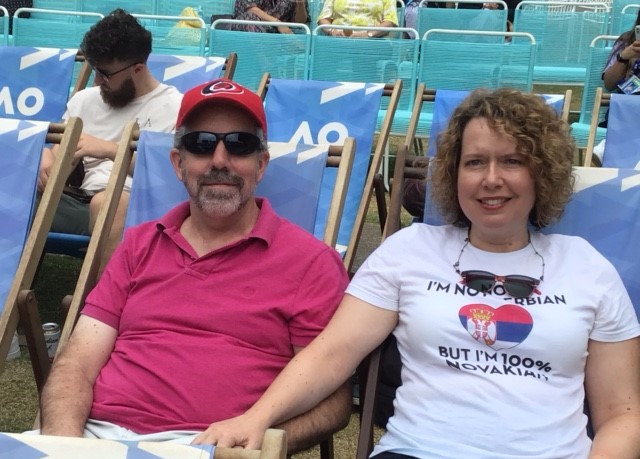
AM: Obviously, someone reading this won’t necessarily see what you’re wearing. But I can’t help but note that you’ve got on a t-shirt that says, “No, I’m not Serbian, but I’m 100% Novakian.” There’s this myth that the majority of Novak fans around the world are Serbian—and you’re kind of debunking that on your very body. [Note: after posting this, I learned both the identity of the woman who came up with the original shirt idea in 2021 and that still other fans have created variations on the theme. Djoković himself has joked about this media narrative.]

Also, you’re not from Novak’s part of the world—I mean, you’re not from Europe; you’re not from Eastern Europe; you’re not from the former Yugoslavia; you’re not from Serbia. As far as I’m aware, you don’t have any connection to that part of the world. You may not “get” him and get his background in the same way that people who do have that in common with him do. So, I’m curious both what you make of that myth (that all, or the majority, of his fans have ties to Serbia) and what it is about Novak that you connect to, despite the significant age gap as well as cultural differences?

C: The first question, what do I make of the myth? I feel like the people who are shaping the tennis narrative—the primary people in the media who shape the tennis narrative and who have shaped the narrative of the Big 3—I think they find Novak off-putting. I mean, I don’t see any other way to think about that. I’m sure they must admire his tennis and probably some of them admire him and like him; but, overall, they seem to find him off-putting. So, I think that when they see fans waving flags with his face on it—which is inevitably going to be a Serbian flag—they just assume only people who are connected with Serbia can like him, because he’s so unlikable. I really think that this is what they believe: he’s so unlikable that the only fans are people who only care about pretty tennis, first of all, a small segment of people, but the devoted fans must be connected to Serbia in some way. I think that they think that—and I think that they have to be completely wrong about that. I mean, I myself have met people who love him and have no connection to Serbia. I don’t know why it’s so hard for them to believe.

AM: If you had to guess, or if you’ve seen articles or coverage, what are the handful of things that you think they think make him unlikable?

C: I think that they don’t like the way that he responds to difficulty on the court and the way that he manages his matches when he’s fighting various things. Mind you, from what I can tell (because I’ve watched him play Andy Murray quite a bit, because I’ve watched his career), Andy Murray has a very similar way of managing himself on the court. And, yet, it’s okay. So, I think that they don’t like it that he smashes racquets. I think they don’t like it that he screams Serbian curse words. I think they don’t like it when he yells at his box, even though they have no idea what he’s saying to them.

I just think that he gets this over-scrutiny of how he behaves, and people expect him to behave a certain way. And I think he sort of gives off all this passion that Anglo people—so, Americans and UK and Australians—find distasteful. Somehow, Andy Murray is able to do all that, and it doesn’t bother them a bit. So, it may have a certain color to it that’s sort of intangible.

AM: Back to the second part of the original question: why do you connect with Novak?

C: We’re getting into the realm of emotion and intangibles here…. You know, I connect with his authenticity. There’s this sense that there’s a veneer over people who come from a certain class—who are raised a certain way, live a certain way. There’s kind of a veneer there. And those of us who were not don’t have that veneer.

AM: I saw, on your Twitter feed, photos of your passports—is it true that you and your husband did not have passports before you planned this trip?

C: That is true. I mean, we had them once, but they were well expired.

AM: When was the last time you took an overseas trip?

C: I took one single overseas trip before this one when I was 15 years old. That’s the only time I’ve been outside of the country.

AM: So, this is your second trip—in your life—outside of the country…

C: Yes.

AM: and you came from Maine to Melbourne…

C: That’s right.

AM: to see Novak Djoković?

C: To see Novak Djoković, yes.

AM: Whom you’ve never seen play live?

C: I’ve never seen him in person—I had never attended a tennis match before in my life.

AM: What was the route that you guys took from where you live in Maine?

C: We drove to the Portland airport and we took a plane from Portland, Maine to Philadelphia; and then we took a plane from Philadelphia to LA and from LA to Melbourne.

AM: And how long did that take?

C: It took us over 24 hours to get here, door to door.

“As I’ve thought about our trip. . . it seems absolutely crazy that we rolled the dice on a) traveling all that way to see one guy, and b) picked the SECOND week to visit, when there was no guarantee that he’d get that far. And it paid off. Bonkers, just bonkers. And Novak proving us right to do so will probably just make us more insufferable.”

PAT REFLECTS ON THEIR DECISION TO BOARD an airplane on sunday night, aware that DJOKOVIĆ could lose his FOURTH-ROUND MATCH while they were in flight

AM: Why did you and your apparently very supportive husband decide to travel in January, when it’s not a natural kind of break? It’s not the holidays; it’s not a normal vacation time. Why did you guys feel it was worth the time and money to do that?

C: Well, I really wanted to see Novak play in person, ever since what happened last year in Australia. I was really afraid that Australia had destroyed his career—very afraid. I still believe that Novak is probably the only tennis player who could endure what he endured and come back from it. And I was really afraid it was all over. So, when Novak wound up getting deported, I just told Pat, “I will see this man play. If he’s going to play again, I will make sure I see him play.”

Even though I won’t meet him or have a chance to talk to him, I can at least be there, put the vibe out there to support him, and thank him in my own personal way for his tennis—and cheer him on whenever he’s playing. I had originally wanted to go to the Serbia Open; and then I couldn’t get my [stuff] together in time to do that…. So, once I couldn’t do that, I thought, “Well, I’ll go to Belgrade next year”—and then I found out that they were not going to play in Belgrade. And so I said, “Ok, I’ve been avoiding the obvious: I need to go to the Australian Open.”

AM: Do you think that if Novak had been allowed into the United States last summer, you would have gone to the US Open instead?

C: Yes. I know I would have gotten to Belgrade as well, so I may have ended up in this situation anyway; but I definitely would have gone to the US Open to support him.

AM: Is there anything else that you feel like it would be important for readers (in Serbia) to know about why you and your husband came—or your experience since you’ve been here?

C: I will only say that I still really want to go to Belgrade—and I plan to go the next time Novak plays in Belgrade. I probably won’t go to Banja Luka, now that we spent all this money on Australia; but I will go next year.

From what I have seen of his [domestic] fans—and I have now interacted with a lot of Serbian fans and a lot of Aussie-Serbian fans—I understand how they made Novak. I feel like there’s a lot of love there and a lot of pride in him; and I would love to be in his home city and be surrounded by that and experience Belgrade and Novak Djoković [together] in a trip. I would love to connect with him, his home, and his people. And, again, I have no idea why. All I know is that I am so thankful for him and his tennis—and, so, I’m very thankful for Serbia for making him.


After he won the title and finished the English portion of his press conference, Djoković spoke at length to the Serbian media. I took the opportunity to tell him about Claire. (Watch our exchange, which was a bit more of a back and forth than I’ve presented in translation below, and you’ll be able to interpret Novak’s facial expressions for yourself.)

AM: I met a woman here, a member of “Nole Fam,” who came to Australia all the way from Maine, on the far east coast of the US. Before this week, she’d never seen a live professional tennis match and hadn’t traveled outside the country in nearly 40 years. She didn’t even have a valid passport. She came to see you. What does hearing things like this mean to you?”

: I didn’t know that—it’s the first time I’m hearing this story. So, thanks for calling it to my attention; and I’ll look into it because this kind of story truly fulfills me and I’m very grateful. The support I’ve had this year is really something sacrosanct, something beautiful. I mean, I’ve always had support in Australia from lots of people, especially the Serbian community. Of course, I’ve also seen people who came from China and [other parts of] Asia to support me—and I thank them a lot for that. But this year’s support, really, both in the stadium and outside it in the Square, was probably the best, biggest, strongest, loudest ever. I think they also recognized the importance of this moment and this year, considering last year’s events, and that somehow they wanted to be there for me, to give me wings—and that’s exactly what they did. So, from the heart, thank you.

Djoković v Australia: Timeline

Below, you’ll find a timeline that provides both background information and key events of the Novak Djoković Australian visa debacle of 2022. In many cases, I’ve linked photos, news articles, court filings, government publications, and the like to help detail what happened. Whenever possible, I opted for a primary source rather than media reports or commentary. The twelve days in January that Djoković was en route to or in Australia generated countless articles, columns, editorials, tv segments, blog posts, YouTube videos, podcast episodes, and tweets—on top of producing pages and pages of legal documents. Suffice it to say, I’ve found the latter files most useful in compiling a factual record.

Note: I consider Novak’s travel in the 2-3 months prior to his trip to Australia part of the relevant background information, particularly as covid testing protocols remained in place both at tournaments and at international borders in late 2021. Australia was the first country to which the professional tennis tour had traveled since its resumption from hiatus in August 2020 where covid vaccination was required for entry. No previous ATP, WTA, or ITF events had mandated players or their team members be vaccinated, though some had required attendees to show proof of vaccination before entering (e.g., the 2021 US Open). In fact, these public-health policies were generally set by host cities, states, or countries rather than the tournaments themselves. Further, as we witnessed during the 2021 Australian Open (where players, teams, & officials were able to enter the country despite the border being closed to non-residents) and the 2021 French Open (where a curfew was lifted to allow spectators to remain in the stands at Roland Garros for the duration of the semifinal between Djoković and Nadal), governments were willing to bend their rules &/or make exceptions to assist these sporting events in going forward.

2021

2022

Although I have linked many legal documents above, there are even more. The complete court files (including hearing videos) are here:

Podcast and Radio Appearances

February 2023: “Novak Djokovic surpasses Steffi Graf for the record of number of weeks at No. 1” on NPR’s Morning Edition.

February 2022: It was a real treat for me to have the opportunity to talk about Goran Ivanišević, the state of Yugoslav tennis before the breakup of the country in the early 1990s, and what the big-serving Croat brings to Team Djoković with Jeff Sackmann of Tennis Abstract. Listen here.

January 2022: Thought I made several appearances on BBC Radio during Novak’s Australian saga, they seem not to have permalinks for programs over a month old. So, the only segment I can share from the complicated lead-up to the 2022 Australian Open is this one on Melbourne’s ABC radio: “Decision to cancel Novak Djokovic’s visa sparks anger in Serbia.” Listen here.

May 2021: “All About Djoković.” One of these things is not like the other: Niki Pilić, Boris Becker, Goran Ivanišević, and I were guests for an hour-long BBC 5 Live Sport discussion of the ATP #1.

July 2020: Carl Bialik invited me on to Thirty Love, his short-form podcast, to discuss Novak Djoković and the Adria Tour. Much of our conversation relates to my tennis journalism hobby-horse: shortcomings of the Anglophone-dominated international media in covering players whose native language isn’t English. Listen here.

Sport Klub’s Dubai Interview with Novak Djoković

The night before his quarterfinal match in Dubai, Djoković sat down with veteran Serbian sports journalist Nebojša Višković in the garden outside a tent housing the player gym. “Viško,” as he’s known to colleagues and Sport Klub viewers, has covered Novak since he was a promising junior—and they have a friendly rapport rooted in obviously-mutual respect. Indeed, were it not for this longstanding relationship, it’s unlikely Sport Klub would have gotten this time with the then-ATP #1. To my knowledge, Novak did no other one-on-one interviews during his first event of the season, and the three Serbian print reporters in attendance got one native-language question each per press conference.* At the start of their chat, Višković semi-jokingly observed that talking with Novak had become “a journalist’s toughest-possible task.”

In addition to providing match analysis from SK’s Belgrade studios and conducting post-match interviews at the handful of tournaments he attends each year, Višković co-hosts a weekly tennis podcast called “Wish and Go” with fellow commentator Ivan Govedarica. In that format, which they started using during the pandemic, the pair have interviewed not only every top Serbian player and plenty of local tennis insiders but also a bunch of other ATP and WTA athletes from the region (e.g., Croatia’s Borna Ćorić and doubles team Mektić and Pavić, Montenegro’s Danka Kovinić, and Bosnia’s Damir Džumhur). The conversations are quite long for today’s media climate—often running over an hour—and substantive, with hosts well-versed in both the history of the sport and the intricacies of the game. Govedarica, once a junior player, was a tennis coach and an official before he turned to broadcasting; Višković, who also coached in his twenties, is father to a current Serbian junior; and both men play tennis regularly (their on-court rivalry is one of the podcast’s running themes). Whenever I watch the show on YouTube, I lament the fact that episodes don’t have subtitles making them accessible to the wider tennis world. Until there’s a reliable transcription app for Serbian, though, I understand why this is too much work for anyone to take on in addition to the rest of his/her professional responsibilities.

This SK interview, however, is short enough to be manageable. Here’s my translation of the full interview, with occasional, hopefully clarifying, additions in brackets. Please note: I produced this translation before “Wish and Go” made a subtitled version of the interview available on YouTube (today!) and I decided to post my work, regardless, because it allows me to both introduce and comment on the Q&A content.


NV: “It seems to me that something like this is perhaps easier in Dubai. Even with all the protocol, it’s more relaxed.”

NĐ: “Well, yes, the atmosphere is different here, a bit more pleasant and less formal than at the Grand Slams and some other tournaments where you’ve been. You’ve been involved in tennis all these years and we know each other, of course; that relationship is why I wanted to do this. Plus, you’re the only representative here from Serbian tv. So, thanks for coming.”

NV: “We won’t talk about Australia, because that story’s passé and you’re sick of it, I’m sick of it, everybody’s sick of talking about it.”

NĐ: “Thanks.” [laughing]

NV: “But I will have a few questions that aren’t ‘tra la la,’ just so you know.”

[crosstalk]

NV: “Just tell me: have you put a period on that episode—Australia, full stop, turn the page, done?”

NĐ: “You know, I can’t completely erase everything that happened from my memory. And everything is so fresh. There have been some other things in my life —whether tied to tennis or not— that shook me, emotionally, that I couldn’t forget, let alone something like this. This really was unprecedented in every sense, in terms of everything I’ve experienced in my professional career and in my life overall.

But I can accept that it is as it is—and move on. What you’ll certainly not see or hear from me is that I’m running away from responsibility or from answering anyone’s questions. I have nothing to hide; I’m not avoiding anyone; and I’m here [i.e., available]. I also invited the BBC, who weren’t always friendly to me as global media. They came to Belgrade—and I thank them for that. They allowed me to say, for an international audience, what I had to say. We agreed to whatever questions they asked. They broadcast half an hour, but we talked for almost an hour and a half; so, there was a lot…”

NV: “If I could interrupt—why’d you invite the BBC [specifically]?”

NĐ: “Well, precisely because if I’d invited someone with whom I have a better relationship, then people would say, ‘Eh, here he is, setting up an interview so that they don’t ask him anything [because] they’re inclined toward him,’ like they may’ve said about RTS. Of course, it’s logical to expect that when I talk to the national broadcaster of Serbia, or someone from international media who’s been more sympathetic toward me over the course of my career—and people who follow tennis know who’s more sympathetic and who isn’t—then, some would think, ‘Here he is, running from uncomfortable situations; so, he’s hiding something and doesn’t want them to ask anything awkward.’

That’s absolutely the biggest reason I called them: I really wanted those who’ve criticized me a lot to come and ask me anything they thought was necessary to ask. And, of course, because they’re one of the world’s biggest media, with over half a billion viewers, I’d have the opportunity to speak to the world.”

Radio Television of Serbia aired a lengthy interview with Djoković the week before he played Dubai.

NV: “They didn’t just criticize you—they dragged you in the worst way.** I gave a couple of interviews to the BBC and fought for you. I’m glad that you mentioned at the beginning how long we’ve known each other… But I was sorry when I saw that you chose the BBC—this isn’t a lament, like ‘Why not me?’”

NĐ: “For what reason?”

NV: “Because we defended you during the whole Australian [episode] and then you suddenly give an interview to the very people…”

[crosstalk]

NĐ: “That’s it, though. Simply: to those who criticized me the most, come and you’re welcome to ask me whatever you want…. I had absolutely no influence on the questions they raised. We only wished for it to be in Belgrade, if possible, because I was training there, getting ready for Dubai. They accepted, came, and were very nice, polite, neutral, and firm—in the sense that, ‘Ok, we’ll ask everything that hasn’t yet been addressed from your side.’ No problem. I’m sorry they didn’t broadcast some things…”

NV: “They cut a lot.”

NĐ: “Of course, I know that they had to make cuts to fit the time slot they had, but…”

NV: “They cut what didn’t suit them.”

NĐ: “Well, that’s how it is. But, to repeat: I run from no one and nothing.”

NV: “Politics shouldn’t interfere with sports, but sports should influence politics—at least, that’s how I see it. Because there are many good things…”

NĐ: “For me, sports—excuse me for interrupting—has always been above politics. Even if, perhaps, some people who aren’t well-versed in the situation or who don’t necessarily follow tennis much think I politicized this whole thing, that I deliberately intended to enter the country by force or to attract attention to myself and somehow distract from other tennis players…”

NV: “Don’t go back over all that—we know, all of it’s clear…”

NĐ: “No, no, no—but it matters in the context of all this. Because some people think I went more into politics than sports. Just the opposite: I went because I’m an athlete and that’s the place where I’ve achieved my best results. And because I wanted to respect my colleagues, I didn’t explain or respond to all the questions until [the Australian Open] was finished. The other side, so to say, didn’t hesitate to speak in public, and it went the way it went: a very ugly picture of me was created. They really humiliated me, if I may say so, on the world stage.

And that’s why it’s very important, when I get the opportunity, and if someone asks, that I answer questions. I’ll probably repeat the same responses that I gave to the BBC because I don’t have anything else to add, especially in terms of questions about things like the [COVID] tests—I’m neither an IT expert nor do I understand how those tests are processed and registered. I mean, that’s not on me.

I did everything that was required of me and was in the same position as any other tennis player—which is very important since I see there’s some belief that I was privileged or used my position to get that [medical exemption] status due to who I am. But everyone had the same opportunity [to apply] for an exemption. Since I see that the BBC cut this, it’s important that I say it and that people hear it. So, I’ll repeat this a hundred times like a parrot: when I arrived in Australia, a WTA player from the Czech Republic and an ATP coach from Croatia with the exact same exemption—in the same situation, with the same vaccination status as I have—had already been there for days. She played in a tournament, he coached his player in a different tournament and there was no problem. Suddenly, I get there and it’s a problem. Why is that? You tell me, because I’m stopping there. ”

NV: “I said I wasn’t going to ask about Australia…” [laughing]

[The body language from 7:50-7:58 is universal, so I suggest watching it yourself.]

NĐ: “What’d you want to ask me?” [laughing]

NV: “Listen, what you’re saying is clear to everyone. It’s not [clear] only to those who won’t use their brains and don’t want to [understand], and that’s that.”

NĐ: “But Viško, it’s important for me to repeat it, not only for our people and those from the Balkans but because I know that some international media will pick this up. It’s important to say it and I hope that some people will write about this situation.

So, you tell me: is it political or is it not? If I enter, I’m a problem; but two people who entered before me with the identical situation had no problem at all?”

NV: “It’s 100% political and that’s totally clear. But, unfortunately, politics and your career are intertwined nonstop. You just had a meeting with the president of Serbia which provoked a lot of comments, upheavals, emotion, and so on.”

NĐ: “I’m aware of that. I saw that people think that I now support the president or his political party in their re-election campaign. There’s been a bunch of speculation on that topic, condemnation. I’ve become accustomed, in this period [presumably, during the pandemic], to condemnation from the international media; and now, likely because of such situations, also some domestic ones. However, I have to thank the majority of our national media, who were with me [during the Australian episode]. The nation stood with me—so, from my heart, thanks to all Serbs around the world. I felt the support, listened to the recordings, and saw the people who met me at the airport, the messages on the Belgrade waterfront tower. It was fantastic, really, and I have to mention it because I feel an [emotional] obligation.

I went to see the president because I wanted to thank the man, as the leader of our country, who stood up for me as a statesman in public, just as the Prime Minister, Ana Brnabić, did.*** Also, the Institute for Public Health “Batut” didn’t stand up for me, specifically, but they came out with a public statement that there was no problem with my test results. That meant a lot to me because Der Spiegel, and others who got into the investigation, picked on [the results] and thought that I was somehow cheating on them. [The IOPHOS] said, ‘Here you go: everything is perfectly clean.’

So, I went to the president as a Serbian citizen, as an athlete, as someone who felt that support. And I wanted to thank him—and to do it publicly because he deserved it, as did everyone who stood by me. I’m not getting involved in any kind of politics or any election campaigns—it’s never a good time for that. I haven’t done that before, even though I received recognition from the former president and I’ve been in the National Assembly. I’ve always tried to keep my distance from the political sphere, and [related] stories and currents. When I went to do it, I knew that people would talk about it. Like I said, it’s always a bad time to do it—there’s always a campaign; there’s always something. But I wasn’t thinking about that.”

NV: “It’s the spot [i.e., a political ad] that caused the most uproar.”

NĐ: “What spot?”

NV: “The ruling party’s [campaign] video. You appear in it—that’s actually the biggest reason…”

NĐ: “Honestly, I haven’t seen it. I heard… I only saw a video on Instagram of our meeting that [the president] posted. There was no mention of the Progressive party.”

NV: “They put a video on YouTube.”

NĐ: “I didn’t see anything with a logo on it or tied to the Serbian Progressive Party. What I saw was just an edited version of our meeting that day. For me, that was… Again, people will always look for a needle in a haystack and try to take anything they don’t like and make it into something that [supports] their side.

But if we want to look at it that way, I went ‘against’ both his party and the state when I supported the [environmental] protests. In the end, as I told him and everyone else, that had nothing to do with politics. I didn’t get involved in the negotiations or agreement between Rio Tinto and the state—I was supporting my people, who took to the streets to fight for cleaner air, water, and food. Those are elementary things and not tied to politics. It’s a problem that dates back 15, 20, 30 years. We have a problem with pollution in Belgrade and it has nothing to do with any [specific] government. I mean, it does—every government is responsible for [things like] that. And that’s why I did it [i.e., posted on Instagram about the protests]—it has nothing to do with politics.”

NV: “Nole, thank you for being forthright. You’re open to the core, as always, and that always…”

NĐ: “Well, yes, it’s honest… Viško, look: I have nothing to hide. Of course, I know that I sometimes need to “filter” things. But the truth is the truth, and my position is my position. I know that people will continue to criticize me because I decided not to get vaccinated and because I have some views that are incomprehensible to people. I respect everyone’s decision and I hope that people, even if they don’t understand, will at least respect mine. I don’t think I’m endangering anyone. It’s my decision, I’m aware of the consequences, and it’s not in my hands. It’s not entirely up to me whether I will go to Indian Wells or to some other tournaments.

At the moment, I’m here [in Dubai] and I’m enjoying tennis. I’m grateful and proud of everything that I’ve achieved. And this sport has given me so much, I’m trying to give back to the same extent. It’ll always be the case that some people don’t like me or criticize me for this or that. Sorry, because you’re part of that world, but the media often live off sensationalism—many in media, not all.”

NV: “Do you differentiate?”

NĐ: “You’ll agree, that’s how it is. Of course, I differentiate—I mean, I’m talking to you because I know you’re not like that.”


  • * Note 1: Despite my “mixed” ancestry and the fact that I was in Dubai representing my blog, not a Serbian outlet, I include myself in this category. Frankly, it was a long way for me to go to get in my allotted three questions and the limitations put on us by the ATP is something I’ll have to weigh in making future plans for tennis travel.
  • ** Note 2: I was also invited on BBC Radio before, during, and after the 2022 Australian saga and generally found the program hosts, in addition to their tennis correspondent Russell Fuller, to be quite fair. Given that the BBC is a huge media organization comprising print, radio, and tv services, there are a range of sports journalists and commentators who have covered Djoković over the years. So, I think it’s possible that “BBC” is standing in not only for some specific individuals who work for the UK’s national broadcaster but also for the whole of British sports media, who have been rough on Djoković, particularly between 2011 and 2017, when he and Andy Murray were competing regularly for major titles. Having said that, it is the case that a BBC article was cited by the Australian government in making their case that Djoković may, by his mere presence in Melbourne, galvanize anti-vaccine sentiment. As I noted on Twitter at the time, almost all international reporting on Novak’s vaccination-related views has been based on a problematic translation of comments he made in April 2020.
  • *** Note 3: I couldn’t help but notice that while Novak mentioned the Serbian PM by name, neither he nor Višković ever referred directly to President Aleksandar Vučić. Of course, I have no idea how conscious or deliberate this was on either man’s part—so, it may not be terribly significant. This would probably be a good time to clarify that the Serbian Progressive Party is not what most would consider ideologically “progressive.”

Prologue: 2022

Note: this is an excerpt from a work in progress.

I. Spain: November, 2019

“Would you like to try some?” he asked, offering up a brown paper package he’d just retrieved from a stuffed gym bag. I must have looked dubious, as he added, “It’s good, actually.” But I was hesitant not because I feared how his gluten-free snack would taste but because I was unsure of the propriety of a writer’s sharing food with her subject.

In that moment, though, I wasn’t operating as a journalist. And Novak Djoković was less a world-famous athlete than one of a small group of Serbs hanging around after a press conference, commiserating over a painful loss. Despite our differences in status, it felt like we were in this together.

I cupped my hands and watched as he poured a mix of oats and carob chunks into them. He was right: it wasn’t bad. We both munched as we resumed our conversation—by that point, we’d shifted from tennis and sports journalism to the most apt Serbian translation for “drama queen” to recent films about Nikola Tesla.

We’d started talking some 15 minutes earlier, after Djoković stretched out on the dais near one of his Davis Cup teammates, with whom I was chatting. In front of the podium, the other Serbian players were taking turns doing their final domestic tv interviews of the week. In an unusual move, Djoković was waiting for everyone to finish up so they could leave the media center as a team. Even the players too young to have been there from the beginning knew what this day had become: it was the end of an era.

Photo taken from a distance by Argentine photographer JP

Whether the era in question began in 2001, when Jelena Janković and Janko Tipsarević foreshadowed the success to come by winning the juniors singles titles at the Australian Open, or in 2004, when Nenad Zimonjić lifted the mixed doubles trophy in Melbourne, beating defending champions Martina Navratilova and Leander Paes with his Russian partner, or even in 2007, when Ana Ivanović and Novak Djoković made their first major finals (at the French Open and US Open, respectively) and ended the year ranked among the top 4 players in the world—it hardly matters. In fact, one could argue that the era started in 1995, when rump Yugoslavia returned to international tennis competition, in both the men’s Davis Cup and women’s Federation Cup, after several years in the wilderness due to UN sanctions. Zimonjić, the only Serb whose career had spanned this entire quarter century, was now 43 and playing on artificial hips.

In November 2019, the Serbian men approached the Spanish capital for the national team tournament with two goals: to finish the decade as they’d started it, by winning the Davis Cup, and to give their outspoken, bespectacled teammate Janko Tipsarević a proper sendoff into retirement. (A group vacation in the Maldives was to follow.) Tipsarević had already competed at his final ATP event a month prior, making the quarterfinals at the Stockholm Open. He was selected for the national team despite having played only intermittently—not just during his last season but over the previous five years—due to a series of injuries which had derailed his career after two seasons ranked in the top ten. In Madrid, he and Viktor Troicki, who had performed the hero’s role in their 2010 Davis Cup victory, played two doubles matches in the round-robin group stage, winning one and losing the other to one of the very best doubles teams in the world: Pierre-Hugues Herbert and Nicolas Mahut of France, who had gone undefeated at the ATP’s year-end championship the previous week. In the quarterfinal tie against Russia, with the teams poised at one match apiece, the Serbs had opted to substitute Djoković in to partner Troicki in the deciding doubles contest. The childhood friends, who had won their first titles together as juniors, suffered a devastating loss in a third-set tiebreaker, having failed to capitalize on several match points.

The six-member team entered the interview room in silence and sat behind their microphones and tented name-cards with bowed heads, at least a few sporting red eyes and Djoković hiding his face under the bill of a baseball cap. The players’ answers were emotional from the start, with Djoković admitting the loss “hurts us really badly” and Troicki adding, “I probably feel the worst ever [after a loss]. I never experienced such a moment in my career, in my life. And I let my team down, and I apologize to them.” It likely wasn’t until Zimonjić, in the captain’s chair, choked up that the majority of the assembled press understood what was at stake for the Serbs in this Davis Cup campaign.

“Sorry,” he began haltingly. “It’s not [about] winning or losing, just for you to understand.” Through tears, he explained: “It’s that the four players sitting here. . . I would say they are the golden generation of our tennis. And I see it as an end because it’s Janko’s last match. . . . You dream, maybe, to go all the way—to celebrate, you know, with a victory. But sometimes it doesn’t happen, what you wanted to happen.”

Even though, two years later, Djoković remains on the top of the game, Zimonjić was right: the loss in Madrid marked the end of something significant. Ana Ivanović, the youngest of the “golden” group, had preceded all of them into retirement, opting to stop playing at age 29, after injury cut short her 2016 season. Though Jelena Janković hasn’t officially hung up her racquets, she also hasn’t competed professionally since undergoing back surgery after the 2017 US Open. Viktor Troicki, who rebounded from that worst-ever feeling by helping Serbia win the inaugural ATP Cup trophy at the start of 2020, spent the last year transitioning from active player to Davis Cup captain.

II. Serbia: July, 2010

Though I didn’t know it at the time, this was a summer that would change my life.

I spent a chunk of it, including my birthday, in the village of my father’s birth, 100km west of Belgrade. There was nothing unusual about this, as I’d been visiting my grandmother’s farm since infancy; nor was it a rare occurrence for me to celebrate at least part of my birthday inside, watching tv. When my grandmother first got a black and white television in the early ‘80s, my siblings and I would rush from the back yard where we spent most of our day into the living room to catch the cartoons that came on before the nightly news—most often, Looney Tunes reels dubbed into what was then called “Serbo-Croatian.” But as I got older, I watched more sports coverage, especially of my favorite event, Wimbledon, which (like my birthday) takes place in early July.

In 2010, I got a double-dose of tennis. Though Novak Djoković had lost in the semifinals at the All England Club, the Davis Cup quarterfinals were scheduled for the weekend following Wimbledon’s conclusion—and Serbia was playing in them for the first time as an independent nation. This was a huge occasion, in part because it had taken the Serbian team 15 years to climb from the lowest tier of regional zone competition to the “World Group”: the 16 best tennis nations. For the previous three seasons, they’d been knocking at the door of the tennis elite but unable to gain full entry, repeatedly losing in the first round and having to win September playoffs to get another chance the next year. Perhaps a bigger deal in the Balkans: Serbia was facing neighbors, former compatriots, and relatively recent co-belligerents in Croatia for a spot in the semifinals. As this was the first international meeting between the two men’s teams, members of which had all been born in Yugoslavia before the wars, there was some concern about what kind of welcome the Serbs would get from their hosts in Split. But apart from some hecklers in the crowd, it was uneventful off court. On court, the Serbs triumphed by a 4-1 margin, with all their wins coming in straight sets.

This victory—as well as those that followed, culminating in a championship tie played in front on twenty-thousand spectators packed into Belgrade Arena—marked a turning point not only for several members of the Davis Cup team but also for me.

Initiated into playing tennis by both parents and into being a tennis fan by my father, I’d been casually involved with the sport since childhood. Trips to the neighborhood court brought all manner of lessons, not merely in groundstroke technique but in sportsmanship as well. To this day, I can’t step on a tennis court without hearing my dad’s voice—at one moment, admonishing me for not returning balls directly to my opponent when it was his or her turn to serve; at another, expressing pleasant surprise at how well I hit a backhand. In the late ‘70s and ‘80s, the later rounds of majors were broadcast on network tv and I was allowed to stare at the screen for longer than usual. One of the first philosophical disagreements I recall having with my father concerned the on-court antics of John McEnroe: while we both admired Bjorn Borg and disliked Jimmy Conners, we were divided over the American who had earned his nickname “SuperBrat.” The introductory music NBC chose for their “Breakfast at Wimbledon” program still transports me back to our shared time in front of the tv—not quite as powerful or as sentimental as Proust’s madeleine, perhaps, but something like it. Though I rooted for Martina Navratilova and enjoyed seeing other WTA players in action, my early fandom reached its peak when Boris Becker—like me, a teenager—smashed his serve and threw his body around the grass courts at Wimbledon in the mid-‘80s.

In 1986, the year “Boom Boom” Becker won Wimbledon for a second time, another player in the men’s draw caught my eye. Though it’s the case that he was the stereotypical “tall, dark, and handsome” type of romance novels, I was attracted less by his features or physique than by his name—one bound to tie the tongues of Anglophone commentators. Because he shared my father’s first name, Slobodan (a name which would become infamous within a few years for reasons having nothing to do with tennis), I knew that meant he also shared his homeland. Growing up as an “ethnic” American, I was accustomed to people using Yugoslavia as a punchline: the long name, obscure location, and ambiguous geopolitical position, never mind the compact car, were the source of much teasing in the waning days of the Cold War. (One coach affectionately called me “half-breed,” something unimaginable today.) But Yugoslav passion for and prowess in sports were no joke. For one thing, Sarajevo had hosted the winter Olympics in 1984, while I was in high school. For another, the country had been collecting medals in team sports for decades: football, handball, volleyball, water polo, and (above all for an American) basketball. So, I had already experienced both collective exhilaration and cultural pride as a spectator of European championships and Summer Olympics. But since “Bobo” Živojinović was the first Yugoslav tennis player of whom I was aware, seeing him advance to the singles semifinal at Wimbledon—and, later that summer, win the men’s doubles trophy at the US Open—ignited a new feeling in me.

My favorite sport being played by people with names like mine, speaking the language I’d learned by communicating with my grandmother? That was something special. The rise and dominance of Monica Seles a few years later—she first won the French Open as a 16-year-old in 1990—was even more significant. Before she was stabbed by an unstable fan of one of her rivals, Seles had won eight grand slam titles playing under the Yugoslav flag.

Of course, all of this happened before the violent breakup of Yugoslavia—and before my ethnic identity became a source of shame rather than pride. As a child, I heard countless stories about both the traumatic events and heroic exploits of the two World Wars in which Serbs had fought alongside the Allies. In the center of our village, there was a monument bearing the names of both my grandfather and great-grandfather; their portraits, in uniform, hung in our living room. During our summer trips, I felt just as comfortable on Croatia’s Adriatic coast as in rural Serbia. At home in the DC suburbs, my parents hosted an annual “slava” celebrating our patron, Saint Nicholas, at which ex-pats from all over Yugoslavia outnumbered the Americans. Serbo-Croatian, spoken abroad, was like a secret language that only a select few could understand. And even though I’d had to correct the pronunciation of my name the first time the teacher called roll in every class for my entire school life, having such strong ties to another culture and what felt like a permanent home in a different country—as opposed to the various apartments, duplexes, and houses where we’d lived in California, Ohio, and Maryland—had always grounded me.

When the Serbian team became Davis Cup champions in December 2010, I felt something unfamiliar: pride in the part of myself that I’d tried to keep at a distance for nearly two decades. In retrospect, it seems unsurprising that when Novak Djoković began the 2011 season not just by winning the Australian Open but by going unbeaten for weeks, then months, totaling 41 matches and 7 titles in a row, I was hooked. No longer dependent on network or even cable tv, I watched every one of his matches during the first part of the season on my desktop monitor thanks to digital streams. At least weekly, I would call my father with updates or send him links to online coverage of the winning streak. Then, just a few days before my birthday, Djoković won Wimbledon, beating Rafael Nadal for the fifth time that year, and took over the top spot. Within the month, I had put my job search on hold and written my first piece about tennis. Within two months, I had booked a flight to Belgrade and talked my way into media credentials for the Davis Cup semifinal against Argentina.

In an interview during that September week in Serbia, Djoković recalled his twelfth birthday in 1999, during which NATO bombs dropped on his hometown, observing: “The war made me a better person because I learned to appreciate things and to take nothing for granted. The war also made me a better tennis player because I swore to myself that I’d prove to the world that there are good Serbs, too.” It didn’t require twenty major titles and countless other records for Djoković to prove that there are good Serbian tennis players. Indeed, that had likely been established as a fact long before he made the promise to himself. But the burden of representing a twenty-first century Serbia to the world is one that he and, to a lesser degree, the other members of the golden generation still carry. It’s why tennis, for them, is more than a game.

All About Djoković

Belgrade Open 2021 Novak Djokovic (SRB) v Federico Coria (ARG) photo: Marko Djokovic/ Starsportphoto ©

In the lead up to the busiest part of the tennis season, I had the pleasure of joining BBC radio host Steve Crossman and tennis correspondent Russell Fuller on a 5 Live Sports special program discussing what makes the ATP #1 tick.

You can listen here and read excerpts from Fuller’s interviews with former players and Djoković coaches Niki Pilić, Boris Becker, and Goran Ivanišević here.

Introducing: Marko Topo

On the center court in Belgrade today, one of Serbia’s top juniors made his ATP debut. Marko Topo, 17, faced Argentina’s Federico Coria, who was promoted into the main draw after Pablo Andujar withdrew with an injury. Topo was impressive in the first set, which he won 6-4, going toe to toe with the ATP’s #94 player as if this level of competition were something he’s used to. Mid-way through the second set, however, the young Serb over-exerted himself—opting for a tweener at the end of a 25-shot rally (which Coria smashed back to win the point)—and seemed to hit a wall. He lost a bit of confidence after that, his head and his level dropping. Coria took advantage: winning the second set 6-2, then blanking the youngster in the third, 6-0. Despite the lopsided final set, it was a solid effort for Topo’s opening-day performance on the main stage. Watching on from the balcony of the Novak Tennis Center was none other than Djoković himself, whom I later asked for his impressions.

AM: I’m curious to get your scouting report on young Marko Topo. And more than what his potential is as a player, I’m wondering if you could reflect a little bit on what it might have meant to you to have a tournament like this at home when you were his age, and what kind of opportunity you think these juniors are getting by having an ATP tournament in Belgrade?

: It was tough luck [for him] to get injured. He was coming into the tournament with a slight back pain and it got worse today as the match went on; but he showed the fighting spirit, and I’m proud of him. I just saw him as he walked out of the court and congratulated him for not giving up and staying there and, you know, showing a good attitude on the court. I think that’s very important for a young player on the big stage like this to have a great opportunity to play with the best tennis players in the world. Coria, I think, is top hundred, a clay-court specialist. He was never going to hand Marko the match—he had to earn it. So, I thought he played very well for a set and a half. Then after, it just became more physical, where Coria was just more comfortable. But I think, overall, Marko showed a lot of positive things in his game, his behavior, and fighting spirit.

He really appreciated the opportunity to have a wildcard and play the main draw, and I’m very, very pleased with him. So, you know, not many negative things I can say. Actually, on the contrary, I’m really pleased with the way he’s playing, the way he has been improving. He’s been training here at our center with our coaches for a while now, moving between Serbia and Germany, where he grew up. So, we are very happy to have him around and I think he’s got great potential to become a successful tennis player professionally.

Now, there are many factors in play and elements that have to come together so that his formula of success is accomplished, but he’s got the means and we’ll do everything we can to support him, as much as we will do with Hamad [Medjedović, who] is playing tomorrow. Obviously, they are the same age, they know each other, and they’re both top-20 juniors in the world.* Both of these guys, I think, they can help each other actually; hopefully, they can spend more time training and traveling together. As I remember, back in the day, with Viktor Troicki—even though Viktor is a year older than me, I spent a lot of time with him on and off the court and we grew up together, played a lot of matches for our teams here in Serbia and individually. In individual tournaments, we faced each other quite often, but also we shared the room when we were traveling and I think if you have someone to really motivate you and pull you along, it makes your path and your journey much easier, and just more exciting. So I think these two guys, they seems to be in a really good relationship and I would want to see them spend more time together traveling and training.”

*Medjedović is currently ranked #22 by the ITF, with a juniors career-high of #9; Topo is #33 with a career-high ten spots above that.

ATP 250 Belgrade Open 2021 Marko Topo v Federico Coria foto: Srdjan Stevanovic/Starsportphoto ©

Moving on to the man—or, rather, boy—of the hour, I wanted to get an introduction to Marko Topo. What I learned from our conversation is that Topo is the child of immigrants. He was born in Munich to Serbs who left Croatia in the 1990s due to the conflict there. Like many in the former Yugoslavia, he’s an ethnic mix: “a bit of everything,” as he said. He started playing tennis when he was six years old: that is, in 2009. Although he’s a dual citizen of Germany and Serbia, he opted to play for the country where his family’s roots are: “I moved here when I was 12, and. . . I got so many choices to play [with] the wildcards and they’re giving me so much. So, I’m just feeling more Serbian and I just feel at home here.”

Topo told the Argentine reporters present (virtually) that, “It was an amazing feeling to play here—to play with the top guys, to play with Federico. For the first set, I had the control. I played good: I served well; I pushed him back [from the baseline]. I was leading the game and [stepping into] the court. And then in the second set, I just felt a little bit of losing energy. My head started to think also about my back—I had a little bit of pain. So, I started to think too much, maybe. And that’s it. My level dropped [and] he raised his level. He played solid to the end and he won it.”

Informed that Djoković had said “very nice things” about him in his own press conference, Topo lit up. He then described what it means to him to have Novak as a mentor: “to be almost a friend with Nole, to practice with him is an amazing thing. . . For me, he is the greatest of all time. He’s my idol. I can’t say anything [else] about it. I mean, he’s the biggest in our sport. It makes me proud to hear good stuff about me from him. . . . I’m still young—I’m 17—and to be part of this academy and to be part of Nole, to have the chance to speak to him is just amazing and I’m very grateful to be here. And I’m grateful to have this chance to play, to get the wildcard.”

The rest of our exchange, lightly edited for clarity, follows.

AM: “When you picked up a tennis racquet, if my math is correct, Novak was already number three in the world (which is a little bit of a crazy perspective for those of us who are older!). Basically, your whole life, Novak has been at the top. So, I would imagine that even before you met him, he was probably your idol?”

MT: “Yeah, that’s true. I mean, when I started to play, the best guy of our country was Novak. He did so much for our sport. He’s just, for me, the greatest, like I said. It’s amazing that he is already 12 years at the top—I don’t know how he can manage it, but he’s just unbelievable.

AM: “Novak said that you’re training there. Does that mean you have your own personal coach or are you working with somebody from his center?”

MT: “I moved here two weeks ago. I’m just new here. So, yeah, we have to solve that problem. I’m training at the moment with Boris [Bošnjaković]. I was at Djukić Academy before, [where] I trained with Petar. So, we have to manage how to get a coach for me—maybe from another country, so I’m looking forward to that.”

AM: “I’m assuming you’re going to play all the big junior events for the rest of the year. And then, are you thinking of going pro immediately after you turn 18 or are you going to go to college? What are your plans?”

MT: “Now, the next tournament for me is Roland Garros, the junior one. So, yeah, I’m looking forward to play the big tournaments, junior Grand Slams. I will combine that with some Futures and Challengers, wherever I can get the chance to get a wildcard or just to get in. So, I will mix it up with some pro tournaments and some juniors. Then after my junior career, so next year, I’m looking forward to immediately go to the pros. Hopefully, everything will go as fast as possible, to get up there maybe where Nole is now. . . . That’s my plans.

AM: “Your plan is to go all the way to number one?”

MT: “I mean, I think it’s the dream of every tennis player—some reach it, some not. [But] everyone is fighting for that.”

Points from the Coria-Topo match are #3 and #1 on the highlight reel.

AM: “Could you give us a little bit of a self-assessment in terms of what you think your strengths are as a player and what areas of your game you still need to improve?”

MT: “I’m a young player, so I have to improve a lot. I have many strengths and many, I would call them, problems in my game because I’m young—I mean, it’s normal. I have to improve. I think my game is based on an attacking game. I’m trying to play aggressive, maybe a bit different than Nole. But, yeah. My forehand—I like my forehand. I’m serving also well. Today I was not serving that good, but normally I’m serving well. And I have to improve on my fitness a little bit. That’s it overall.”

When Topo contrasted his with his idol’s game, he laughed a bit, as if to acknowledge his own audacity. It struck me as a potentially revealing moment—of what, precisely, we’ll have to wait and see.

Rival Cause: Explaining the Adria Tour

Friends, can we talk about causal reasoning—and causation, more generally?

This isn’t what we usually turn to tennis to do, I realize, but some of the arguments circulating in the wake of the Adria Tour, especially after four participants (plus team and family members) tested positive for covid-19 early last week, have hurt my brain.  More than giving me a headache, though, this stuff isn’t good for our understanding of the event and its consequences—or of the figure at the center of the controversy.  Odd a response though this may be, reading some of the initial analysis sent me scrambling for a textbook I used to assign in a course at the University of Richmond.*  After refreshing my memory on the topic of rival causes, a term for “a plausible alternative explanation [for] why a certain outcome occurred,” I decided to identify a couple of patterns I’ve observed in the assessments of what went wrong with the Adria Tour.


Diction like this is a sign that causal thinking is afoot.

causation 1


A Tennis Channel segment reacting to the news of Novak Djoković’s covid-19 diagnosis provides us with a convenient starting point for discussion.

During the exchange, Sports Illustrated’s Jon Wertheim asked Paul Annacone how he thinks the developments from the truncated Balkan tennis tour will play in the locker-room.  The coach and commentator replied, “I think there’s a lot of [Novak’s] peer group that are scratching their heads.”  “If I were on the [ATP Player] Council,” Annacone added, “I would be asking a lot of difficult questions to understand how he got to where he was.”  Even before the ATP #1 reunites with his colleagues, we’ve had plenty of tennis media attempting to answer these very questions—some, like Annacone, with the benefit of having interviewed the Serbian player recently, and others by putting at least a few puzzle pieces together on their own.

Not only because I could use some exercise after being stuck at home for months, I think it’s worth walking through what we know about the Adria Tour and what we don’t.  Given journalism’s primary function, some combination of these two categories forms the basis of the descriptive claims we see in virtually any media response, whether it’s straightforward reporting, a column offering an interpretation of events, or a debate about how professional tennis should proceed as it returns (spoiler: not like this).  So, let’s start with the basics.  Journalism 101 tells us there are five questions news stories need to answer: who, what, when, where, and why.  With regard to this event, the first four are easy to answer—and they’re not up for much, if any, debate.

Here’s a non-exhaustive list of things we know about the Adria Tour (“AT”):

  • The traveling tournament was conceived by Novak Djoković and designed to bring tennis to several ex-Yugoslav countries over four weeks. In addition to being the one with the money & influence to make it happen, the host was responsible for inviting the featured players—most notably, the top-20 talent.
  • It occurred during what I’ll call “phase 2” of a global pandemic: i.e., when most countries have lifted restrictions on public movement and activities (to differing degrees & with varying levels of success).
  • The AT ended up taking place over two consecutive June weekends in Serbia and Croatia.
  • It was planned & run by an organizing committee led, at least nominally, by director Djordje Djoković. Each stage of the event had a separate tournament director & sub-committee: for example, Goran Ivanišević was TD and Neven Nakić, VP of the Croatian tennis federation, was the president of the organizing committee for the Croatian stop.
  • Round-robin, short-format matches were broadcast on regional network Sport Klub, as well as internationally on Eurosport, Tennis Channel, and beIN Sports.
  • The Serbian and Croatian tennis federations, who helped organize the first two stages of the AT, also held tournaments for regional players in the weeks leading up to the main events in Belgrade and Zadar, respectively.
  • Subsequent stops were being planned in the two biggest Bosnian cities: Banja Luka & Sarajevo. Particularly after an anticipated third leg in Montenegro had to be scrapped (because the government couldn’t guarantee entry from Serbia in time), organizers scouted other possible locations in the former Yugoslavia.
  • While the marquee players traveled from abroad to participate, most others hail from, and were already in, the region. (Djoković and his family, who had spent several months isolating in Marbella, Spain, arrived in Serbia three weeks before the official tournament start.)
  • In addition to the on-court action, there were press conferences, kids days, concerts, fireworks, & other affiliated group activities, at which neither mask wearing nor social distancing was widely observed.
  • Thus far, some 8 Adria Tour participants (& at least two of their spouses) have tested positive for covid-19.

Turning to “why,” answering questions gets more complicated.  Why did Djoković want to host this tournament?  Why now?  Why in Serbia and the neighboring countries? (The first part is easy, obviously; the second part is more complicated, as this article suggests. I’ll have more to say about Novak’s motivations in a separate post.)  Why did he invite players from Austria, Bulgaria, Germany, and Russia (several of whom had been staying in the US since Indian Wells was canceled in early March &/or made other stops en route to Belgrade), instead of sticking with an all-Serbian or even all-Balkan contingent?  Why did the event have a) live spectators, b) so many of them, &/or c) so close together?  Why, despite having masks (and gloves!) available at entrances, wasn’t more done to encourage or enforce use of them among event staff, volunteers, spectators, or participants?  And the question everyone’s been asking: why all the hugging?!

Cultural interlude…


I could go on, but you get the point.  The overarching question that emerges is: why, given what is common knowledge about how the coronavirus spreads, did this event take the particular shape it did—on court, in the stands, across the tournament grounds, and after hours?  For what it’s worth, I don’t think “Because it was allowed by the local authorities” is a sufficient answer.  That the tournament was given a green light by the powers that be is clear—and that Belgrade nightclubs weren’t specially opened for the player party should be evident to anyone looking at photos.  But those facts don’t really help us understand why so many people—and not, by the way, just a dozen or so players—were acting like they’d found a time-traveling portal to the pre-covid era.

Although it’s not an official, alliterative part of journalism’s “5 Ws,” the question “how” is, of course, also relevant.  For instance: how did this happen?  By that, I mean both “What went into planning the Adria Tour?” and “How did an event like this, with few to no precautionary measures in place, occur in June 2020?”  How were all the organizational and logistical tasks divided and decided?  For that matter, how many and which regional tennis figures were on the organizing committee?  With whom from the Serbian and Croatian governments did organizers coordinate?  What shared attitudes or beliefs contributed to thousands of people, seemingly without concern, going along with it all—not once, either, but in ten separate sessions in two different (albeit culturally quite similar) countries?  One of the things a lot of the international coverage has missed, or perhaps ignored, is just how many people were involved in this event.  While it’s understandable that the focus would be on Djoković and his high-profile ATP guests, there were also hundreds of people behind the scenes helping the show go on and a whole crew of regional broadcasters and print journalists on hand to capture the scene, not to mention all the people in the stands, whose main expression of disappointment in all of this was to boo when local sports hero Ivanišević took to the court to announce the Zadar final between Djoković and Rublev had to be called off.  Were people in Serbia and Croatia—whether press or public—also shocked and outraged by what they observed of the Adria Tour?  Are folks in Bosnia breathing a collective sigh of relief that their leg of the event won’t happen?  If not, why not?

Without having access to sources on the ground (or being able to read BCS), it’s tough to answer most of these “how” questions.  In spite of this obstacle, I’ve seen a lot of people trying to explain what happened, often by making descriptive claims based on assumptions and deductions based on limited information.

Sidebar: I’ll take advantage of this moment to ride a hobby-horse of mine.  A serious shortcoming I see in tennis journalism and the online tennis community’s discourse isn’t that most of it happens in English, though that’s true of the latter.  Rather, it’s that there is not nearly as much cross-cultural collaboration and exchange as this uniquely international sport demands.  Read more

On some level, all the questions above are secondary: it’s not hard to imagine readers who’ve gotten this far wondering, “Who cares about this minutiae? The only thing that matters about the Adria Tour is that it was a mistake!”  Well, yes.  That’s certainly true if all we’re interested in doing is making a judgment, which I think virtually everyone has already done (isn’t Twitter grand?).  Me?  I also like to try to understand things—including the reactions to them, by media in particular.  And I get more than a little uncomfortable when I see analysis that seems to skip the asking questions stage (call it “curiosity”) and go directly to reaching conclusions, not least if the outcome suggests logical short-cuts along the way.  By now, you may have gathered that this is not a complaint unique to the treatment of a single event: the general terms I use below can be applied to virtually any piece of writing that makes an argument, from tweet to thesis.

➜➜➜➜➜➜➜

Without further ado (there’s been plenty of ado already, I know), here are three patterns I’ve observed in coverage of the Adria Tour aftermath: causal oversimplification, post hoc fallacy, and fundamental attribution error.

Since all three have to do with causal reasoning, let’s establish some common ground.  When we think about causation, it takes this basic form: this because that.

To give a generic example: effect B was brought about, at least in part, by cause A.

Broadly speaking, we can say that the Adria Tour (A) caused participants (and perhaps others) to become infected with covid-19 (B).

The main deduction that people have made on the basis of photographic evidence of participant activity at A is that a key factor, C—the lack of precautionary measures like mask wearing and social distancing—caused the spread of the virus within the group. Though this seems like an uncontroversial conclusion to me, it’s also the case that we have very little idea of these individuals’ activities either in the days before June 11 (the first day all the participants were together in Belgrade) or when they were not in front of tv or other kinds of cameras.  With that qualification, let’s move on to examples of where some, perhaps required by the nature of the profession to publish quick takes, got tripped up by gnarly causal reasoning.#

So, what caused factor C?  Almost in unison, the international media answered: Novak Djoković, of course!  From there, we’ve gotten different explanations for how and why Novak ended up where he did on June 23rd: covid-positive, isolating at home in Belgrade, and in the sports section of every major media outlet in the world.  causation 3

Exhibit A comes courtesy of Racquet magazine.

Unlike surreal fanless exhibitions conducted elsewhere on earth, the Adria Tour looked like it was held in the peaceful obliviousness of some other planet. Djokovic maintained that the event fell in line with Serbian guidelines, a claim that has come under fire, and that also makes you wonder bleakly about his sheer force of personality back home.

The “sheer force” of Novak’s personality caused the Serbian health authorities to adjust their guidelines for public gatherings in May and June?  His influence is what led thousands of spectators to decline to wear masks that the tournament itself provided?  Is that what this line is suggesting?  As long as we’re speculating, did the pied piper of Serbia also compel some 25 thousand people to pack Belgrade’s “Marakana” for the soccer grudge match between Partizan and Red Star a few days before the Adria Tour started?  Might there be any other viable explanations for these deeds?  Out of curiosity, what else has Aleksandar Vučić’s government been up to over the past few months—that is, other than granting Djoković last-minute permission to sell more than a thousand tickets to each session of the Belgrade stop?  And let’s not forget about Croatia.  Has the pandemic forced them to abandon all hope for the summer tourist season, which brings in some 20% of the country’s GDP?  (To get a sense of  how things were looking in Zadar in the weeks before the Adria Tour came to town, see the second half of this article.)

causation 4

In lieu of spending more time unpacking this piece, I’ll just leave the above explanations here.

causation 5

Exhibit B is from a Twitter thread by a tennis journalist especially influential on social media.

adria BR reaction

This one-two punch—bad news followed by a tidy explanation for it—implies “after this, therefore because of this.”  Though the causal connection isn’t made explicit, it is nevertheless unmistakable: fringe scientific beliefs resulted in Novak and Jelena’s being at increased risk for catching covid-19.

So there’s no misunderstanding, I’ll say this as clearly as I can: personal opinions are certainly relevant in shaping the behavior of those who have them.  But unless every other person associated with the Adria Tour is also pals with a bearded wellness guru from California, this account only gets us so far.  Also, however “alternative” some of the Djoković views on health, they didn’t stop the pair from urging people in Serbia to stay home during the quarantine so healthcare providers wouldn’t be overburdened with patients or from using their foundation money to purchase ventilators for Serbian hospitals.  These are things they likely wouldn’t do if they don’t think the coronavirus is a serious threat or believe that positive thinking, room-temperature water, and a teaspoon of manuka honey to start the day is enough to ward it off.  Also: crystals.  Don’t forget the crystals.

causation 6

Exhibit C is a column by Jon Wertheim.  Reacting to the announcement of Djoković’s positive covid-19 test, the SI senior writer and Tennis Channel studio analyst crafted a cautionary tale modeled on Greek mythology, in which the ATP #1 serves as a sort of modern-day Icarus.  Unlike the tragic finality of the classics, however, this story remains open-ended: “there are chapters left to be authored,” Wertheim notes before suggesting a few ways Novak might “make amends” for his recent lapses and “win back” whatever—or whomever—he’s lost thus far this season.  Instead of quoting at length, I encourage you to read it, as it’s a much more creative piece of writing than we generally get from tennis journalists.  (You can find the less-creative version of Wertheim’s thoughts on the Adria Tour fallout in his weekly podcast.)

I have no quarrel with the poetic license Wertheim takes and think his narrative gets its message across in an entertaining, self-consciously dramatic manner.  (It’s a tragedy, after all.)  Having said that, the emphasis on the explanatory power of the contents of Novak Djoković’s head strikes me as an example of a what psychologists call fundamental attribution error: a cognitive bias “in which we typically overestimate the importance of personal tendencies relative to situational factors in interpreting the behavior of others. That is, we tend to see the cause of others’ behavior as coming from within (their personal characteristics) rather than from without (situational forces)” (126*).  Abundant in the short tale are terms like “hubris,” “self-belief,” “narcissism,” and “self-importance”—as much the language of personality science (if not psychopathology) as mythology.  Given not only the humanitarian nature of the venture (with the winner’s prize money going to a charity of his choice) but also Djoković’s desire to both provide lower-ranked regional players an opportunity to compete and earn some much-needed cash and bring top-tier tennis to a part of the world that doesn’t normally get it, it’s tough to accept the notion that the event aimed for self-glorification.  Not least, the Balkans is the last place on earth where Novak would need to do anything to be greeted with immense affection, admiration, even gratitude.  There are much easier ways for him to get showered with praise: for instance, he could stand in Trg Republike, Belgrade’s central square.

➜➜➜➜➜➜➜

A common thread linking these three cases is that the explanations they provide for why the Adria Tour took the form it did and ended, perhaps inevitably, with a health crisis rely almost entirely on surmises about the goings on in the mind of an individual human being.  This would be one thing if Djoković were the king of not just Serbia but the former Yugoslavia, and all subjects faced a choice between doing his bidding and being punished.  (Representatives of four countries were involved in the planning! The prime minister of Croatia attended one of the Zadar sessions—likely coming from Zagreb to do so.)  Closer to reality, I’d have an easier time understanding such causal oversimplification if Novak had simply invited a bunch of top-ranked tennis bros to a holiday weekend in his hometown, with practice matches on his backyard court followed by nights out on the town.  But the Adria Tour isn’t a morality play with a single protagonist, nor did it take place on a billionaire’s private island.  Perhaps it’d be better if it had.

Essentially, all of this boils down to one question: are Djoković’s personal views—about himself, about “science”—the cause or a cause leading to the questionable decisions on display during the Adria Tour?  Granting the latter, which I hope you do, are we quite sure those beliefs were the most significant causal factor in shaping the risky behavior at the event? It’s certainly possible, perhaps even probable, that they played a part—in the players’ off-court activities, particularly.  Still, even there, I suspect it was Novak’s pride not in himself but in his country that was among the strongest influences in his decision to perform as a tour-guide for his guests from abroad.  Despite the circumstances that had brought them there, it seems he wanted to give his rivals, colleagues, and friends a weekend to remember: showing them the sights, making sure they tasted a bit of Balkan hospitality, and, yes, giving them a sense of why Belgrade’s nightlife has the reputation it does.  (My guess: they’ll remember.)

Given that the event itself wasn’t merely a debauched weekend among members of the men’s tennis elite, and that thousands of people attended, staffed, or helped organize the event, we have to consider what other factors may have contributed to the outcomes observed on screens both large and small across the globe.  I’ve hinted at a few possibilities from the spheres of politics and economics above (in links under Exhibit A).  Here are some others that aren’t unique to the Balkans: skepticism about expertise; the politicization of science; a less-than-healthy media ecosystem (including sensationalism, propaganda, and misinformation); lack of trust in leadership; public frustration with, even resentment about, months under lockdown; and lovely spring weather.  Though the increasingly rare opportunity to watch live tennis featuring both local favorites and international stars surely drew the crowd, many other factors likely determined the incautious behavior in the stands and on the grounds in Belgrade and Zadar.  To be fair, tennis journalism isn’t suited to explore all of the potential causes of multifaceted occurrences like this: sports reporters are generally on site or watching from home, not embedded as foreign correspondents.  Normally, we talk about what happens between the lines on court, in the media center, at the gym, and in the board rooms of the ITF, ATP, and WTA. For good measure, we check players’ Twitter and Instagram feeds.  The coronavirus pandemic has not only deprived us all of the sport we love but also given us a whole new set of concerns to ponder—separate from the ways in which it’s turned the rest of our lives upside down.  Still, wouldn’t it be something if we could take a bit of the extra time many of us, unable to pursue our professions or pastimes as before, now have to seek out and consider a few more causes?


Notes

* All textbook citations are from chapter 9 of Browne & Keeley, Asking the Right Questions: A Guide to Critical Thinking (12th edition).

# I hope it goes without saying that I selected these three examples not out of any personal animus for the authors but because they come from widely-read sources and help make my point.  Although its length suggests otherwise, this is not an exhaustive survey of English-language coverage of the Adria Tour.  A little scary, I know.