You Are Not Alone

This blog is almost exclusively a repository for my tennis-related thoughts.  But, occasionally, something beyond the tour inspires me (is that the right word?) to put words on virtual paper and share them with more than a few intimates.  Election 2016, in general, and the results of the presidential contest, in particular, is one such thing.

In the wake of November 8th, are people you know trying to defend the Trump voters among their friends, relatives, coworkers, &/or acquaintances?  Does that frustrate you (or make you angry, sad, or another stronger—even darker—emotion)?  You are not alone.

In replying to a friend of a friend on Facebook, I ended up writing something that might be useful to others who find themselves in a similar predicament in the coming days, weeks, and months (I can’t handle thinking longer-term than that right now).  That is: trying to respond to someone nice & polite & reasonable who says something along the lines of, “I would not classify myself as a ‘Trump Supporter,’ but I would say I am becoming increasingly sympathetic to those who voted for Trump and are now being unfairly labeled or judged.”  My reaction has two parts: an acknowledgment of what I think are legitimate concerns and a rejoinder to an often-implicit argument that I don’t find in the least compelling.

First, it is of course unfair to lump all of Trump voters together into one basket and label it “deplorable.” Doing so was one of the biggest mistakes, if not the biggest, HRC made in the general-election campaign and it came back to bite her—hard. There’s no doubt in my mind that that comment unified & strengthened the resolve of those who already supported Trump, pushed some undecideds his way, and gave both his team and conservative media a political club with which to bash her for the final two months of the election.  Rhetorically, strategically, and perhaps even ethically, it was a bad move.

However, I don’t think it’s unfair to judge Trump voters in the following way: they themselves may not be racist, antisemitic, sexist, misogynistic, homophobic, Islamophobic, &/or xenophobic—in a word, bigots.  But the election results indicate they are willing (on some level) to tolerate a lot of deeply troubling, offensive, & even threatening words & actions from both Trump himself and a not insignificant segment of his supporters.  Whom one gets “in bed” with politically isn’t irrelevant.  What sorts of things one is willing to overlook, qualify, play down, or explain away because it makes it easier to justify voting for someone—or feel less bad about doing so—matters. I’m guessing (or maybe it’d be more accurate to say “hoping”) that there are many millions who voted for Trump despite all the horrible things he said—despite the indications of what kind of person he is, despite his lack of discipline, despite ample evidence that he does not bring out the best in his fellow man—not because of them.  Maybe a lot of Trump voters held their noses and voted for him anyway, hoping that the mainstream media (and his biographers) were exaggerating his flaws and painting the behavior of his less-savory supporters with a colorful brush.  Maybe these people (I’ve seen some suggesting as much) genuinely believe that he’s the lesser of two evils, will bring needed change, and can fulfill some of the economic promises he’s made.  Maybe they believe all the Fox News stories about the Clintons and take as given that they (& their “corruption”) are truly different in kind, rather than degree, from other politicians.  Maybe they were expressing frustration with “business as usual” in Washington and are hoping an “outsider” like Trump will disrupt all of that—and then, out of the chaos he creates, something better will emerge.  I can easily imagine that being the case for lots of people.  But it still doesn’t excuse the fact that they decided those reasons for voting for Trump were more important than all the risks he so obviously brings with him.

My hunch is that those who were able to see Trump for what he is, be bothered by it in some way, & and vote for him anyway are mostly, if not entirely, white people who are insulated from the dangers he represents.  That, to me, is a problem.  We might even call it by a name that I know some in conservative circles scoff at: white privilege.  So, I do indeed judge them for what they have—through their votes—deemed to be tolerable, especially since they’re not going to be the ones doing the “tolerating.”  That burden will fall on black & brown people, on Muslims & Jews, on Sikhs (because people are ignorant and think turban = terrorist), on members of the LGBT community, and, yes, on women.  As a woman, as a friend to many in the aforementioned groups, and as a person with an active moral imagination, I judge Trump voters for putting their fellow Americans at risk on the gamble—because let’s be very clear, it is a gamble—that some economic or political good may come of his presidency.  That’s a bet I don’t think was worth making—and I particularly judge college-educated voters with annual incomes over $75K for making it.  I think it’s a deeply selfish decision.
Speaking Out of Turn: Five Thoughts on the “Audible Obscenity” Rule

This piece was published on the (now-defunct) Tennis Space in May 2013.  I was inspired to re-post it this week by a scene at the ATP tournament in Vienna, where Viktor Troicki had another of his infamous meltdowns.

After what he perceived to be a bad call to put him down a break-point in the first, Troicki made his displeasure known to the lines-person, Chair Umpire Timo Janzen, and his more experienced colleague Cédric Mourier, who was watching from the sidelines.  Upon losing the set, 6-4, Troicki had a further outburst—unlike the first, however, these complaints were both mostly directed toward a sympathetic member of his team and in Serbian.  As he walked to his chair, Troicki was followed by a line judge, who seems to have reported that the Serb’s yelling included some choice curses; only then does the umpire call him for a code violation.  Given how this incident was resolved, have matters improved over the past three years?

➼ ➼ ➼ ➼ ➼ ➼ ➼

In Madrid this week, there was a tense exchange between Novak Djoković and a crowd that was not simply lively or partisan toward his opponent, Grigor Dimitrov, but at times almost inexplicably hostile to the Serb.  After saving a match point and winning the second-set tiebreaker, the men’s No. 1 defiantly shouted a vulgar phrase in his native tongue.  While it stands to reason that few in the Caja Mágica understood what he was saying, Djoković’s outburst—or, more specifically, the lack of response to it from Chair Umpire Carlos Bernardes—nevertheless reignited an ongoing tennis debate.  In an international sport with a global television audience, is it fair for only those players speaking English (or, in rare cases, the language of the umpire) to get penalized for violations of the “audible obscenity” rule?

atp-audible-obscenity
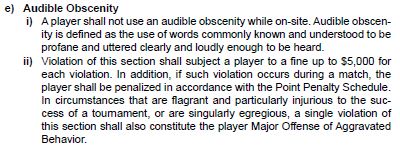
1.  Players on both tours agree to abide by a code of conduct geared toward encouraging professional behavior and promoting the integrity and positive image of tennis.  In fact, the code is in effect throughout the tournament grounds, though fans generally hear about it only when it’s been breached during a match.  The audible obscenity rule, which can include point penalties as well as fines of up to $5,000 per violation (up to $20,000 at Slams), differs from rules about the game itself as it concerns consideration for those within earshot of the court.  As the rule is general, merely stating that a player can be called for a violation if he or she uses “words commonly known and understood to be profane and uttered clearly and loudly enough to be heard,” it makes sense that it should apply equally to all players.  Or, if that seems unrealistic, perhaps the powers that be will consider abandoning the rule altogether rather than maintaining a double standard.

2.  While audible obscenities are hardly a plague on the sport, it’d be a good idea for WTA, ATP, and ITF administrators to put their heads together and decide if they’re committed to the rule, what principles are behind it (for instance, is it intended to safeguard only the sensibilities of on-site spectators or those of all viewers?), and how to more fairly implement it.  With the number of languages spoken by players, however, this may be easier said than done.  We witnessed just how complicated—albeit entertaining—it can be earlier this year in Miami, when Chair Umpire Marija Čičak assessed a code violation to Svetlana Kuznetsova after she shouted a word that sounded like profanity in the player’s native Russian but turned out to be the Spanish word for “court.”  Still, given that umpires call the score and request fans to be “Quiet, please” in various languages, I see no reason why they can’t be asked to master a short list of choice words in the three most common linguistic clusters on tour: Romanic, Germanic, and Slavic.  (Readers who think this would be an onerous task for tournament officials are welcome to suggest alternatives.)  If such a change encourages more players to learn Chinese, so be it.

3.  The above example aside, determining whether a player has used an obscenity is relatively straightforward.  Umpires, then, have only two judgment calls to make before enforcing the rule.  Was the profanity sufficiently loud so that others, including ball-kids, will have heard it?  Was there anything “flagrant” or “egregious” about the utterance that would warrant the player’s being assessed with a major offense of “aggravated behavior”?  Unless the act falls under separate rules for verbal abuse or unsportsmanlike conduct, the direction in which a player is cursing—at him- or herself or in the general direction of the stands—doesn’t matter.  As likely goes without saying, players are expected to comport themselves professionally, however frustrated they may be or poorly a crowd behaves.

4.  Having said that, the umpire can and should warn a crowd if it gets out of hand.  (For the record, I think cheering for faults and whistling or booing a player’s winners is a pretty low standard of behavior.)  Everyone, especially players, likes an active and engaged audience.  But since tennis has a longstanding tradition of silence, excepting “oohs” and “aahs,” during points, there’s good reason for officials to intervene before the atmosphere gets too rowdy.  Even in Davis and Fed Cup, there are limits.  While all players must learn to deal with adverse conditions, no player should have to put up with deliberate distractions or disrespect from spectators.  To disrespect players is, after all, to disrespect the game.

5.  Call it wishful thinking, but I think that if the rule were more fairly applied, we’d see two positive developments.  First, non-Anglophone players would likely clean up their on-court exclamations.  Second, fans might be less inclined to make moral judgments in response to players’ colorful verbiage.  What sounds unusual or awfully vulgar to me may be common or fairly benign in another language, even another dialect.  Almost without exception, players curse—they’re human, like the rest of us.  And, in the immortal words of Andy Murray, they do so while “trying their tits off.”  By all means, apply the rule to all players; then, let’s cut them some slack.  Sound fair?