Unknown's avatar

About amitric

literature • culture • history • media • sports • Earl Grey tea

Off Court, Novak Djoković Takes a Significant Step

Novak Djoković is the most prominent Serbian citizen who has voiced his support for students who have been leading demonstrations since last November. How many people—at home or abroad—have heard his words?

The Background

Since the November 1, 2024 collapse of a concrete canopy outside the train station in Novi Sad, Serbia’s second city, students have been organizing regular meetings to commemorate the 15 lives lost as well as to call out the corruption they believe is behind the tragic accident. They have made a number of demands of the government, including the release of all documents relevant to the renovation of the train station and a 20% increase in funding for higher education. Universities have not held classes for months and students have organized sit-ins at faculty buildings as well as street protests.
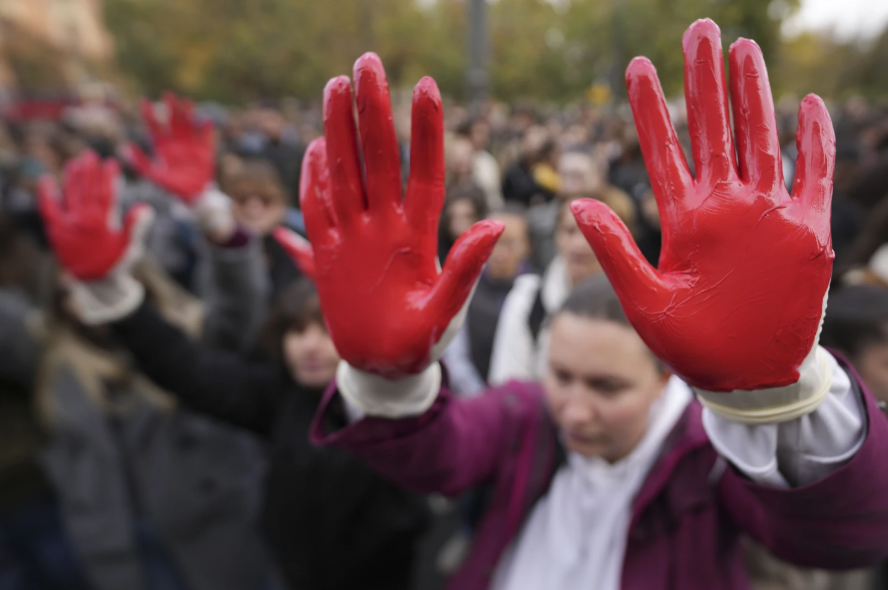
Painted red handprints and the slogan “corruption kills” have become symbols of the protests. (Source: AP Photo by Darko Vojinović)

Though the trigger for the protests—which have spread from Novi Sad and Belgrade to smaller cities and towns across the country—was quite specific, they quickly encompassed broadly-held sentiments: “For the students taking to the streets in their tens of thousands, the Novi Sad tragedy is emblematic of everything they believe is wrong in Serbia: widespread institutional corruption, a lack of accountability, and a technocratic class who are perceived to have risen only due to their ties to Vucic’s ruling Serbian Progressive Party” (Srpska napredna stranka, a.k.a. SNS, in Serbian). The government of President Aleksandar Vučić and his party, who have controlled Serbia for nearly 13 years, is in crisis as the student protests have galvanized citizens from all walks of life. On Friday, there was a general strike that slowed commerce and traffic in the capital to a standstill. And at a 24-hour blockade of one of Belgrade’s key intersections on Monday, students had backup from farmers on tractors, bikers, and white-coated medical staff. Professors, teachers, judges, actors, writers, and other professional and cultural groups have also signaled their support.
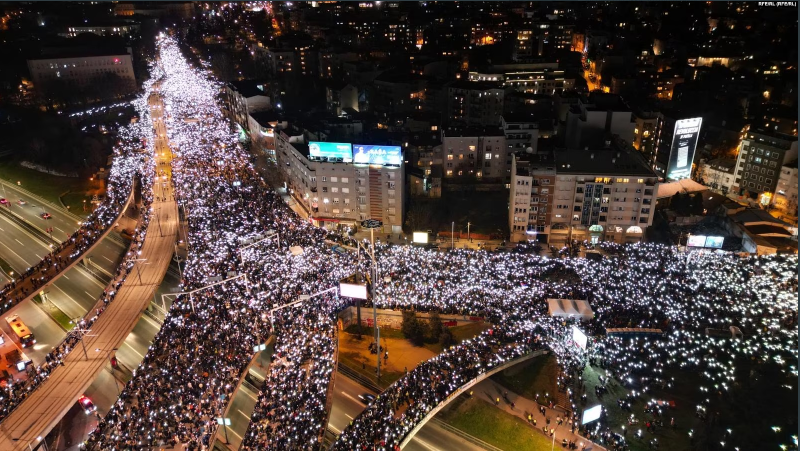
Blockade of “Autokomanda,” a key intersection leading into central Belgrade (Source: RFE)
More

The protest in photos

Vučić has suggested that the students are being funded by unidentified external actors who want to take down his government by force, and his rhetoric—by turns defensive, dismissive, defiant, and pleading—has likely contributed to acts of violence against the protestors. About two weeks ago, a student was injured when a car plowed through a crowded Belgrade street, an ugly incident that was caught on video; and on Monday, a handful of students in Novi Sad were beaten with baseball bats wielded by men who allegedly emerged from a SNS headquarters. Yesterday, only partly in response to the latter event, Prime Minister Miloš Vučević resigned, as did the mayor of Novi Sad, satisfying one of the students’ demands. With the prime minister’s resignation, the entire cabinet essentially collapses. What happens next is uncertain, although, “according to the Serbian Constitution, if parliament fails to elect a new government within 30 days of the prime minister’s resignation, the president is obliged to dissolve the National Assembly and schedule elections.” While opposition groups have called for the formation of a transitional government “made up of experts approved by the students,” the protestors themselves say they are not interested in “political power but accountability and justice within a corrupt system.” Those who can’t be on the streets and Serbs who reside abroad are refreshing their news feeds, exchanging frequent updates on messaging apps, posting photos of the protests on social media, and generally staying on alert.

Djoković Draws a Line

With a few notable exceptions over the course of his two-decade career, Djoković has generally been reluctant to make statements that his compatriots could perceive as political. (Why this is so is a complicated matter I’ll leave for another time. Anyone who can read Serbian or is willing to make do with an AI translation can consider the points raised here.) But over the last few years, beginning with environmental demonstrations in late 2021, his attitude has gradually changed. In the past month or so, after the student protests began, Djoković has seemed noticeably more willing to use his platform to address topics other than sports. As he told an interviewer last summer, for a cover story in the February issue of GQ magazine, “Tennis is still my biggest megaphone to the world.” This was among the reasons he listed for not yet hanging up his racquets, despite having completed his tennis bucket list with the gold medal in Paris.

On the other side of the world at the Australian Open, Djoković turned his megaphone toward home. After his third-round win over Tomáš Macháč, Novak wrote “for Sonja” and drew a heart on the camera, a dedication that would have come across loud and clear to anyone back home watching tennis and tracking the protests. Speaking with Serbian media, Novak explained the gesture. (The translations throughout are my own.)

It was addressed to Sonja [Ponjavić], who is currently in the hospital. I’m sending her support, and I hope that she recovers as quickly as possible. I was shocked, like everyone else, when I saw the video. I simply can’t believe that these kinds of things happen nowadays. I don’t know what clicks in a man’s head so that he’d do such a thing—to run over another person, not least a young woman, a student. Really. I don’t know what else to add, except, as always, to call for peace and understanding. I’m completely opposed to violence of every kind, and, unfortunately, it seems like there’s more and more of it on the streets. I hope it’ll stop soon.

Though these were his first words on the subject in a press conference, they weren’t Djoković’s first comment on current events in Serbia. In mid-December, he posted that he thinks it’s “important for [young people’s] voice to be heard.” Judging by the response on social media, some Serbs didn’t think he went far enough here, as this diplomatic statement neither mentioned the mass gatherings explicitly nor criticized the government. Given his reference to “educated youth,” however, the “with you” salutation is pretty clearly directed at protesting students.

However, his message from Melbourne’s Rod Laver Arena—one of the sport’s biggest stages—was an indication that Serbia’s favorite son had decided to make his statements on the subject more direct. (It’s worth noting that international media did not ask about this act, in stark contrast to the controversy that erupted when he wrote on a camera at Roland Garros in 2023. Since both messages were in Cyrillic, they required some deciphering; but activists on social media were happy to help when the subject was Kosovo and, thus, outrage was easy to generate.) After his fourth-round match, Djoković was asked a follow-up question—once again, in Serbian—related to his message on the camera. Specifically: does he follow the news from back home, or what’s happening around the world, when he’s competing at a tournament?

This time, his reply was much longer, even though he’d been asked a “yes or no” question and everyone in the room would have understood if he wanted to answer briefly and call it a day.

I follow what’s happening in Serbia—not quite everything, but I follow events a lot through social media. I can’t pretend that nothing is happening. . . Even though I’m in Australia, of course I’m upset by things like the situation that happened the other day with Sonja. I hope she recovers quickly and returns home. And that, unfortunately, isn’t the only instance of violence against students and young people. How can I put it? . . . This is a big loss for us as a society—Serbian [society], generally. So, my support is always with young people, and students, and all those to whom the future of our country belongs.

I mean, I can no longer consider myself a young man—I’m somewhere in middle age now—and I would like my children to also grow up in Serbia. I would like for young people from abroad to return to live in Serbia, and to feel that they have a society and an environment which they can enjoy and in which they can develop, and that it’s an environment that actually offers them everything that they need. So, that’s one thing I can say about that; and, of course, I always have been and always will be against violence of any kind. Really, I don’t know. I said this the other day and have nothing to add on that subject.

And in [the rest of] the world, what’s happening with wars, I have no comment on the fact that innocent people are constantly dying—they suffer the most. Honestly, sometimes I think: as an athlete, of course I want people from our country to support me, and I want them to feel, in some way, that what I do has value in their lives. . . . I am trying to be a good ambassador for Serbia in the world, and have been for many years. But, well, when these sorts of things happen, these kinds of tragedies—like Ribnikar or Novi Sad or everything that has happened in the last few years—then truly everything else, including sports and what I’m doing, falls into the shadows. It’s irrelevant compared to human life and to the struggle for some basic rights. That’s all I can tell you.

There is a lot in this statement one could unpack, like the tension Djoković appears to feel between his role as an informal ambassador and any criticism he might wish to make about the state of things in Serbia. But I’ll offer just three interpretations here. First, violence against young people—particularly the mass shooting at a Belgrade elementary school (OOS “Vladislav Ribnikar”) in May 2023—has almost certainly contributed to Novak’s new outspokenness. Second, both his age and his parenthood have shaped his thinking: he wants his kids, now 7 and 10 years old, to “also grow up in Serbia,” like he did, but it’s not certain that they will—not merely because they have the resources to live elsewhere but specifically because Serbia may not provide what they need to thrive. Third, while the exodus from Serbia over recent decades (essentially, since the breakup of Yugoslavia) saddens him, he understands it.

For more on “brain drain” from the Western Balkans, see below.

Research indicates that “young people leave these countries not only because of low salaries and economic issues but also because of corruption, crime, political instability and lack of security.”

To put this last point in context, I turn to Radio Free Europe: “For young Serbs, staying in their homeland is not easy, despite their love for their country. Youth unemployment is high, and many young people feel there is no other option than to find work abroad. According to a 2019 UNDP report, ‘Serbia is among the world’s 10 fastest-shrinking populations due to its low birth rates, high out-migration, and low immigration.'” These comments suggest that Djoković has a lot on his mind, including how he can best contribute to a brighter future for not only the children in his family but also the nation’s youth, more broadly. The work of his foundation, which focuses on early childhood education and has also been offering parenting workshops of late, is already making a difference. But is there more he could be doing? (I hasten to add that this is less my question than one I gather Novak is asking himself.)

Meanwhile, Back in Belgrade

What happened next may surprise and even shock some of you, though, unfortunately, it’s standard operating procedure in Vučić’s Serbia. That is: most regime-affiliated media didn’t report on Novak’s comments—not even those outlets which had sent journalists to Melbourne to cover his Australian Open campaign. They didn’t show his message to Sonja and they didn’t publish his lengthy follow-up observations, which were among the most revealing he’s ever made about contemporary Serbian society. Unlike the mostly-anonymous protestors—whom Vučić, other members of his party, and the media they control feel free to demonize—Novak Djoković is both a well-known figure and a wildly popular one. He also has a direct line for communicating with millions of people, irrespective of whether he’s giving an official press conference. Like the 20-somethings leading the protests, Djoković is accustomed to self-publishing when he feels the need: “The students haven’t just grown up with Vucic; they’ve also grown up with the Internet. Their flair for digital innovation and social media has enabled them to bypass state-controlled media and spread their message far and wide.” So, it isn’t easy to keep what he’s saying from his fellow citizens.
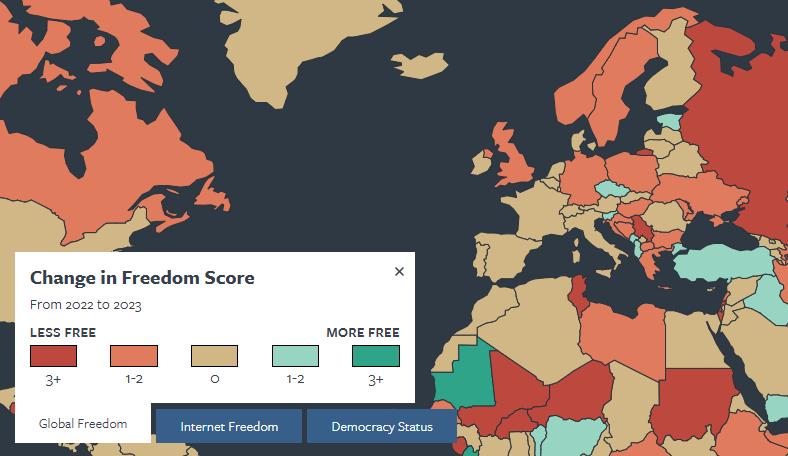
According to Freedom House, Serbia is the only country in Europe other than Russia experiencing a major downward trend in terms of political rights and civil liberties, with the SNS “putting pressure on independent media, the political opposition, and civil society organizations.”

Nevertheless, members of the SNS are trying—through outright media control as well as the sort of “radical self-censorship” that has become common under Vučić’s increasingly authoritarian rule—to limit the reach of Novak’s voice. (Click these links if you want to learn about Vučić’s formative experience as the Minister of Information in the final, desperate years of Slobodan Milošević’s regime or about challenges to press freedom in Serbia.) A colleague, whom I won’t identify out of an abundance of caution, confirmed to me that he didn’t submit Novak’s protest comments because, simply, “Nothing of the sort gets published” by his SNS-controlled employer. Journalists working for such outlets are aware which subjects are forbidden and don’t even try to post these stories, as they know higher-ups will delete the material and they’ll likely lose their job.

Because Djoković made these comments in Serbian, they also didn’t get picked up by international media at the Australian Open. For this to happen, one of the Serbian reporters on site would have had to translate (and somehow circulate) Novak’s statement while also working on deadline to produce multiple articles a day. In any case, his comments weren’t sports-related; so, it’s doubtful any of the tennis beat reporters would have been able to do much with them. Thus, between the suppression of these comments at home and the lack of coverage abroad, it’s unlikely word of them has spread very far.

Acknowledgment

I’d be remiss if I didn’t mention that today’s New York Times features an article that mentions Djokoviċ in this context, the first I’ve seen in international coverage of the protests.

Serbia is a small country, with a population smaller than New York City’s, and most people in the world are unfamiliar with it. Unless there’s a natural disaster, heightened tension with Kosovo, or the Serbian men’s basketball team is threatening to upset the Americans at the Olympics, it’s not often in the international news—not since the Yugoslav wars of the 1990s, that is.

Sidebar

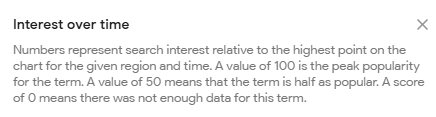
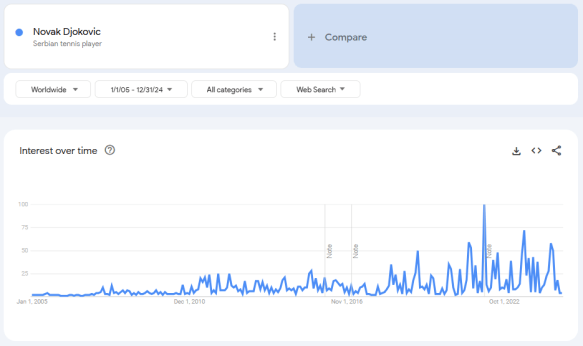
Out of curiosity, I looked on Google Trends to see whether Djoković got more global attention when he won the gold medal in Paris last summer or when he was detained and deported by the Australian government. The results were as I expected: there was far more interest in the January 2022 controversy than in any of his major titles. The five next-highest peaks (visible in the second slide) were during Wimbledon 2023, Roland Garros 2021, the 2024 Olympic Games, Wimbledon 2021, and Wimbledon 2019.
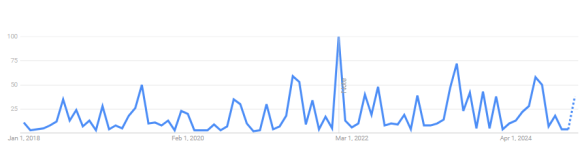
Still, what’s going on in Serbia right now is a big deal for the region. Something like this hasn’t happened for nearly a quarter-century. And the fact that the most recognizable Serb in the world went out on a limb to say something about it—and the Serbian government doesn’t want its own citizens to know—is arguably of much more significance than his having to pull out of a semifinal match at the Australian Open due to injury. Hopefully, Novak’s torn adductor muscle will be healed by the time the clay season rolls around, if not before. When—and how—the current crisis in Serbia will end is much less certain.

Postscript

On Friday, 31 January, Djoković made his first public appearance in Belgrade since returning from Australia a few days prior. At a basketball game between Belgrade rivals Crvena Zvezda and Partizan, he and his wife both sported custom-made sweatshirts expressing their support for students. (The phrase is a riff on the “dreamers are champions” theme from the collaboration between French designer Millinsky and Novak’s foundation.) In the video below, a reporter asks Novak to explain the meaning for those who don’t speak English, to which he replies, “They know—they know very well.” The media coverage of the game combined with a short statement in English more or less guarantees that this message, unlike the ones I discuss above, will be understood around the globe.
Much Ado about. . . Something: Five Thoughts on “Equal Prize Money”

This is a piece I published in early September 2012 on the now-defunct Tennis Space website. Though the original article didn’t include hyperlinks to my sources, I’ve added as many of those as I could here so that anyone interested in more information can track it down. (Despite being tempted to make other changes, I’ve left the content as is, with one exception placed in brackets.) A decade on, I’m gratified to note that many of the arguments I made are being voiced by top players; and with the formation of the Professional Tennis Players Association (PTPA), there is now a group working full-time to advance the best interests of all players.


With extensive television coverage and more column inches dedicated to the sport, it’s not surprising that off-court controversies garner greater attention during the Slams than at other points in the tennis season. At the US Open, we’ve again been exposed to some of the more complicated aspects of life on tour, be it Maria Sharapova’s difficulties maintaining a long-distance relationship while traveling, the USTA’s decision to bench #1 junior Taylor Townsend until she improves her “fitness,” or frustration with tournament transportation, scheduling, and rain delays. And, as at Wimbledon two months ago, ongoing fascination with aspects of the women’s game—specifically, with debating a cluster of topics referred to, more for convenience than accuracy, as “equal prize money”—is a recurring theme. Oddly, though, it is male players who are doing most of the talking.

In London, it was Gilles Simon, newly-elected to the ATP Players Council, who kicked off the debate with comments to French press, only a few which were pursued after Simon made his second-round exit. Although he had raised a number of issues for the Council to tackle (including the 2014 tournament calendar), only remarks that seemed to disparage women’s tennis got much play in the English-speaking media: “You are only talking about [prize money], but I talked about many things,” Simon noted. Given the opportunity to clarify his views for a broader audience, the top-20 player made an argument rooted in entertainment value and market economics: since, in his words, “men’s tennis is actually more interesting than women’s tennis,” and the “price of the ticket from the men’s final” is more expensive than that for the women’s final, male players should get more money at the major tournaments.

Throughout the summer, including the past two weeks in New York, Simon’s views have been echoed and elaborated upon by the likes of Nikolay Davydenko, Sergiy Stakhovsky, and Janko Tipsarević. While continuing to discuss the women’s game, these players shifted the focus to what they see as the unequal work performed by male and female players. “Why,” asked Davydenko, upset after failing to capitalize on a two-set lead over Mardy Fish, do the “girls play best of three sets, and we should play best of five sets, and have the same prize money?” Stakhovsky, also a player representative, took the disagreement a step further, not only mentioning “the amount of time [men] spend on court” during matches but also complaining, in an interview with Lindsay Gibbs, that WTA players are ungrateful for the effort the ATP Council has made in securing prize-money increases and that their presence at “combined” events makes it difficult for male players to book practice courts. Tipsarević, tossing off a casual tweet with the hashtag “#equalprizemoney” after a dominant quarterfinal performance by Serena Williams, is merely the highest-profile ATP player to add his voice to the fray.

That there is “much ado” in the tennis world these days, we can all agree. Given the rapidity with which words circulate and get taken out of context in the age of social media, the opportunities for confusion and misunderstanding are ample, in this context as in any other. All concerned parties risk neglecting significant problems when much of the talk (on Twitter, online forums, and even in locker-rooms and press centers) is one-sided, adversarial, or off-topic. So, moving forward, it’s important that fans as well as players, media as well as management, are able to distinguish the real issues facing professional tennis from the distractions. It also can’t hurt to remind athletes—whose jobs require them to focus on winning—that the most effective debates often function like dialogues in which all parties are seeking common ground, rather than contests in which two sides square off and each tries mightily to force the capitulation of the other.

End of Discussion
The bottom line here, as in many instances, is monetary. Although some are insisting that what’s at stake has something to do with equality between the sexes, it’s really a matter of economic conditions on tour that affect male and female players, particularly those ranked outside the top 50 or lacking support from national federations, in identical ways. As Ivan Ljubičić, a former president of the ATP Player Council, observed from Melbourne in January, “the general feeling is that the money we are getting from the Slams…, it’s definitely not what we would like it to be.” In fact, the issue of player compensation is two-fold: it concerns both the what and the how of tour finances.

What is another word for revenue: specifically, the percentage of tournament intake that goes—or should go—toward prize money. (Christopher Clarey rightly noted in yesterday’s New York Times that there is no consensus among tournament officials about whether to “link” prize money to percentages of either tournament revenue or profit.) While the problem of revenue sharing is more urgent at the ITF-governed Slams, which now allocate between 11-17% of the monies they amass for player checks (compared to between 20-30% at tour events), that is also where there’s been progress of late, with prize-money increases at all of the majors in 2012.

How signifies the way prize money is distributed across tennis’s ranks: that is, according to tour wins. The further a player advances in a tournament draw, the bigger the check; the more overall wins, the greater the annual income. This much makes intuitive sense until we contrast the amounts awarded in early and later rounds and consider how top-heavy the men’s tour, in particular, has become over the last decade, with a small handful of players winning almost all of the big prizes. These results—which, in other contexts, are taken as evidence of a “golden age”— have contributed to what USA Today’s Doug Robson has called the “wealth disparity” in tennis: a class divide amongst players that is comparable to economic conditions protested by the Occupy Wall Street movement.

With regard to “income inequality,” Stakhovsky himself has been one of the most articulate members of the ATP, helping to convey what life is like for players outside of the tennis elite. In an April interview with journalist Evgeny Shvetz, the Ukrainian player used his own case as a player ranked near 100 to illustrate that many pros, far from enjoying the life of luxury suggested by Moët, Rolex, or Mercedes advertising, actually have a hard time breaking even after covering the ever-increasing costs of life on tour: equipment, airfare, food and lodging at tournaments, coaching, fitness training, physiotherapy, and so on. Of the players now at the top of the game, “Stako” remarks, “that’s simply another world. What those four earn—isn’t comparable to all the rest. We simply don’t exist in comparison with them. [Endorsement] contracts, clothes—that’s all for the top-5 or top-10 players. . . all the big brands [know] that they only need to pay the top players, all the rest are for free.” What Stakhovsky and others have described in detail are the realities on the ground—not simply for a handful of ATP players but for so many who make the tours possible in the first place. If men’s and women’s tournament draws each featured only 16 players instead of 64—or the 128 of the majors—how long would events last and how interesting would the competition be? Though tennis is an individual sport, the fates of almost all the players (veterans and newcomers, higher and lower ranks, male and female) are tied. Instead of using their public statements to score points or talk past each other, then, ATP and WTA players need to identify and prioritize their ends and work toward achieving them collectively.

Battle of the Sexes
One of the central impediments to progress stems from how the debate is currently being framed. During the last quarter of 2011 and the start of this season, the most central challenges facing professional tennis (concerns both economic and structural) were narrowly defined and thus more effectively discussed. Since then, the tennis world has gotten bogged down in numerous conversations pitting male and female players against one another. No one person is to blame for this, of course, but many have contributed to the conversation’s getting off track, including ATP and WTA stars, as well as fans, who’ve responded to perceived criticism by outspoken players with pointed one-liners and even ad hominem attacks.

The media, for their part, have not always helped. A case in point is the New York Times. Clarey’s piece, for instance, doesn’t quote (or even mention) a single female player or official. [Note: a few days after I read it, the NYT posted “a more complete version of the story than the one that appeared in print”; it now quotes Serena Williams.] Despite discussing issues that affect WTA players as much as they do those in the ATP, the article relegates women to a parenthetical aside and describes them as being “along for the ride” in terms of the fight for increased prize money. In doing so, it replicates precisely the sort of behavior that frustrates WTA Player Council members like Bethanie Mattek-Sands, who told Matt Cronin of Tennis.com that the ATP player representatives “really don’t talk to us a lot. We agree with some of the things of they want. . . but they haven’t approached us.” She added, “We’d love to sit down and talk to them. [But] it’s tough when it’s in the media and they aren’t even giving us a chance to say whether we agree.” Last week, the Gray Lady also asked several sports writers to respond to the question “Women’s Tennis: Is Best of Three Sets Enough?” While the implicit topic of this discussion is financial (and featured debater Megan Fernandez says so plainly in her segment, “This Is About Prize Money”), the NYT’s emphasis on gender suggests there is something inadequate about the women’s game as is and creates unnecessary tension between players on the two tours—and their fans, too. Somewhat ironically, blogger Cheri Britton and Tipsarević land on the same side of the “equal play” divide, with the former claiming that “women deserve epic matches” men sometimes experience at Slams (David Ferrer’s quarterfinal triumph over the Serb at the US Open comes immediately to mind) and the latter asserting that it’s wrong-headed to suggest women are “physically unable to play best-of-five sets.” But because no female player has expressed feeling deprived of meaningful victories (just ask Serena Williams how she felt after her come-from-behind win over Vika Azarenka in Sunday’s final!) and few in this day and age believe women aren’t fit or strong enough to go the distance, these arguments fall flat.

Particularly in an Olympic year, where there was a different format on the men’s side, it makes sense to ask “should men play best-of-three sets at major tournaments?” (as Ben Rothenberg did in the NYT‘s US Open preview). After all, it didn’t take Novak Djoković and Rafa Nadal playing nearly six hours in the Australian Open final for fans, tournament organizers, broadcasters, and players themselves to start wondering if less might be more when it comes to match length. But given that “should women get equal prize money” is a question that’s been answered—in the case of the US Open, for some forty years!—and that “should women play five sets like the men?” is not a question being seriously entertained by fans, WTA players, or the ITF, why are they being asked? And why now? Until I’m persuaded otherwise, my answer is that either we’ve got a serious misunderstanding on our hands or this way of presenting the problem benefits some constituencies—or both. Below, I’ve identified a few misconceptions that may be contributing to the confusion about what ails tennis. It’s also possible that the “battle of the sexes” frame works for attention- or conflict-seekers (there’s a reason “to troll” has become a popular verb), those looking to generate page views on media sites, &/or those who have something to lose if the real challenges are addressed. In this “battle,” that is, perhaps it’s not so much that sex sells but that controversy does.

Work It Out
A phrase much used in these debates—“equal pay for equal play”—has a nice ring to it but is, in fact, part of the problem. A conceptual obstacle in these discussions is that male players, in particular, tend to talk about “play” as if match-time represented the only effort they or members of the WTA put into their careers. While it’s of course true that they earn their living via prize money derived from fans who buy tickets to see them perform, most players would be taken aback, if not deeply offended, if anyone suggested the only real work they do is on show-courts at tournaments. As all will testify if asked, they clock hours and hours away from spectators’ eyes. Their days are packed with aerobic work-outs, weight-lifting, on-court practice sessions, stretching and yoga, physiotherapy, and meals prepared less for culinary delight than to maximize performance. In addition to all this physical activity is time in front of journalists and cameras being interviewed, photographed, and filmed for media and marketing purposes. This is all work, is it not? Are ATP players really prepared to not simply assert but actually prove that female players do less work, day in and day out, over the calendar year than they do, just because they happen to spend fewer hours engaged in tournament play at a handful of events?

While the emphasis on play is limiting, it is also understandable. Because tennis players (especially those who aren’t high-profile enough to have a portfolio of endorsements) earn their way by winning, it makes sense they would think of match-play as paramount. Without the wins, there’s no money. But at the same time, without all the other work they do, there are few, if any, wins. For a variety of reasons, tennis professionals may be reluctant to think of themselves as engaged in labor—newly retired Andy Roddick, for one, prefers to call his peers “the talent.” Still, it may be time for them to start thinking of themselves as workers, rather than mere players, because only with a more nuanced and complete sense of their labor (and the conditions in which it takes place) will they be able to effectively negotiate to make sure they’re adequately compensated for it.

Divide and Be Conquered
The ATP and the WTA are separate entities with their own members, events, sponsors, budgets, staff, and leadership. And yet, the two enterprises overlap and cooperate in significant ways and have far more in common than not. Just as there is strength in numbers within the tours, there is also advantage to be gained from forming alliances between them. As Roddick recently acknowledged, getting players to come together is quite difficult: “you’re dealing with a bunch of different languages, different agendas, guys who play singles, guys who play doubles, guys who play clay, guys who play hard.” But, he added, his sights are fixed on a bigger target—on “what’s best for the game.”

In the end, how different are what’s best for the ATP and what’s best for the WTA? The current squabble over prize money suggests that the two constituencies are in competition for limited resources, like hungry children fighting over a single, already-cut piece of pie. Again, Roddick: the “powers that be,” he stated somewhat wearily after his first-round win last week, “are betting against us being able to unify, and they have been getting away with that gamble for 25 years and we haven’t proved them wrong yet.” Even though it would be difficult at first, it would also be more strategic, productive, and beneficial in the long run if ATP and WTA members started thinking of one another as collaborators working toward a shared goal. Ultimately, the fundamental change both groups are seeking is getting a larger slice of the revenue pie for players. Members of the ATP must give up on the idea that the Slams and elite combined events would undo deals that took decades to make by raising only men’s prize money. They have to recognize that the stakes in this specific argument are “all or nothing” and that the tournaments are more likely to give all players nothing than to give one group of players “something.” In sum, the effort expended in fighting with each other—largely through intermediaries in the press—is energy that could be better spent.

Pay Day
Increasing the players’ share of tournament revenue, at the Slams in particular, is important. But perhaps even more important is the matter of economic equity within the tours. To achieve greater parity, to ensure that being a professional tennis player is a viable career path for more than the top 50 on each side of the tour, there needs to be a reconsideration of the entire pay structure of the ATP and WTA. In other words, the main questions players should be debating are: “Is the pay structure in tennis working as is? Beyond how efficiently the system functions, is it fair? If not, how could it be improved? What outcomes would we like to bring about through our joint efforts?”

Answering these questions is a daunting task, one that requires strong leadership and organization among top and rank-and-file players, as well as creative and critical thinking about how—and on whose behalf—the tours operate. At present, players are individual contractors who are paid by way of tournament prize-money. This system is flawed, however, both because the players do far more than play and because the tours, to even exist, are dependent on the labor of workers, a majority of whom do more losing than winning throughout the year (for example, Stakhovsky, one of the hundred-best male tennis players in the world, came into the US Open with a record of 12-22). Sports like basketball set minimum annual salaries, based on years of service, thereby recognizing that every player makes a contribution to the team’s success, even if he or she is not the top scorer in a given game or the MVP of the league. In other professional spheres, there is often a distinction made between base salary, which hopefully sees annual cost-of-living increases, and merit- or bonus-pay, which is tied to specific measures of productivity or quality of performance. And in the realm of unskilled labor, there are debates about whether “minimum wage” should be substituted with a “living wage” ensuring that those working full-time jobs are able to support their families at a subsistence level. Rather than being a world apart, tennis might look to and learn from the best practices in other professions.

It isn’t beyond the imagination or ability of those in professional tennis to devise a pay structure that both incentivizes winning and provides a reasonably steady income for the dedicated workers who make it possible for the game we enjoy so much to exist beyond the exhibition format. But there has to be someone—in all likelihood, multiple people—working toward such significant change on a full-time basis. It’s not enough for individual players to speak out occasionally or for their councils to hold meetings a few times a year. These problems, which have been present for decades, will require focus and dedication to solve. Surely, tennis can find a few good men and women for the job.

Yugoslavia 101

When was the last time you needed to look back decades—or even a century—to understand something that happened at a tennis tournament or other sporting event? If the answer is “never,” you’re surely not alone. But if you’ve ever tried to follow a regional controversy or grasp the relationship between sports and nationalism in the Balkans, it’s likely you’ve come across references to conflicts from long ago and the shadow they not infrequently cast over the present-day occupants of the region as well as the ex-Yugoslav diaspora.

I put together this post so that readers of my other essays will have at least some knowledge of the complicated history of the region known, in the 20th century, as Yugoslavia (literally, “land of the south Slavs”). Suffice it to say, this is no substitute for reading work by specialists, some of whose books I recommend below. It is, however, a start.


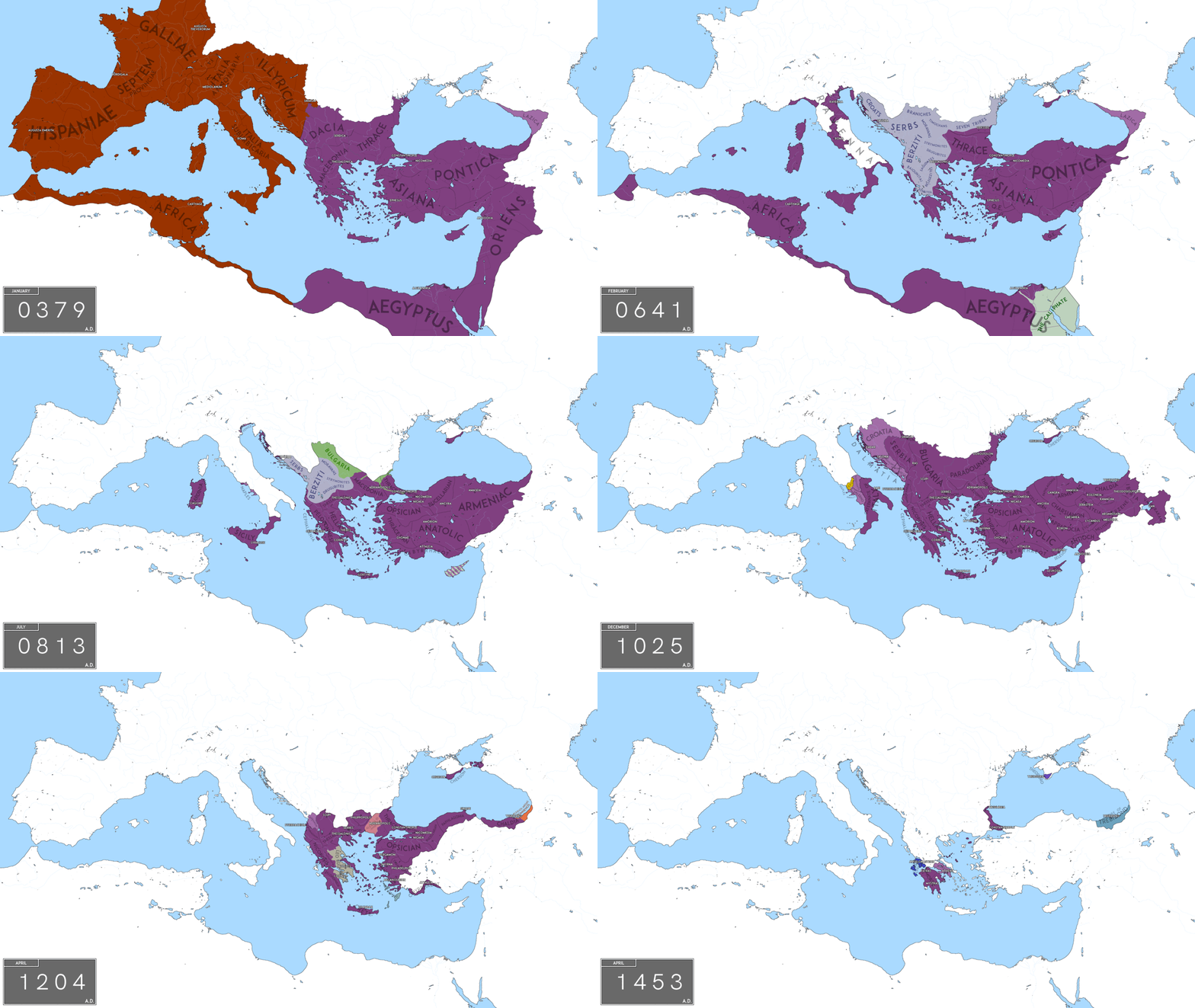
1) Slavic tribes migrated to southeastern Europe starting in the 6th century CE. From late antiquity, through the medieval and early modern periods, and right up to the end of the 19th century, this region was both part of vast empires (e.g., the Roman Empire) and made up of smaller provinces, principalities, republics, and kingdoms. Beyond the arrival of the Slavs, there are two key historic developments I think are worth highlighting here. First, the Great Schism: the split between the Roman Catholic and Eastern Orthodox churches in 1054 (though even before this, the region was divided between the “Greek East” and “Latin West” spheres of influence). Second, the rise of the Ottoman Empire: specifically, incursions into and conquest of much of southeastern Europe, beginning in the mid-14th century.

The territorial evolution of the Eastern Roman Empire (via Wikimedia Commons).

For several centuries, the territory of what would become Yugoslavia after World War I was contested between the Habsburg (later, Austrian and Austro-Hungarian) and Ottoman empires, with portions of what are now Croatia, Bosnia, and Serbia part of a “military frontier” providing a buffer between the Ottomans and central Europe. It was also the site of regional resistance to imperial rule by the local Slavic populations. While Montenegro and Serbia gained independence in 1878 (following the tenth Russo-Turkish War and the Congress of Berlin), various Balkan conflicts continued until the eve of the Great War. Given all of the above, the population of this region is quite diverse: in addition to the south Slavic majority (which extends to Bulgaria), there are minorities of Albanian, Austrian, German, Greek, Hungarian, Italian, Roma, Romanian, and Turkish descent. Needless to say, there are people from the former Yugoslavia whose ancestry includes a mix of the aforementioned ethnic groups; likewise, there were many Yugoslav marriages between members of the Catholic, Orthodox, Muslim, &/or Jewish faiths.

2) What we now refer to as “the former Yugoslavia” was, in fact, two separate historical entities: from 1918-1941, the Kingdom of Yugoslavia (previously, the Kingdom of Serbs, Croats and Slovenes), a parliamentary constitutional monarchy; and from 1945-1992, the Socialist Federal Republic of Yugoslavia (SFRY), led by Josip Broz “Tito” from the end of WWII until his death in 1980. The latter federation had the same basic external border as the former kingdom and included six constituent republics of Slovenia, Croatia, Bosnia, Montenegro, Serbia, and Macedonia, plus two autonomous provinces, Vojvodina and Kosovo, within Serbia.

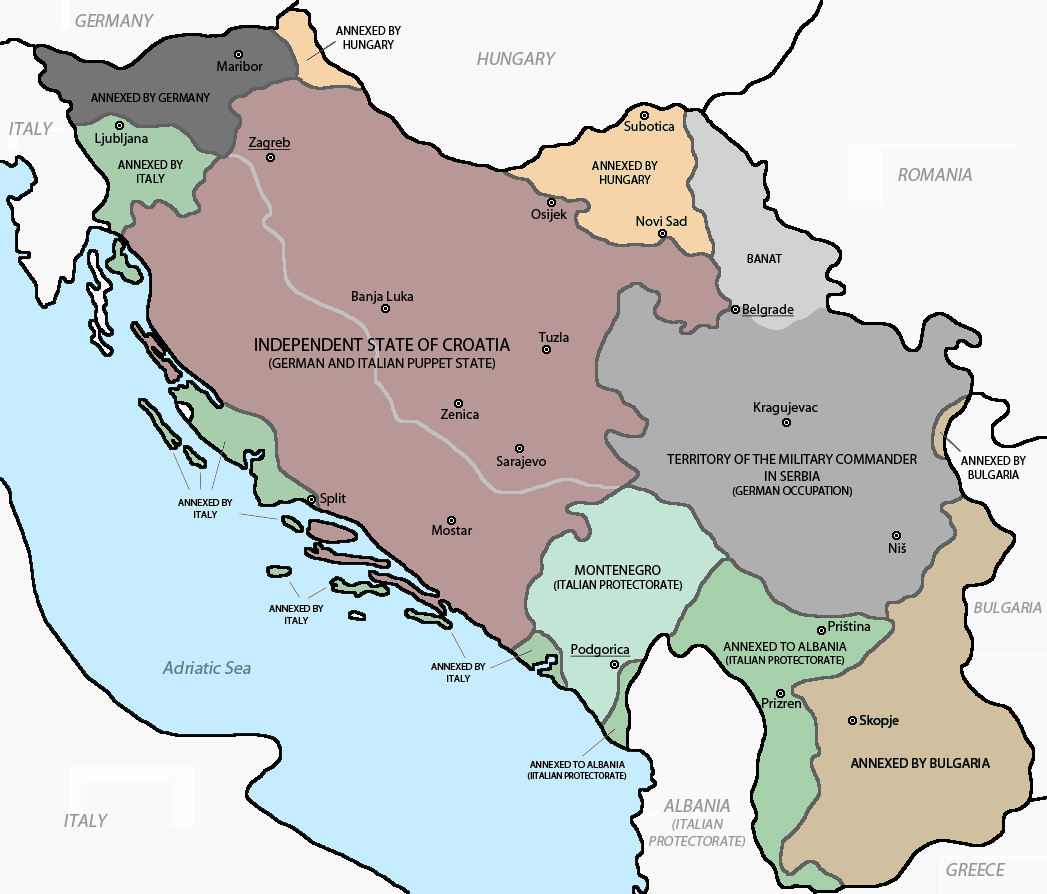
3) During WWII, something akin to a civil war took place within what had been the Kingdom of Yugoslavia; so, the fight wasn’t simply between Axis and Allied forces or German occupying armies and Yugoslav resistance fighters. Instead, there were multiple groups who were clashing for ideological &/or sectarian reasons. When the Royal Yugoslav Army surrendered to the Germans shortly after the Axis invasion in April 1941, the king and military leadership went into exile and many men of fighting age took up arms with other groups: namely, the Četniks (Serbian nationalist and royalist militias), Partisans (the multi-ethnic military arm of the communist party, to whom the Allies turned once the former group of rebels proved unreliable), and Ustaše (the Croatian fascist movement). While the Ustaše led a German and Italian puppet regime (the so-called Independent State of Croatia) and enacted a south-Slavic version of the “final solution,” the Četniks were a motley force of Serbian guerrillas who resisted or collaborated with the Axis powers more opportunistically, depending on both local circumstances and long-term goals. Yugoslavs may have joined forces depending on ethnicity, region, ideology, principle, pragmatism, &/or pressure, with some changing sides at different points in the war, including when given amnesty by the Partisans in the late stages of the conflict.

Axis occupation and partition of Yugoslavia in World War II (via Wikimedia Commons).

After the Allied victory and the subsequent formation of the Federal People’s Republic of Yugoslavia in 1945, both Ustaša and Četnik members faced reprisals under Tito’s leadership. The communist party’s principle of Yugoslav “brotherhood and unity” was reflected in the federal constitution and meant to promote both the peaceful coexistence of different ethnic groups and interdependence among the constituent republics. (The main highway across Yugoslavia, the first section of which was opened in 1950, was even named for this policy.)

4) Post-war Yugoslavia, despite being a socialist country, did not belong to the Eastern Bloc. Following the Tito-Stalin split in 1948, Yugoslavia made its own way (albeit with economic and military support from the US, especially in the early years of the Cold War). Declining to join NATO in 1953 or sign the Warsaw Pact in 1955, Tito played a leading role in the Non-Aligned Movement. Generally, Yugoslavia was a more open (i.e., liberal) society than the countries behind the “Iron Curtain.”

5) Following Tito’s death and ensuing political and economic crises, Yugoslavia broke apart in the early 1990s. Between June 1991 and March 1992, four of the six constituent republics—Slovenia, Croatia, Macedonia, and Bosnia—declared independence from the SFRY, leaving Serbia and Montenegro as “rump” Yugoslavia. (The latter entity, called the Federal Republic of Yugoslavia from 1992-2003 and the State Union of Serbia and Montenegro from 2003-06, lasted another 14 years.)

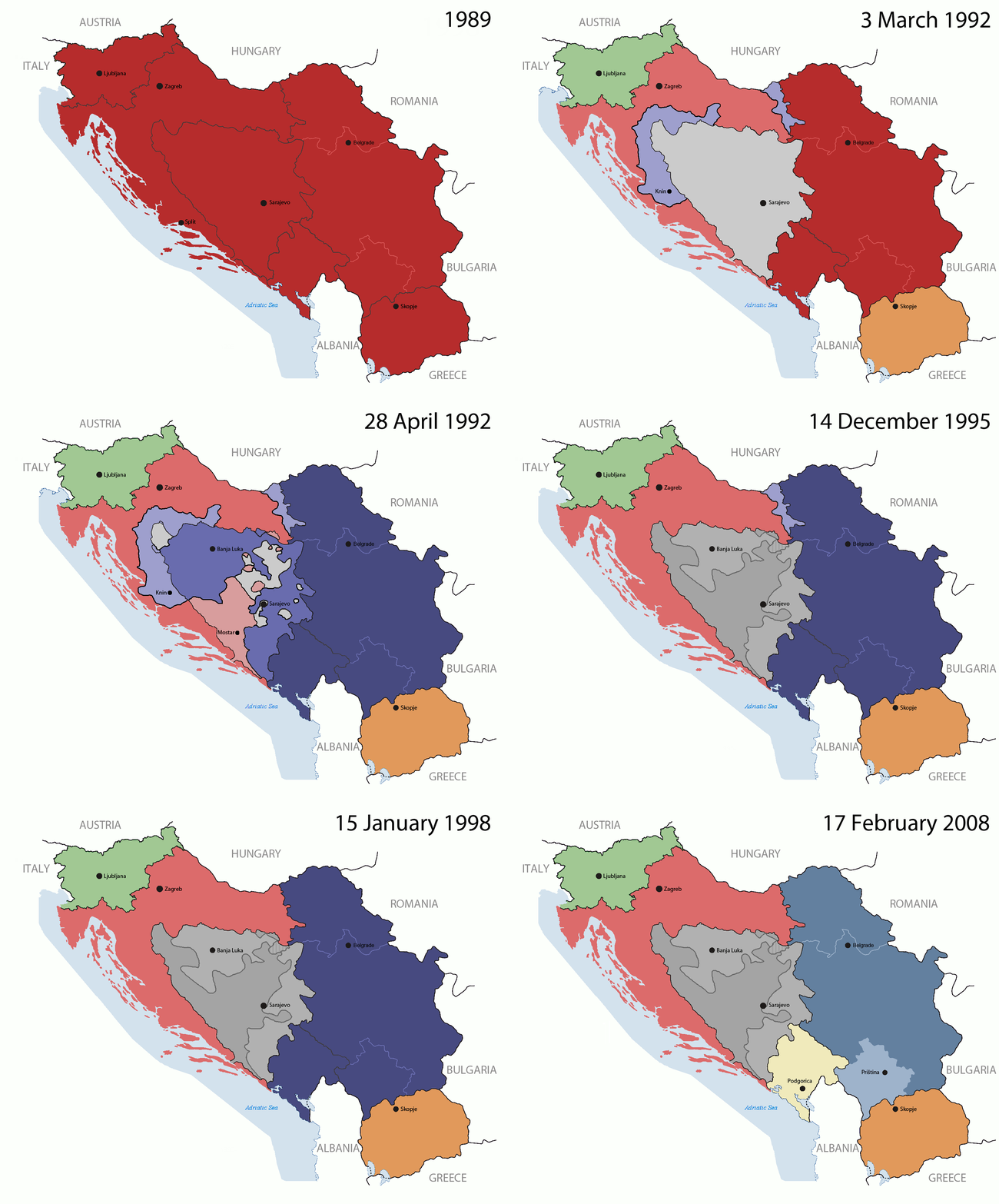
The breakup of Yugoslavia (via Wikimedia Commons).

The dissolution of Yugoslavia and establishment of successor states was a protracted and painful process which included several distinct wars: a 10-day conflict between the Yugoslav People’s Army (JNA) and the Territorial Defense of Slovenia in 1991; the far longer and bloodier hostilities in Croatia and Bosnia, which lasted until late 1995; and the Kosovo war, which started as a years-long attempt by Serbian police to put down an insurgency by the Kosovo Liberation Army (KLA) and culminated in the NATO bombing of Yugoslavia in 1999. Although Kosovo declared independence from Serbia in 2008, the status of the territory remains unresolved. The United Nations maintains an “interim administration” in Kosovo, cooperating with local leadership as well as a number of other international organizations (including the EU and NATO).

In 1993, the UN established the International Criminal Tribunal for the former Yugoslavia in The Hague (Netherlands) to investigate and prosecute genocide, war crimes, and crimes against humanity. All told, the ICTY indicted 161 individuals for crimes committed in the region between 1991-2001. When the ICTY was dissolved in 2017, other national and international judicial bodies continued its work. For example, as I write this, a trial of several former KLA leaders is under way.


Tennis fans should care about some or all of the above only if their interest in the sport extends beyond the rectangle that is the court. Some people watch tennis to escape from the real world—and that’s alright! But if you’re one of those fans who gets invested in a player and wants to better understand his/her background, the history of Yugoslavia may help. And, I hasten to add, this history isn’t merely relevant to Novak Djoković. Before anyone in the international tennis world even knew his name, there were four grand slam singles champions from the former Yugoslavia: Mima Jaušovec, Monika Seleš, Iva Majoli, and Goran Ivanišević. The last two decades have yielded a remarkable crop of players from the region, all of whom were affected, in one way or another, by the breakup of Yugoslavia.

Beyond that, there’s the old adage “knowledge is power.” The more you know about this history, the less likely you are to be confused, misled, or even manipulated by poor reporting or propaganda. Sports journalists often oversimplify these background stories or off-court incidents because, well, they’re on deadline and it’s not their job to cover history or politics. But there are also those—on social media, especially—who are operating in bad faith or from a place of ignorance &/or ideological investment. Their versions of events can thus be inaccurate, incomplete, or slanted for any number of reasons (including clout-chasing and trolling). So, I’d encourage anyone who encounters a controversial claim about a current player tied to the dark chapters of the Yugoslav past to verify the facts, research or seek out experts who can help provide the relevant context, and hold off on judgment.

Selected Reading List:
This list includes both scholarly and journalistic work. Generally, I prefer to rely on academic experts; but I acknowledge that their published work, often addressed to other specialists, can be dense and dry. Nevertheless, I’d urge caution with regard to journalistic coverage of both the history and politics of the region, especially the books produced in the midst of the 1990s conflicts. A similar warning applies to the Wikipedia entries for any of the aforementioned topics: although they are often good starting points, they can also contain revisionist history influenced by the ethnic nationalism that is sadly widespread in the Yugoslav successor states.

Catherine Baker, The Yugoslav Wars of the 1990s (2015)

John V.A. Fine, Jr., The Early Medieval Balkans: A Critical Survey from the Sixth to the Late Twelfth Century (1983) and The Late Medieval Balkans: A Critical Survey from the Late Twelfth Century to the Ottoman Conquest (1987)

Patrick J. Geary, The Myth of Nations: The Medieval Origins of Europe (2003)

Misha Glenny, The Balkans, 1804-2012: Nationalism, War and the Great Powers (2012)

Tim Judah, The Serbs: History, Myth and the Destruction of Yugoslavia (3rd edition 2009)

John R. Lampe, Yugoslavia as History: Twice There was a Country (2nd edition 2000)

Sabrina P. Ramet, Thinking about Yugoslavia: Scholarly Debates about the Yugoslav Breakup and the Wars in Bosnia and Kosovo (2005)

Laura Silber and Alan Little, Yugoslavia: Death of a Nation (1997); accompanying BBC documentary series

Srdjan, Serbian Nationalism, & the Uses of Information

Despite the title, this isn’t really a post about Srdjan Djoković. Like various others during the second week of the Australian Open, I’m using the father of the top men’s player in the world to get your attention. Unlike many of them, I’m doing so for what I hope is an edifying purpose. Namely, I want to unpack a widely-reported incident that took place outside Rod Laver Arena last month in order to make distinctions between different types of information. In the second part of the post, I’ll offer an interpretation of the varieties of fan sentiment, ethnic pride, nationalist iconography, &/or political ideology that were expressed on the tournament grounds after the quarterfinal match between Novak Djoković and Andrey Rublev.


Part 1

First, the facts: Following complaints by spectators during a first-round match between Kateryna Baindl (UKR) and Kamilla Rakhimova (RUS), as well as a demand from the Ukrainian ambassador to Australia, Tennis Australia belatedly introduced a ban on Russian and Belarusian flags. Over the course of the subsequent 12 days, they added more flags, banners, and symbols to the prohibited list in order to cast a wider net for potentially-provocative displays by attendees.

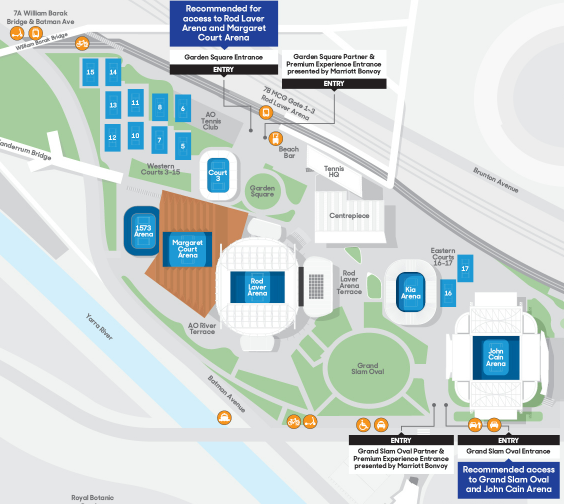
Though there may have been others who managed to sneak in flags here and there (and we know that security ejected unruly spectators for a variety of reasons throughout the fortnight), it wasn’t until the middle of the second week that there was a news-making incident involving about six men waving Russian (and related) flags and chanting pro-Putin slogans on the steps leading from the two main show-courts into Garden Square.

Map of Melbourne Park, with Garden Square at center, courtesy Tennis Australia

The timeline: Djoković’s on-court interview ended around 10:00pm; shortly thereafter, Novak fans began to assemble on the steps, as they had after each of his wins. Though at least one of the aforementioned men is visible in the background of my videos and photos of the festivities, it wasn’t until the significantly larger group began to disperse, at approximately 10:30, that these men briefly took center stage.

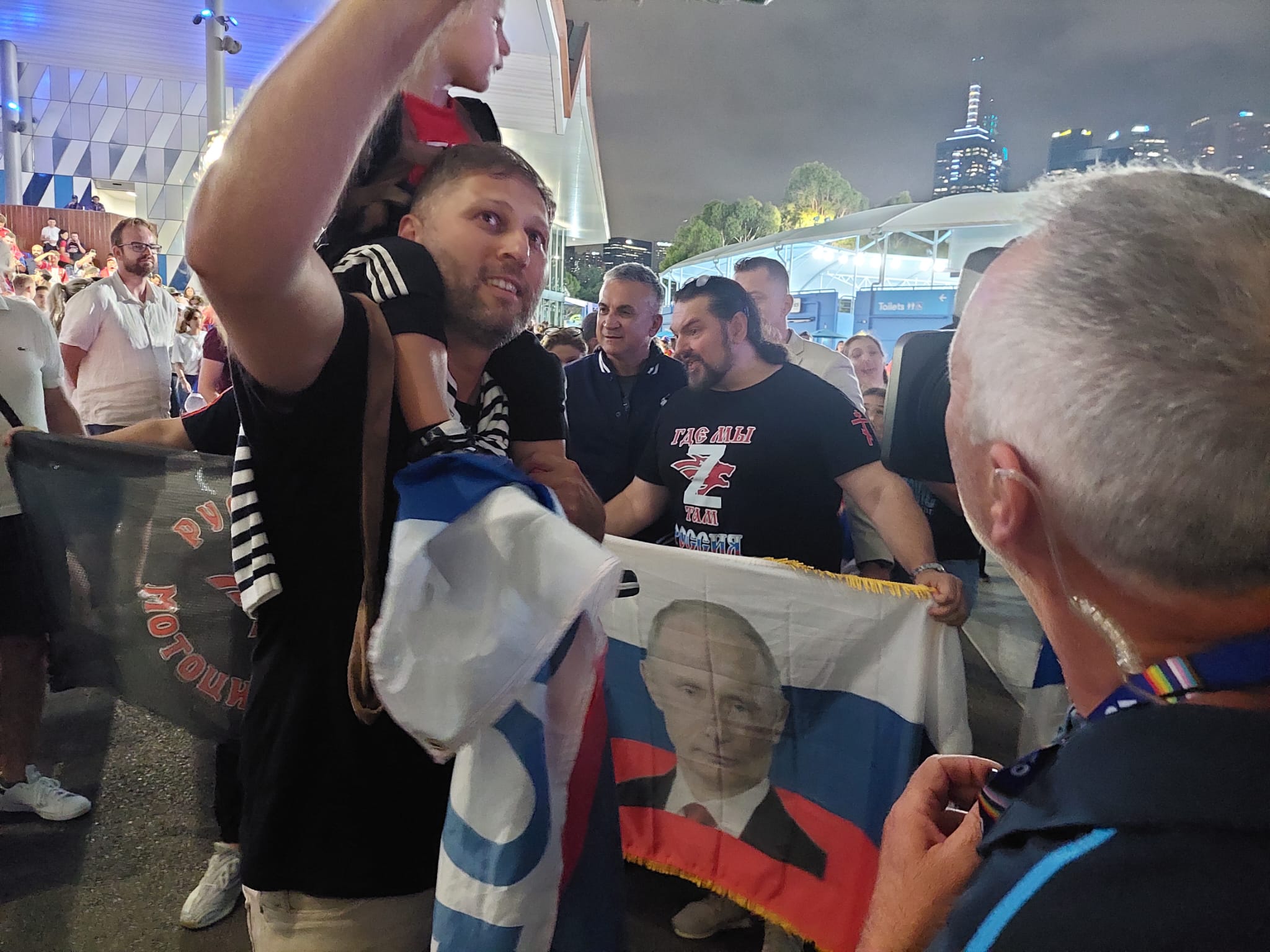
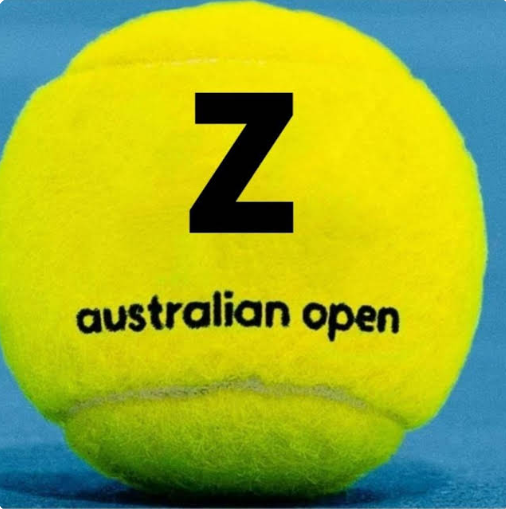
A few minutes prior to that, some of the men in question had stopped Srdjan Djoković for a picture as he was leaving the fan gathering. As can be seen in the photo below, the main culprit is not only holding a flag emblazoned with Vladimir Putin’s face but also wearing a t-shirt with a “Z” symbol over the Night Wolves logo. (I’ll discuss the significance of these accoutrements in Part 2.)

Srdjan Djoković poses with fans & other attendees as AO security looks on (photo credit: Miodrag Dimitrijević of Nova)

Within minutes, event security confronted the men and escorted them from the site, where they were questioned by Victoria Police.

For the record: while I spent some time observing the celebration, and walked past Srdjan and his entourage on my way from the media center to the steps, I left the area 5-10 minutes before things got ugly. So, unfortunately, I’m not in a position to say whether people were dispersing organically or began leaving due to these men’s disruptive behavior. (I do know, however, that some fans wishing to say hello to Novak’s father turned away when they saw these men approaching him.)

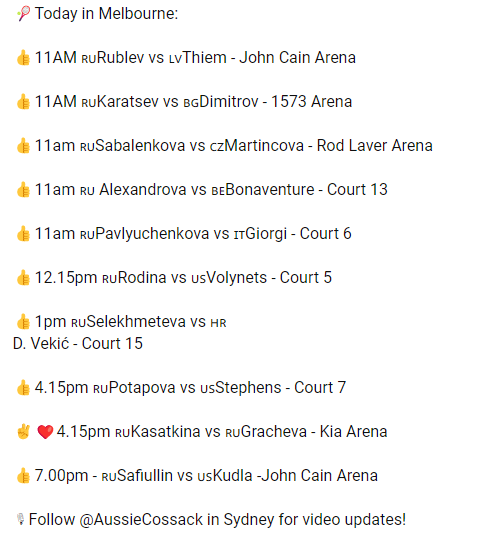
In the background: An ethnic Russian activist named Semyon Boikov, who also goes by the name “Aussie Cossack,” had encouraged his social-media followers to “retaliate” against Tennis Australia for what he called their “discrimination,” “racism,” and “attack on honor and dignity” in banning various Russian flags. The very day TA announced the ban, Boikov offered a cash reward to anyone who succeeded in displaying a pro-Russian symbol during a televised match and provided a helpful list of all matches featuring Russian players. Subsequently, he congratulated attendees who had managed to evade the ban, before specifically suggesting the Djoković-Rublev quarterfinal as a high-profile opportunity to do so. In all, Boikov—who has some 161,000 YouTube subscribers, solicits volunteers, and raises money off his content—published twenty-two posts and videos about Russian flags at the Australian Open on his channel over a two-week period.

Assessment: Clearly, the Tennis Australia flag policy and the security measures in place to implement it weren’t enough to stop people determined to bring banned items into Melbourne Park. In fairness, though, it’s pretty tough to thoroughly search the bags—and bodies—of each of the tens of thousands of people coming through the gates every day; and AO security had the additional challenge of distinguishing between similar-looking Russian (🇷🇺) and Serbian (🇷🇸) flags. In a few cases, members of the security team were over-zealous with flag-draped fans there to support Djoković; in a handful of other cases, they missed people who, I think it’s safe to say, had ulterior motives for coming to the tournament on the day(s) they did. All things considered, my main criticism of the AO is that their security staff didn’t act sooner to remove these men. But, even so, my criticism is qualified, as there may have been other factors contributing to their decision, such as waiting for police back-up or prioritizing the safety of the larger crowd by delaying action in order to minimize chances of people getting hurt should any violence erupt as they attempted to detain the men.


Afterwards: In the interest of transparency, I’ll confess that I jumped to conclusions when I first saw the headlines about Srdjan Djoković. Anyone who has followed Novak’s career knows that the father has often been a public-relations liability to the son; and I’ve followed it more closely than most—not least, because I speak Serbian. So, I reacted to the photo a colleague sent our Serbian media group chat late Wednesday night by rolling my eyes. The next day, I reacted to the flurry of tweets I saw when I first checked Twitter like a lot of other people did: by making a judgment without clicking the accompanying links and reading the articles, never mind watching the video “evidence” and evaluating its source. And I did this despite having more contextual information at my disposal than most people, not less. So, this whole episode was a salutary reminder for me, too: slow down; take a breath; read the article; check the source; try to keep your confirmation bias at bay; and consider what else you know or where you can look for more information. Also: since no one needs to tweet (ever), there’s no professional obligation or journalistic value in tweeting about an event before you have the facts straight.

In terms of the way this incident was covered in the first 24-36 hours, I’d suggest readers look at when stories were published or broadcast, which outlets published or broadcast them first (and which waited on details), whether they were published online only or also in print (the editorial standards for the latter are generally higher), what sorts of reporting they were based on, and how they were framed. Five things, in particular, stand out to me:

  • Many stories were published too soon after the incident to allow for much reporting (e.g., verification, interviews, & research) or even fact-checking.
  • The main character of the stories shifted very quickly from a group of disruptive men tossed from Melbourne Park to Novak’s father.
  • None of the articles that I read or news segments that I watched quoted eyewitness accounts (by the journalists themselves or spectators who had observed the events in question).
  • Many of the reports highlighted an inaccurate translation based on a questionable quotation of what Srdjan Djoković said to the men, often in the headline or subhed.
  • The primary source for most stories, other than a Tennis Australia press release, was a video created by the culprits themselves, which included misleading edits, descriptions, and subtitles provided by the “Aussie Cossack” channel.

As a result, stories presented a mix of accurate information (Srdjan did indeed pose for a picture with two of these men), misinformation (the misquotation and inaccurate translation), and speculation (e.g., attempts to interpret the deeper meaning of Djoković senior’s behavior based on an incomplete &/or inadequate grasp of the facts). On top of that, the stories also—albeit inadvertently—spread disinformation by amplifying a propaganda video made to manipulate viewers and advocate specific ideological and policy positions.

To expand on the disinformation point: even if one didn’t witness the scene that night or have enough information at hand to be able to spot the inaccuracies in the video posted by “Aussie Cossack,” one can make some inferences by viewing it in context. Specifically, who filmed the two parts of the incident: 1) the “photo” of Srdjan with two supposed Novak fans that abruptly (and presumably without explanation to Djoković senior) morphed into a video greeting to Alexander Zaldostanov; and 2) the group unfurling Russian flags and cheering Putin on the steps? Though The Guardian’s Tumaini Carayol happened to catch these guys in the latter act, they certainly weren’t leaving it to chance. Why were their short clips then featured in a longer video (set to patriotic Serbian music!) produced for social-media consumption? What can be gleaned about these fellows from a) what they were wearing, holding, and saying; b) the YouTube channel to which they submitted their cell-phone videos; &/or c) a simple Google search for either Boikov himself or the Night Wolves motorcycle “club”?

An aside: the initial media cycle lasted less than a day before it moved on to stories about reactions to the incident—interestingly, more to Srdjan Djoković himself than to the flag-ban-evading, political-statement-making culprits. If you’re interested in journalism, I’d recommend reading a post by NYU professor Jay Rosen about “scoops.” Rosen opens by observing that “Journalists tend to be obsessed with scoops, meaning: the first to break the news, and being seen as the first, which means getting credit for it among peers. But not all scoops,” he continues, “are created equal.” I’ll leave it to others to determine what kind of “scoop” the Srdjan story was—and how well the initial reports held up.

Jay Rosen, Four Types of Scoops

Answering only part of the last question: Boikov is someone with a substantial record of both pro-Russian activism in Australia, where he was born, and propagandistic videos and appearances on Russian television. Additionally, Boikov has stated, “We never felt ourselves to be Australian, we were aliens there. I consider myself to be a Russian.” He is not, to put it mildly, a reliable source. In fact, he has made his “Aussie Cossack” group’s motives quite clear in interviews: “We’ll always support the policies of the [Russian] state, we respect very much our Commander-in-Chief, Putin. And we have a unique capacity to support Russia from within a hostile state. Even the FSB or a battalion of the Russian SAS can’t achieve that, because unlike them we are citizens of this state.” Enough said. Why journalists would take what Boikov says on any subject at face value is beyond me.

To make matters worse: while most of Boikov’s videos have below 50 thousand views, the much-embedded, linked, and shared video about the “bold political statement” Srdjan Djoković supposedly made now has 181 thousand views. By every measure imaginable, this was a propaganda win for “Aussie Cossack” and his allies—not because his content is the work of a sophisticated genius but because so few media outlets could resist the lure of a controversy that could be tied to Djoković.


More to follow…

On the 2012 Serbia Open: If You Build It, They Will Come

But will they come for the tennis? This remains a key question facing the organizers of the Serbia Open, which is being contested this week in Belgrade. Given the crowds during last weekend’s qualifying rounds and on Tuesday’s May Day holiday, there was room—despite the absence of local hero Novak Djoković and his Davis Cup teammates—for cautious optimism. But with the Wednesday retirement of Dušan Lajović, the only Serbian player remaining in the main draw, the answer was looking less hopeful.

The 250-series event, now in its fourth year, is a big deal for both Serbia, which has never hosted an ATP tournament before, and the Djoković family, who owns it. As Novak’s uncle Goran, who serves as tournament director, proudly noted on Friday, Serbia is one of only 32 countries to hold such an event, which has the potential to “contribute significantly to the positive image of the country.” That there is much at stake here is also made clear by the fliers distributed throughout the grounds encouraging spectators to observe proper behavior during matches—not only to help “maintain high standards” at the organizational level but also to “show that we are a tennis nation.” This week’s tournament, however, indicates that there is still a ways to go to prove this point.

First, the bad news. While the popularity of tennis has seen a dramatic increase over the past decade, Serbia does not have a well-developed tennis culture. Traditionally, the public gravitates toward team sports like football, basketball, and volleyball—in which Serbia has had considerable success and spectators are free to support their favorites with little restraint. Serbian fans of the “white sport,” as it is symbolically called, fall into three categories, each bigger than the last: life-long followers of tennis (most of whom also play recreationally), relatively recent converts to the sport (including youngsters with aspirations to play professionally), and bandwagon fans, who are less tennis enthusiasts than admirers of a few successful players.

For the latter group, Djoković is not merely the nation’s best athlete—its Michael Jordan, if you will—but also its Brad Pitt and even its Kim Kardashian. That is, they fill the stands to be near the bright light of celebrity as much as, if not more than, to see Nole play. That Djoković has earned his achievements through talent, dedication, and hard work is not lost on the many parents, teachers, and even politicians who hold him up as a role model for the nation’s youth. But his success also registers in more superficial ways: his money, status, and fame make him equally a focus of the tabloids and a mainstay of the sports pages. And some of Djoković’s allure has rubbed off on tennis itself, so that regardless of who’s playing, people will come along to the “Novak” Tennis Center to see and be seen. Alas, such patrons are unlikely to make it into the stands unless a familiar face is on court.

Without well-known Serbian players to draw the crowds, the tournament must rely on either the curiosity of the general public or the passion of a much smaller group: those who really care—or want to learn—about tennis. Unfortunately, given the state of the economy, most people can’t afford the seats; or, if they do splurge, it won’t be for more than one session. Perhaps recognizing this, organizers made entry to the site free—not just during the qualifying rounds, as planned, but all week. While this has meant that hard-core fans and students of the game can watch matches on the two outer courts without tickets, it has left the stadium court mostly empty. Unsurprisingly, the largest crowds all week have not been for the tournament’s top seed, Pablo Andujar, but for its biggest name: David Nalbandian, who is familiar from both competing in Belgrade for Davis Cup and, more importantly, being a former top-ten player.

On to the good news. One thing can certainly be said for Djoković Family Sport: they know how—and where—to throw a party. With courts on the banks of the Danube, adjacent to the Belgrade fortress, and just a short walk from the city’s main square, the tournament is ideally situated. Further, evidence of a previous family business, a pizzeria in the ski resort of Kopaonik, can be seen all over their latest enterprise, from the four different restaurants on site (one, naturally, offering gluten-free items) to the Balkan beauties in tennis outfits offering samples of sponsor products; from the expert wait-staff whisking fruit juices, beer, espresso, and clean ashtrays to packed tables at the centrally-located café to the entertainment of the nightly karaoke contest presented by odd couple Mercedes and MTV.

On a more substantive level, the Serbia Open is also doing well by arguably its most important attendees: players and serious fans. According to Andujar, it is a well-run event: “I think it’s a very good tournament,” he noted after his quarter-final win over Lukas Rosol, “even if it’s new and they are [just] starting.” While Andujar admits that he and other players always want “enormous” crowds at their matches (as at Indian Wells, where the stadium was “full of people, clapping every point”), he also acknowledges that the absence of players like Tipsarević is “good for us, for these kinds of people—players that want to grow and be more famous.”

Others, too, benefit from the presence of such an event: for instance, next-generation Serbian hopefuls, like seventeen-year-old Miki Janković, who played his first ATP event this week. Locals who follow the sport closely are also happy to have international talent on display in Belgrade, even if it’s not from the best-known names on tour. Last but not least thrilled by the tournament are practitioners and students of the game, like Hristijan Kovačević and his coach, who, though they couldn’t afford stadium seats, came every day to pick up tips from training sessions and observe the match-play of the professionals whose ranks the thirteen-year-old hopes to one day join.

Ultimately, what stands out at the Serbia Open is the aspirational quality of the venture. The organizers are committed to making the tournament a future success—and not simply in financial terms. Despite this year’s merely “satisfactory” crowds, the director is already talking about developing it into a 500-series event. Though a cynic might see the place as little more than a glorified gift shop selling brand Novak, there are numerous indicators that the venue serves a greater purpose. Take, for instance, the trophy room, full of glittering prizes won by the current #1: perhaps seeing an Olympic medal or a replica Wimbledon Cup will inspire a Serbian child to pick up a racket. And if that isn’t concrete enough, how about this: the center is set to host several ITF Futures events this summer.


Originally published on The Tennis Space (6 May 2012)

Faces in the Crowd: Australian Open Edition

Last January, at the height of the Djoković debacle in Australia, I made the Twitter acquaintance of an American Novak fan named Claire (a.k.a. @luvinthetennis). Almost immediately, I was struck by how substantive and articulate her tweets were, including long threads about how the international media was—and, ideally, should be—covering the story. So, it didn’t come as a complete surprise when I eventually learned that Claire is a writer. (I’ll leave it to her to decide when and how to introduce herself more fully.) Like many fans I’ve met at tournaments, Claire doesn’t fit the stereotype of “Nole Fam” that has developed over the past decade, especially online—and this is one reason why I was interested in her personal path to fandom.

When I found out that, like me, Claire and her husband Pat would be traveling to Melbourne for this year’s Australian Open, I made a point of meeting them. We chatted a few times around the grounds before Claire and I found a shady spot to talk before the men’s singles final. She and Pat had arrived as the gates opened that Sunday to score seats outside Rod Laver Arena, so they could get the full Garden Square experience.

Before focusing on her Novak fandom, I asked Claire about her relationship to tennis in general. She told me she’d started watching the sport as a child, during the later years of the Evert-Navratilova rivalry. “I was the only person in the family who cared about tennis at all,” she noted, “and I remember being extremely young and just staring at the screen and sort of figuring out how scoring works. And, little by little, I just fell in love with what they were doing. I was a big Martina fan.” She kept watching as new players arrived on the scene, eventually becoming an Agassi fan: “that’s when I became a devoted fan and I started really following it. And I loved him. I loved his career: up and down, lots of drama and fun. Then he retired and I actually wasn’t interested in anyone else who was playing. I was also a huge Monica Seles fan, by the way; but then I stopped watching the women play [after] the stabbing.”

As for Djoković, Claire admits she “didn’t even know that Novak existed” until the summer he first ascended to the men’s #1 spot. “I was visiting a friend one day,” she recounted, “and that friend had the US Open on. It was 2011 and I saw Novak playing. I was talking to my friend, with the [tv] sound off, and I kept getting diverted because I loved the tennis. I was saying, ‘His tennis reminds me of Agassi’s tennis’: the precision shots, the baselining, the crisp returns. But he’s such a different player. He has so much passion just rolling off of him—and I love that about him. So, in the end, I started staring at the screen, and my friend and I watched the rest of the match. I know that a fan was born then and I’ve been following him ever since.”

However, like many Americans, it was challenging for Claire to be more than a casual fan due to the fragmented way tennis is broadcast in the US: “I don’t tend to pay for extra channels…. So, I would only see the majors.” Two more recent events contributed to Claire’s becoming a “really huge Novak fan.” First, significant personal losses in 2019; then, the start of the pandemic in 2020. “I was stuck at home, and I had some other big things going on in my life that were difficult and painful to work through. I needed a good distraction,” she said.

In fact, it was Djoković’s default at the 2020 US Open that seems to have transformed her fandom from a pastime into something more like a project. Claire “was shocked at the vitriol he got for” hitting a line judge with an errant ball, “since he obviously did not do it on purpose”; and she felt motivated to try “to figure out why” he was getting such a reaction.

I’ll let Claire take it from here. (What follows is an edited version of our conversation; though I made minor changes for clarity, I mostly cut for length.)

C: The more I looked into it—the more I would dig and watch previous matches, would see some press conferences with him—I started to realize how misrepresented [Novak] has been in the press. And that really annoyed me because the more I watched those pressers, the more I really liked this guy. I was only into his tennis [at first] and I didn’t care that he broke a racquet—I love to see passion on the tennis court. But I actually fell in love with him as a person once I started to dig deep and see who he was.

So, I just got more and more devoted to him, watching all these old matches. It was a great distraction during the pandemic—and I really needed it. Then, I followed his 2021 calendar Grand Slam race. I was so devastated with the loss in the US Open final; but it was a great season and I was excited to start again. And here comes 2022 Australian Open! We all know what happened there…

I was completely devastated by that and I realized I had really connected with him. And, again, a lot of things had been happening in my life: I lost both of my parents, six weeks apart, right before the pandemic; and I couldn’t be with my sister and brother to grieve over that. So, I think what happened to me was that I was using Novak’s tennis to sort of help me through that period of grief, watching all those old matches, watching his career [develop], being so impressed with his commitment to excellence, watching all his old press conferences, finding out what a great guy he is. I just became really attached to him as a person—in a weird way, since I know he’s a person I’ll never meet.

I really appreciate what he did for me. He helped me through the worst time of my life, really, and so I wanted to come here and support him.

AM: Going back to what you said about how, during the pandemic and after the US Open default, you started to dig into old matches and that kind of thing. This may seem like a strange question, but I’m curious how you came to the conclusion that he was being misrepresented. In other words, did you go on Twitter and meet a bunch of Novak fans, for whom that is a big issue? Or is that a conclusion you drew simply on the basis of watching him, reading his press conferences, and then reading the coverage?

C: No, I came to it completely on my own and this is how it happened. When I saw the disqualification, I went on to Twitter. This is how I follow the news—by Twitter—because I follow a lot of journalists who post articles. And I saw that it was trending, so I was looking at what people were saying. I didn’t land on Djoković fans at first. I was just reading these really vitriolic comments that did not match what I had seen [on tv]. You know, disqualification—fair, not fair—people can disagree about that. But it’s clear he didn’t do it on purpose. And I was seeing people say, “Well, of course he did it on purpose; he’s that kind of person.” In effect, they were saying that, and I was just very curious about that, so I started looking into it.

I had heard the commentary on the US Open 2020, [in which] they kept referring to the Adria Tour, and how supposedly badly Novak had behaved during the pandemic. I was curious about that too; so, I went back and read a news article about it, and I was like, “Oh, that’s kind of disappointing.” And then I read another news article and I thought, “Well, wait, those two things don’t really match.” Then, actually, I started digging around and I found the piece that you did on it. And I read the details and realized that it was being misrepresented.

AM: Thank you for being one of the 15 people who’s read my blog.

C: Well, you did such a great job of covering that and you answered all my questions. It was just very clear to me, because the things that I was seeing about the Adria Tour just didn’t really make sense. They kept saying, “He organized this event” and “Novak did this thing.” And I thought, “This was a whole country—a region, actually. One man cannot organize an event [like this on his own]. Obviously, he had to follow rules, he had to be in touch with people who would allow these things. So, what on earth is going on here?” As you pointed out, there was a big soccer event at the same time [etc.]. So, it was just very clear that was being misrepresented.

But the real key part of feeling like he’s been misrepresented through the years is when I went back. I actually followed every Grand Slam victory he’s had: I watched every semifinal I could get in whole and every final, and I watched highlights of other things. I went chronologically because I wanted to understand what had happened.

AM: So, you started roughly in 2007?

C: Yeah, I did.

AM: Okay. Wow.

C: I would listen to the match commentary, then I would go to the presser—almost all this stuff is available online, if you look for it. I would hear the things that the commentators were saying about him—something he had done or said, or they would quote him, “Well, in his press conference, Novak said ‘blah, blah, blah’—and I’d go back and listen. And I was like, “Oh, they took that entirely out of context. Interesting.” And that just kept happening and happening and happening. I mean, commentators that I have no reason to think are intentionally misrepresenting him, but they are taking things out of context and twisting what the meaning is. I’ve actually been very shocked by it. I had no idea.

AM: I happen to know—because I found out a little bit about you before we met in person, now, for the first time—that you studied linguistics [in graduate school]. Do you think there’s any connection between your study of linguistics and how you approached reading and viewing the pressers? Is there any link there?

C: I think there’s one small link there in that I’m very aware of language barriers. So, when I am listening to how Novak answers a question, I feel like I can tell when he didn’t catch all the connotations that were in the question. So, he’s answering it a little bit differently because he heard it differently. I feel like I can tell what he means to be saying, sometimes, when he doesn’t use quite the same word we would use—and maybe, because of the phrasing or the word he uses, it has a negative connotation or a connotation no American or English speaker would put in it. I can kind of tell what he’s going for.

I think that’s true of anyone, if you pay attention, you watch everything in its entirety, and you take someone on good faith. That’s the key—you take someone on good faith. I think anyone can see that. But, yes, I think I do pay even closer attention to that—I’m a writer and I studied linguistics. So, I do pay attention to what’s going on, how people are wording things, why they’re wording them the way they are. And I’m very aware of the language barrier, even though he’s a fluent speaker of English and has a much higher vocabulary level than your average English speaker, frankly. Still, he says things in a different way sometimes—and I’m aware of that.

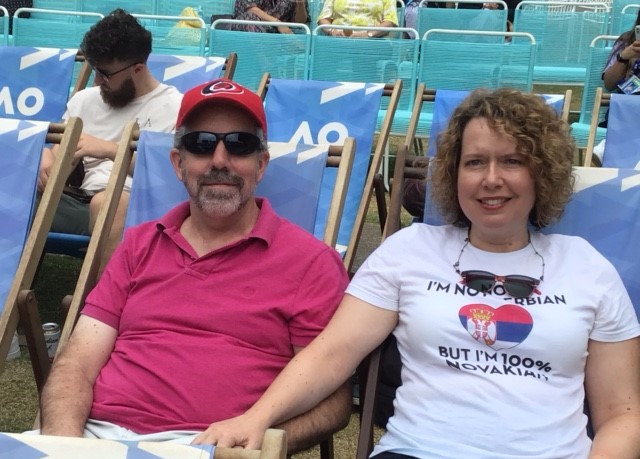
AM: Obviously, someone reading this won’t necessarily see what you’re wearing. But I can’t help but note that you’ve got on a t-shirt that says, “No, I’m not Serbian, but I’m 100% Novakian.” There’s this myth that the majority of Novak fans around the world are Serbian—and you’re kind of debunking that on your very body. [Note: after posting this, I learned both the identity of the woman who came up with the original shirt idea in 2021 and that still other fans have created variations on the theme. Djoković himself has joked about this media narrative.]

Also, you’re not from Novak’s part of the world—I mean, you’re not from Europe; you’re not from Eastern Europe; you’re not from the former Yugoslavia; you’re not from Serbia. As far as I’m aware, you don’t have any connection to that part of the world. You may not “get” him and get his background in the same way that people who do have that in common with him do. So, I’m curious both what you make of that myth (that all, or the majority, of his fans have ties to Serbia) and what it is about Novak that you connect to, despite the significant age gap as well as cultural differences?

C: The first question, what do I make of the myth? I feel like the people who are shaping the tennis narrative—the primary people in the media who shape the tennis narrative and who have shaped the narrative of the Big 3—I think they find Novak off-putting. I mean, I don’t see any other way to think about that. I’m sure they must admire his tennis and probably some of them admire him and like him; but, overall, they seem to find him off-putting. So, I think that when they see fans waving flags with his face on it—which is inevitably going to be a Serbian flag—they just assume only people who are connected with Serbia can like him, because he’s so unlikable. I really think that this is what they believe: he’s so unlikable that the only fans are people who only care about pretty tennis, first of all, a small segment of people, but the devoted fans must be connected to Serbia in some way. I think that they think that—and I think that they have to be completely wrong about that. I mean, I myself have met people who love him and have no connection to Serbia. I don’t know why it’s so hard for them to believe.

AM: If you had to guess, or if you’ve seen articles or coverage, what are the handful of things that you think they think make him unlikable?

C: I think that they don’t like the way that he responds to difficulty on the court and the way that he manages his matches when he’s fighting various things. Mind you, from what I can tell (because I’ve watched him play Andy Murray quite a bit, because I’ve watched his career), Andy Murray has a very similar way of managing himself on the court. And, yet, it’s okay. So, I think that they don’t like it that he smashes racquets. I think they don’t like it that he screams Serbian curse words. I think they don’t like it when he yells at his box, even though they have no idea what he’s saying to them.

I just think that he gets this over-scrutiny of how he behaves, and people expect him to behave a certain way. And I think he sort of gives off all this passion that Anglo people—so, Americans and UK and Australians—find distasteful. Somehow, Andy Murray is able to do all that, and it doesn’t bother them a bit. So, it may have a certain color to it that’s sort of intangible.

AM: Back to the second part of the original question: why do you connect with Novak?

C: We’re getting into the realm of emotion and intangibles here…. You know, I connect with his authenticity. There’s this sense that there’s a veneer over people who come from a certain class—who are raised a certain way, live a certain way. There’s kind of a veneer there. And those of us who were not don’t have that veneer.

AM: I saw, on your Twitter feed, photos of your passports—is it true that you and your husband did not have passports before you planned this trip?

C: That is true. I mean, we had them once, but they were well expired.

AM: When was the last time you took an overseas trip?

C: I took one single overseas trip before this one when I was 15 years old. That’s the only time I’ve been outside of the country.

AM: So, this is your second trip—in your life—outside of the country…

C: Yes.

AM: and you came from Maine to Melbourne…

C: That’s right.

AM: to see Novak Djoković?

C: To see Novak Djoković, yes.

AM: Whom you’ve never seen play live?

C: I’ve never seen him in person—I had never attended a tennis match before in my life.

AM: What was the route that you guys took from where you live in Maine?

C: We drove to the Portland airport and we took a plane from Portland, Maine to Philadelphia; and then we took a plane from Philadelphia to LA and from LA to Melbourne.

AM: And how long did that take?

C: It took us over 24 hours to get here, door to door.

“As I’ve thought about our trip. . . it seems absolutely crazy that we rolled the dice on a) traveling all that way to see one guy, and b) picked the SECOND week to visit, when there was no guarantee that he’d get that far. And it paid off. Bonkers, just bonkers. And Novak proving us right to do so will probably just make us more insufferable.”

PAT REFLECTS ON THEIR DECISION TO BOARD an airplane on sunday night, aware that DJOKOVIĆ could lose his FOURTH-ROUND MATCH while they were in flight

AM: Why did you and your apparently very supportive husband decide to travel in January, when it’s not a natural kind of break? It’s not the holidays; it’s not a normal vacation time. Why did you guys feel it was worth the time and money to do that?

C: Well, I really wanted to see Novak play in person, ever since what happened last year in Australia. I was really afraid that Australia had destroyed his career—very afraid. I still believe that Novak is probably the only tennis player who could endure what he endured and come back from it. And I was really afraid it was all over. So, when Novak wound up getting deported, I just told Pat, “I will see this man play. If he’s going to play again, I will make sure I see him play.”

Even though I won’t meet him or have a chance to talk to him, I can at least be there, put the vibe out there to support him, and thank him in my own personal way for his tennis—and cheer him on whenever he’s playing. I had originally wanted to go to the Serbia Open; and then I couldn’t get my [stuff] together in time to do that…. So, once I couldn’t do that, I thought, “Well, I’ll go to Belgrade next year”—and then I found out that they were not going to play in Belgrade. And so I said, “Ok, I’ve been avoiding the obvious: I need to go to the Australian Open.”

AM: Do you think that if Novak had been allowed into the United States last summer, you would have gone to the US Open instead?

C: Yes. I know I would have gotten to Belgrade as well, so I may have ended up in this situation anyway; but I definitely would have gone to the US Open to support him.

AM: Is there anything else that you feel like it would be important for readers (in Serbia) to know about why you and your husband came—or your experience since you’ve been here?

C: I will only say that I still really want to go to Belgrade—and I plan to go the next time Novak plays in Belgrade. I probably won’t go to Banja Luka, now that we spent all this money on Australia; but I will go next year.

From what I have seen of his [domestic] fans—and I have now interacted with a lot of Serbian fans and a lot of Aussie-Serbian fans—I understand how they made Novak. I feel like there’s a lot of love there and a lot of pride in him; and I would love to be in his home city and be surrounded by that and experience Belgrade and Novak Djoković [together] in a trip. I would love to connect with him, his home, and his people. And, again, I have no idea why. All I know is that I am so thankful for him and his tennis—and, so, I’m very thankful for Serbia for making him.


After he won the title and finished the English portion of his press conference, Djoković spoke at length to the Serbian media. I took the opportunity to tell him about Claire. (Watch our exchange, which was a bit more of a back and forth than I’ve presented in translation below, and you’ll be able to interpret Novak’s facial expressions for yourself.)

AM: I met a woman here, a member of “Nole Fam,” who came to Australia all the way from Maine, on the far east coast of the US. Before this week, she’d never seen a live professional tennis match and hadn’t traveled outside the country in nearly 40 years. She didn’t even have a valid passport. She came to see you. What does hearing things like this mean to you?”

: I didn’t know that—it’s the first time I’m hearing this story. So, thanks for calling it to my attention; and I’ll look into it because this kind of story truly fulfills me and I’m very grateful. The support I’ve had this year is really something sacrosanct, something beautiful. I mean, I’ve always had support in Australia from lots of people, especially the Serbian community. Of course, I’ve also seen people who came from China and [other parts of] Asia to support me—and I thank them a lot for that. But this year’s support, really, both in the stadium and outside it in the Square, was probably the best, biggest, strongest, loudest ever. I think they also recognized the importance of this moment and this year, considering last year’s events, and that somehow they wanted to be there for me, to give me wings—and that’s exactly what they did. So, from the heart, thank you.

Djoković v Australia: Timeline

Below, you’ll find a timeline that provides both background information and key events of the Novak Djoković Australian visa debacle of 2022. In many cases, I’ve linked photos, news articles, court filings, government publications, and the like to help detail what happened. Whenever possible, I opted for a primary source rather than media reports or commentary. The twelve days in January that Djoković was en route to or in Australia generated countless articles, columns, editorials, tv segments, blog posts, YouTube videos, podcast episodes, and tweets—on top of producing pages and pages of legal documents. Suffice it to say, I’ve found the latter files most useful in compiling a factual record.

Note: I consider Novak’s travel in the 2-3 months prior to his trip to Australia part of the relevant background information, particularly as covid testing protocols remained in place both at tournaments and at international borders in late 2021. Australia was the first country to which the professional tennis tour had traveled since its resumption from hiatus in August 2020 where covid vaccination was required for entry. No previous ATP, WTA, or ITF events had mandated players or their team members be vaccinated, though some had required attendees to show proof of vaccination before entering (e.g., the 2021 US Open). In fact, these public-health policies were generally set by host cities, states, or countries rather than the tournaments themselves. Further, as we witnessed during the 2021 Australian Open (where players, teams, & officials were able to enter the country despite the border being closed to non-residents) and the 2021 French Open (where a curfew was lifted to allow spectators to remain in the stands at Roland Garros for the duration of the semifinal between Djoković and Nadal), governments were willing to bend their rules &/or make exceptions to assist these sporting events in going forward.

2021

2022

Although I have linked many legal documents above, there are even more. The complete court files (including hearing videos) are here:

Meet the Sabanov Brothers

The Sabanov twins at the 2022 U.S. Men’s Clay Court Championship in Houston

In many ways, Ivan and Matej Sabanov come from a typical family in what was once Yugoslavia. Two of four boys, they were born near the Hungarian border in the ethnically-diverse Vojvodina region to a Croatian father and a Serbian mother. This sort of “mixed” marriage was so common back then, it didn’t warrant comment. Unfortunately, however, it was 1992: the violent conflicts related to the breakup of the country were raging. Even though their family was safe in northern Serbia, the economic conditions were very difficult.

While they were kids, their mother relocated a two-hour drive away to Osijek, Croatia for work as a Latin and Greek high-school teacher. After the brothers completed primary school, they moved to live with her. By then, they were already accustomed to having long-distance relationships with family members, as their older brother and first coach, Aleksandar, had gone to Zagreb for university. (The Sabanovs are quite an erudite family: Aleksandar, in addition to being a certified coach, speaks five languages and holds a Masters degree in Religious Studies.) After finishing a sports gymnasium, the twins were all set to attend college in the United States. But, at the last minute, they decided to turn professional instead.

It’s been a slow road for the Sabanov brothers since then, one involving years playing ITF Futures (a.k.a. the World Tennis Tour) within driving distance of home before eventually graduating to the ATP’s Challenger Tour and airline travel. Along the way, the twins have slept in their car and strung racquets for colleagues to make ends meet. For winning a Futures doubles title (which they did nearly 25 times together and a handful of times with other partners between 2013-2019), they were generally rewarded around $500. Occasionally, they would travel far from home—for example, to Nigeria in 2017—in the hopes of winning more prize money (which they did: there, they earned $775 alongside a Futures trophy).

When they needed to push themselves, improving through competition against a higher caliber of opponents, the brothers would enter Challenger tournaments farther afield: after traveling throughout Europe in 2016, they made their first mid-tier final the next year in Bangalore, India. But then, without consistent success, they’d return home to the former Yugoslavia where they could stack up wins at Futures events without having to pay a lot for flights. It wasn’t until 2018, when they were steadily playing Challengers, that they began to break even. (A big factor: participants’ food and lodging are covered by tournaments at that level.) This is the sort of un-glamorous grind that fans don’t hear much about, as tennis media focus on the big names earning the big paychecks. In many ways, though, it’s more representative of most aspiring players’ experience of the pro tour: one with lots of effort and investment without any guarantee of a return.

At the time we spoke, the Sabanovs didn’t have clothing or equipment sponsors. One brother was playing with Filip Krajinović’s old racquets and the other with Laslo Djere’s sticks. While they joked that Djoković’s racquets are too heavy for them (the twins are about 4 inches shorter than the top-ranked men’s player), they’ve since been spotted wearing Novak’s older Lacoste kit. In January, Matej was selected to play alongside Nikola Ćaćić in the ATP Cup, while Ivan traveled down under (in place of Viktor Troicki) as Team Serbia’s coach. As they did for Wimbledon last year, the brothers partnered Filip Krajinović and Dušan Lajović in order to make the rankings cut for the doubles draw at the Australian Open. With their success in Houston this week, that kind of improvisation should be a thing of the past.

Team Serbia at the 2022 ATP Cup

The quotations below are selections from a Q&A session after they won their first title at the 2021 Serbia Open. Alas, because I only have an audio recording, I couldn’t tell which twin answered which question. I’ve lightly edited their answers for clarity.


On their start in the sport: “So, we are actually a big family. It’s four brothers: the two of us, and then two more brothers. The oldest, Aleksandar, is our coach since the beginning. He started training us when we were five. Our grandfather built a tennis court in our garden, so that’s how we started playing tennis.”

On their family and national identity: “We were born in Serbia, we lived in Croatia, and now we are back in Serbia. Our father is Croatian and mother is Serbian, so we are mixed. We like to be that way.”

“Yeah, we don’t want to be specifically Croatian or Serbian. I think we are all the same, the same people; so, I don’t see the difference.”

On their early-career struggles: “Every start is very tough, especially the financial side. I remember one time, we ended the year with our ranking at 230, I think, and we decided to go to South America to play Challengers. [Note: this was in 2016, when they began the season tied at #242.] But we didn’t have money for the travel, so we went to the bank and asked to take [out a line of] credit. But of course we couldn’t, because we don’t work. So, the sister of our mother, she got money from the bank. And she gave it to us and we went to South America.”

“At the first tournament, we passed first round and then we lost. And then, we didn’t get in the second tournament—we were in Buenos Aires and we didn’t [make the rankings cutoff]; we were first [team] out. So, we spent a lot of money to pay for the hotel and food and everything. [From there], we went to Rio, where we also passed the first round and then lost in the second round. And then we didn’t have money to actually come back home—and it was like the end of the world for us. We thought we were going to die there. And, somehow, we made it back home and started [all over] again. We always work very hard. And, in the end, I think it paid off, as we see.”

“There’s one more story: we were traveling with a stringing machine to the tournaments in our car, and we were stringing the racquets for other players. Instead of 10 euros, we were charging 5 euros per racquet and then everyone was giving us the racquets—and that’s how we earned the money for the hotels and apartments. And then we started earning some money winning these Future events and then somehow we managed to earn something playing a lot of club matches in Germany, France, Italy, Hungary, everywhere. We were sleeping in the car and driving all night just to earn some money to keep playing tennis. And then it pays off—it’s beautiful.”

[By the way, though it took several years to do it, they paid their aunt back.]

On the lack of sponsor support: “We don’t have sponsors—we are just getting some Fila clothes from one manager in Germany.”

“He’s sending us his own clothes. I mean, we don’t have any contract signed; so, it’s just his goodwill.”

“It’s difficult to get the contracts in Serbia and Croatia.”

“But this won’t stop us to do our thing and to become good players; and this tournament [win] also won’t change us. We will still be the same [people] and will work hard for our dreams—this is just a small step forward.”

On a fortuitous 2020 meeting: “Last year, we met Novak Djoković in Vienna, and he invited us to come to his club here in Belgrade—to practice here. He gave us the amazing facilities and everything. So, we are very thankful to Novak—he did an amazing job. And we stayed the whole winter [2021] in Belgrade; we practiced really hard. Also, we hired our old friend, Ivan Bijelica, as a coach, and he’s now with us: he’s traveling with us and he’s coaching us next to our brother…. This week shows that we really did a good job with them all together, and we couldn’t be more happy.

On idols and mentors: “We always dreamed about becoming professionals and we watched the videos of champions like Novak and Roger and Rafa. We always downloaded the videos and watched all night long, so that was our future life—we wanted to do that.”

“The Bryan brothers were our idols since we were starting playing doubles…. And then, last year, we had a chance to practice and to spend some time with Mike Bryan, because his wife is from Slovakia and his manager organized everything. We went to Slovakia and spent six, seven days with Mike. He gave us a lot of really good advice and said that we have a good potential, that we need to keep working hard and then we will get the chance—and that’s what happened this week. We’re still in contact with Mike Bryan and he is giving us advice and encouraging us. So, we’re very, very thankful.”

“Also, there’s some other players like Mate Pavić and Ivan Dodig from Croatia—whenever we saw them on the tournaments, they were encouraging us. And that really means a lot to us, because it shows that we have potential and then, one day, we will be there and we will earn a living from playing tennis—and that’s what we’ve always wanted to do.”

On their differences (beyond the fact that Ivan plays with a one-handed backhand): “Yeah, we are different, our personalities are different, definitely. Ivan is maybe more energetic and he’s a quick temper. I am a little bit more calm, let’s say. Also [in terms of physical differences], I have two small moles on my face and Ivan doesn’t, so that’s how people recognize us.”

On court during their 2021 title run in Belgrade

On winning their first ATP title: “Yeah, besides the money and the points and everything, it shows that we have a really good level. [Even] before this tournament, we were winning against Grand Slam champions on the Challenger level—for example, we beat Kevin Krawietz and Andreas Mies in a Bosnia and Herzegovina Challenger [in September 2018]. We beat some more players who were winning ATP titles, so we knew that we have a good level—and that we have to be patient and wait our time. It means a lot. We will definitely keep working very hard and we want to improve more, we want to play Grand Slam tournaments and to play on the center courts of the biggest tournaments. That’s our goal and that’s what we were dreaming about our whole life, so we’re not gonna stop here.”

“I think it’s the motivation for me. I feel like I will be more motivated to practice and to do all the things to improve more after this tournament because I now I have proof that we can do this. The hard work is paying off.”

Podcast and Radio Appearances

February 2023: “Novak Djokovic surpasses Steffi Graf for the record of number of weeks at No. 1” on NPR’s Morning Edition.

February 2022: It was a real treat for me to have the opportunity to talk about Goran Ivanišević, the state of Yugoslav tennis before the breakup of the country in the early 1990s, and what the big-serving Croat brings to Team Djoković with Jeff Sackmann of Tennis Abstract. Listen here.

January 2022: Thought I made several appearances on BBC Radio during Novak’s Australian saga, they seem not to have permalinks for programs over a month old. So, the only segment I can share from the complicated lead-up to the 2022 Australian Open is this one on Melbourne’s ABC radio: “Decision to cancel Novak Djokovic’s visa sparks anger in Serbia.” Listen here.

May 2021: “All About Djoković.” One of these things is not like the other: Niki Pilić, Boris Becker, Goran Ivanišević, and I were guests for an hour-long BBC 5 Live Sport discussion of the ATP #1.

July 2020: Carl Bialik invited me on to Thirty Love, his short-form podcast, to discuss Novak Djoković and the Adria Tour. Much of our conversation relates to my tennis journalism hobby-horse: shortcomings of the Anglophone-dominated international media in covering players whose native language isn’t English. Listen here.

Sport Klub’s Dubai Interview with Novak Djoković

The night before his quarterfinal match in Dubai, Djoković sat down with veteran Serbian sports journalist Nebojša Višković in the garden outside a tent housing the player gym. “Viško,” as he’s known to colleagues and Sport Klub viewers, has covered Novak since he was a promising junior—and they have a friendly rapport rooted in obviously-mutual respect. Indeed, were it not for this longstanding relationship, it’s unlikely Sport Klub would have gotten this time with the then-ATP #1. To my knowledge, Novak did no other one-on-one interviews during his first event of the season, and the three Serbian print reporters in attendance got one native-language question each per press conference.* At the start of their chat, Višković semi-jokingly observed that talking with Novak had become “a journalist’s toughest-possible task.”

In addition to providing match analysis from SK’s Belgrade studios and conducting post-match interviews at the handful of tournaments he attends each year, Višković co-hosts a weekly tennis podcast called “Wish and Go” with fellow commentator Ivan Govedarica. In that format, which they started using during the pandemic, the pair have interviewed not only every top Serbian player and plenty of local tennis insiders but also a bunch of other ATP and WTA athletes from the region (e.g., Croatia’s Borna Ćorić and doubles team Mektić and Pavić, Montenegro’s Danka Kovinić, and Bosnia’s Damir Džumhur). The conversations are quite long for today’s media climate—often running over an hour—and substantive, with hosts well-versed in both the history of the sport and the intricacies of the game. Govedarica, once a junior player, was a tennis coach and an official before he turned to broadcasting; Višković, who also coached in his twenties, is father to a current Serbian junior; and both men play tennis regularly (their on-court rivalry is one of the podcast’s running themes). Whenever I watch the show on YouTube, I lament the fact that episodes don’t have subtitles making them accessible to the wider tennis world. Until there’s a reliable transcription app for Serbian, though, I understand why this is too much work for anyone to take on in addition to the rest of his/her professional responsibilities.

This SK interview, however, is short enough to be manageable. Here’s my translation of the full interview, with occasional, hopefully clarifying, additions in brackets. Please note: I produced this translation before “Wish and Go” made a subtitled version of the interview available on YouTube (today!) and I decided to post my work, regardless, because it allows me to both introduce and comment on the Q&A content.


NV: “It seems to me that something like this is perhaps easier in Dubai. Even with all the protocol, it’s more relaxed.”

NĐ: “Well, yes, the atmosphere is different here, a bit more pleasant and less formal than at the Grand Slams and some other tournaments where you’ve been. You’ve been involved in tennis all these years and we know each other, of course; that relationship is why I wanted to do this. Plus, you’re the only representative here from Serbian tv. So, thanks for coming.”

NV: “We won’t talk about Australia, because that story’s passé and you’re sick of it, I’m sick of it, everybody’s sick of talking about it.”

NĐ: “Thanks.” [laughing]

NV: “But I will have a few questions that aren’t ‘tra la la,’ just so you know.”

[crosstalk]

NV: “Just tell me: have you put a period on that episode—Australia, full stop, turn the page, done?”

NĐ: “You know, I can’t completely erase everything that happened from my memory. And everything is so fresh. There have been some other things in my life —whether tied to tennis or not— that shook me, emotionally, that I couldn’t forget, let alone something like this. This really was unprecedented in every sense, in terms of everything I’ve experienced in my professional career and in my life overall.

But I can accept that it is as it is—and move on. What you’ll certainly not see or hear from me is that I’m running away from responsibility or from answering anyone’s questions. I have nothing to hide; I’m not avoiding anyone; and I’m here [i.e., available]. I also invited the BBC, who weren’t always friendly to me as global media. They came to Belgrade—and I thank them for that. They allowed me to say, for an international audience, what I had to say. We agreed to whatever questions they asked. They broadcast half an hour, but we talked for almost an hour and a half; so, there was a lot…”

NV: “If I could interrupt—why’d you invite the BBC [specifically]?”

NĐ: “Well, precisely because if I’d invited someone with whom I have a better relationship, then people would say, ‘Eh, here he is, setting up an interview so that they don’t ask him anything [because] they’re inclined toward him,’ like they may’ve said about RTS. Of course, it’s logical to expect that when I talk to the national broadcaster of Serbia, or someone from international media who’s been more sympathetic toward me over the course of my career—and people who follow tennis know who’s more sympathetic and who isn’t—then, some would think, ‘Here he is, running from uncomfortable situations; so, he’s hiding something and doesn’t want them to ask anything awkward.’

That’s absolutely the biggest reason I called them: I really wanted those who’ve criticized me a lot to come and ask me anything they thought was necessary to ask. And, of course, because they’re one of the world’s biggest media, with over half a billion viewers, I’d have the opportunity to speak to the world.”

Radio Television of Serbia aired a lengthy interview with Djoković the week before he played Dubai.

NV: “They didn’t just criticize you—they dragged you in the worst way.** I gave a couple of interviews to the BBC and fought for you. I’m glad that you mentioned at the beginning how long we’ve known each other… But I was sorry when I saw that you chose the BBC—this isn’t a lament, like ‘Why not me?’”

NĐ: “For what reason?”

NV: “Because we defended you during the whole Australian [episode] and then you suddenly give an interview to the very people…”

[crosstalk]

NĐ: “That’s it, though. Simply: to those who criticized me the most, come and you’re welcome to ask me whatever you want…. I had absolutely no influence on the questions they raised. We only wished for it to be in Belgrade, if possible, because I was training there, getting ready for Dubai. They accepted, came, and were very nice, polite, neutral, and firm—in the sense that, ‘Ok, we’ll ask everything that hasn’t yet been addressed from your side.’ No problem. I’m sorry they didn’t broadcast some things…”

NV: “They cut a lot.”

NĐ: “Of course, I know that they had to make cuts to fit the time slot they had, but…”

NV: “They cut what didn’t suit them.”

NĐ: “Well, that’s how it is. But, to repeat: I run from no one and nothing.”

NV: “Politics shouldn’t interfere with sports, but sports should influence politics—at least, that’s how I see it. Because there are many good things…”

NĐ: “For me, sports—excuse me for interrupting—has always been above politics. Even if, perhaps, some people who aren’t well-versed in the situation or who don’t necessarily follow tennis much think I politicized this whole thing, that I deliberately intended to enter the country by force or to attract attention to myself and somehow distract from other tennis players…”

NV: “Don’t go back over all that—we know, all of it’s clear…”

NĐ: “No, no, no—but it matters in the context of all this. Because some people think I went more into politics than sports. Just the opposite: I went because I’m an athlete and that’s the place where I’ve achieved my best results. And because I wanted to respect my colleagues, I didn’t explain or respond to all the questions until [the Australian Open] was finished. The other side, so to say, didn’t hesitate to speak in public, and it went the way it went: a very ugly picture of me was created. They really humiliated me, if I may say so, on the world stage.

And that’s why it’s very important, when I get the opportunity, and if someone asks, that I answer questions. I’ll probably repeat the same responses that I gave to the BBC because I don’t have anything else to add, especially in terms of questions about things like the [COVID] tests—I’m neither an IT expert nor do I understand how those tests are processed and registered. I mean, that’s not on me.

I did everything that was required of me and was in the same position as any other tennis player—which is very important since I see there’s some belief that I was privileged or used my position to get that [medical exemption] status due to who I am. But everyone had the same opportunity [to apply] for an exemption. Since I see that the BBC cut this, it’s important that I say it and that people hear it. So, I’ll repeat this a hundred times like a parrot: when I arrived in Australia, a WTA player from the Czech Republic and an ATP coach from Croatia with the exact same exemption—in the same situation, with the same vaccination status as I have—had already been there for days. She played in a tournament, he coached his player in a different tournament and there was no problem. Suddenly, I get there and it’s a problem. Why is that? You tell me, because I’m stopping there. ”

NV: “I said I wasn’t going to ask about Australia…” [laughing]

[The body language from 7:50-7:58 is universal, so I suggest watching it yourself.]

NĐ: “What’d you want to ask me?” [laughing]

NV: “Listen, what you’re saying is clear to everyone. It’s not [clear] only to those who won’t use their brains and don’t want to [understand], and that’s that.”

NĐ: “But Viško, it’s important for me to repeat it, not only for our people and those from the Balkans but because I know that some international media will pick this up. It’s important to say it and I hope that some people will write about this situation.

So, you tell me: is it political or is it not? If I enter, I’m a problem; but two people who entered before me with the identical situation had no problem at all?”

NV: “It’s 100% political and that’s totally clear. But, unfortunately, politics and your career are intertwined nonstop. You just had a meeting with the president of Serbia which provoked a lot of comments, upheavals, emotion, and so on.”

NĐ: “I’m aware of that. I saw that people think that I now support the president or his political party in their re-election campaign. There’s been a bunch of speculation on that topic, condemnation. I’ve become accustomed, in this period [presumably, during the pandemic], to condemnation from the international media; and now, likely because of such situations, also some domestic ones. However, I have to thank the majority of our national media, who were with me [during the Australian episode]. The nation stood with me—so, from my heart, thanks to all Serbs around the world. I felt the support, listened to the recordings, and saw the people who met me at the airport, the messages on the Belgrade waterfront tower. It was fantastic, really, and I have to mention it because I feel an [emotional] obligation.

I went to see the president because I wanted to thank the man, as the leader of our country, who stood up for me as a statesman in public, just as the Prime Minister, Ana Brnabić, did.*** Also, the Institute for Public Health “Batut” didn’t stand up for me, specifically, but they came out with a public statement that there was no problem with my test results. That meant a lot to me because Der Spiegel, and others who got into the investigation, picked on [the results] and thought that I was somehow cheating on them. [The IOPHOS] said, ‘Here you go: everything is perfectly clean.’

So, I went to the president as a Serbian citizen, as an athlete, as someone who felt that support. And I wanted to thank him—and to do it publicly because he deserved it, as did everyone who stood by me. I’m not getting involved in any kind of politics or any election campaigns—it’s never a good time for that. I haven’t done that before, even though I received recognition from the former president and I’ve been in the National Assembly. I’ve always tried to keep my distance from the political sphere, and [related] stories and currents. When I went to do it, I knew that people would talk about it. Like I said, it’s always a bad time to do it—there’s always a campaign; there’s always something. But I wasn’t thinking about that.”

NV: “It’s the spot [i.e., a political ad] that caused the most uproar.”

NĐ: “What spot?”

NV: “The ruling party’s [campaign] video. You appear in it—that’s actually the biggest reason…”

NĐ: “Honestly, I haven’t seen it. I heard… I only saw a video on Instagram of our meeting that [the president] posted. There was no mention of the Progressive party.”

NV: “They put a video on YouTube.”

NĐ: “I didn’t see anything with a logo on it or tied to the Serbian Progressive Party. What I saw was just an edited version of our meeting that day. For me, that was… Again, people will always look for a needle in a haystack and try to take anything they don’t like and make it into something that [supports] their side.

But if we want to look at it that way, I went ‘against’ both his party and the state when I supported the [environmental] protests. In the end, as I told him and everyone else, that had nothing to do with politics. I didn’t get involved in the negotiations or agreement between Rio Tinto and the state—I was supporting my people, who took to the streets to fight for cleaner air, water, and food. Those are elementary things and not tied to politics. It’s a problem that dates back 15, 20, 30 years. We have a problem with pollution in Belgrade and it has nothing to do with any [specific] government. I mean, it does—every government is responsible for [things like] that. And that’s why I did it [i.e., posted on Instagram about the protests]—it has nothing to do with politics.”

NV: “Nole, thank you for being forthright. You’re open to the core, as always, and that always…”

NĐ: “Well, yes, it’s honest… Viško, look: I have nothing to hide. Of course, I know that I sometimes need to “filter” things. But the truth is the truth, and my position is my position. I know that people will continue to criticize me because I decided not to get vaccinated and because I have some views that are incomprehensible to people. I respect everyone’s decision and I hope that people, even if they don’t understand, will at least respect mine. I don’t think I’m endangering anyone. It’s my decision, I’m aware of the consequences, and it’s not in my hands. It’s not entirely up to me whether I will go to Indian Wells or to some other tournaments.

At the moment, I’m here [in Dubai] and I’m enjoying tennis. I’m grateful and proud of everything that I’ve achieved. And this sport has given me so much, I’m trying to give back to the same extent. It’ll always be the case that some people don’t like me or criticize me for this or that. Sorry, because you’re part of that world, but the media often live off sensationalism—many in media, not all.”

NV: “Do you differentiate?”

NĐ: “You’ll agree, that’s how it is. Of course, I differentiate—I mean, I’m talking to you because I know you’re not like that.”


  • * Note 1: Despite my “mixed” ancestry and the fact that I was in Dubai representing my blog, not a Serbian outlet, I include myself in this category. Frankly, it was a long way for me to go to get in my allotted three questions and the limitations put on us by the ATP is something I’ll have to weigh in making future plans for tennis travel.
  • ** Note 2: I was also invited on BBC Radio before, during, and after the 2022 Australian saga and generally found the program hosts, in addition to their tennis correspondent Russell Fuller, to be quite fair. Given that the BBC is a huge media organization comprising print, radio, and tv services, there are a range of sports journalists and commentators who have covered Djoković over the years. So, I think it’s possible that “BBC” is standing in not only for some specific individuals who work for the UK’s national broadcaster but also for the whole of British sports media, who have been rough on Djoković, particularly between 2011 and 2017, when he and Andy Murray were competing regularly for major titles. Having said that, it is the case that a BBC article was cited by the Australian government in making their case that Djoković may, by his mere presence in Melbourne, galvanize anti-vaccine sentiment. As I noted on Twitter at the time, almost all international reporting on Novak’s vaccination-related views has been based on a problematic translation of comments he made in April 2020.
  • *** Note 3: I couldn’t help but notice that while Novak mentioned the Serbian PM by name, neither he nor Višković ever referred directly to President Aleksandar Vučić. Of course, I have no idea how conscious or deliberate this was on either man’s part—so, it may not be terribly significant. This would probably be a good time to clarify that the Serbian Progressive Party is not what most would consider ideologically “progressive.”