On Syria & Serbia: Some Thoughts on US Interventions

There’s something—or a few things—I’ve been wanting to say for a while about US interventions abroad.  But because I was already headed to the US Open when things took a turn for the worse in Syria, I didn’t say them because it seemed odd to intermingle tweets about tennis with thoughts on foreign policy.  Since things have slowed down a bit in New York, though, I’ve collected a few thoughts.  Really, they’re questions and concerns.

If you’ve been following the debates over what the US should or shouldn’t do in Syria, you may have noticed that “Kosovo” keeps getting invoked.  Given that, it seemed worthwhile to share this handful of pieces, most of which explicitly compare the intervention in “Kosovo” with plans for similar action in Syria.  I put “Kosovo” in quotation marks to emphasize one thing only: the fact that NATO’s 1999 intervention in the Balkans is known by an inaccurate shorthand.  The target of the bombings was not strictly the (still-disputed) territory of Kosovo, but Serbia itself—then the largest republic of what remained of Yugoslavia.  While I understand the need for a convenient abbreviation for common use, this inaccuracy also irks me because I think it obscures the actual—which is to say, broader—effects of that military action.

I have several motivations for sharing these articles.  First, I’m a fan of information— seeking, considering, and disseminating it.  Second, I think it’s useful to have a historical perspective when considering political decisions, perhaps especially military ones.  Over the past two and a half decades, the US & its NATO allies have been involved in any number of conflicts across the globe.  To my mind, the degree to which the interventions in the Balkans shaped subsequent foreign policy (in Iraq, especially) has been insufficiently explored and understood by the general public.  So, particularly when trying to figure out what we could or should do in Syria, it seems useful to go back and look at other interventions that were also presented to the public as “strategic” or “limited” in scope.  Questions we might ask include: What went right?  What went wrong?  How similar are these two situations?  What are the key differences?  What can we learn from our previous actions?  What are the short- and long-term aims of the current or proposed mission?  And, perhaps most importantly, what happened in those other places we intervened after the military action was (supposedly) successfully concluded?  (Americans over a certain age remember George W. Bush’s “Mission Accomplished” celebration—and how laughable it seemed weeks, months, and years later, when our troops were still fighting in Iraq.)

Third (and related to the last question above), even though I have no idea what anyone should do about Syria, I am very, very skeptical of claims that Operation Allied Force is the “gold standard” for interventions, humanitarian or otherwise, as one of these articles states.  Or, if it is the gold standard, I think that should worry all of us.  The reason I feel this way is quite simple (and doesn’t have anything to do with, say, the legality of that operation): it’s been fourteen years since NATO intervened in the former Yugoslavia and the situation in Kosovo remains both unresolved and fairly dire, politically and economically.

Bottom line: these conflicts don’t end when we stop bombing or when headlines about them cease appearing above the fold in the New York Times.  We simply have to think long-term, no matter how painful or seemingly unbearable the short-term suffering is.  And we (meaning the US and its allies) have to learn something not only from “Kosovo” but also from Bosnia, Iraq, and Afghanistan.  Years—even decades—later, none of these places is a model of stability, despite our best efforts.  Could they have been worse without our military involvement?  Perhaps.  Might they have been better?  We can’t know.

I’ve tried to present a range of views here, from Clinton administration insiders to academic specialists on the region, from Buzzfeed to Foreign Policy magazine.  Those who follow me on Twitter or know me personally are likely aware of both my ties to Serbia and my commitment to reasoned analysis.  While I can’t claim to be neutral, I do try to be fair.  The pieces below are presented in chronological order, with the oldest (from 2008, when Kosovo declared independence) first.  If anyone has a recommendation, I’d gratefully add more articles to the list.

“Welcome to Kosovo, the Next Failed State?” (Washington Post Op-Ed)

“NATO Strikes Over Kosovo Continue to Divide, 10 Years On” (DW)

“The Folly of Protection” (Foreign Affairs)

“Kosovo Offers United States a Roadmap for Syria” (Washington Post editorial)

“Five Inconvenient Truths about Kosovo” (TransConflict)

“Is Syria Anything Like Kosovo?” (Foreign Policy)

“Syria Is Not Kosovo, Balkan Veterans Say” (Buzzfeed)

“Wesley Clark: Syria vs. Kosovo” (USA Today)

“Kosovo is the Model For U.S. War With Syria, Forget about. . . Iraq” (PolicyMic)

“Intervention Lessons from Kosovo for Syria” (Huffington Post)

“Syria Is Not Kosovo” (New York Times Op-Ed)

Those with more time or interest in the subject might check out an essay collection such as Reflections on the Balkan Wars: Ten Years After the Break-up of Yugoslavia.

Master Class: A Conversation with Nenad Zimonjić

I had an opportunity to sit down with doubles specialist Nenad Zimonjić at the start of the Citi Open in Washington.  Returning to competitive play after a month’s rest, the Serb was in a reflective mood while discussing his rivalry with the Bryan brothers, his numerous partners in recent years, and the ITF’s recent decision to suspend his Davis Cup teammate Viktor Troicki for eighteen months.  (An edited Serbian version of the interview appeared on the B92 website.)
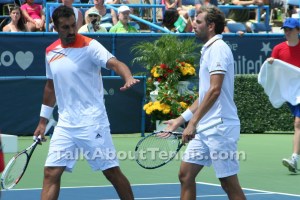
Nenad Zimonjić and Julien Benneteau celebrate a point during their win over Mardy Fish and Radek Stepanek in the Washington final. Photo by Mariya Konovalova.

Nenad Zimonjić and Julien Benneteau celebrate a point during the Washington final. Photo by Mariya Konovalova.

As a winner of multiple Grand Slam titles, including back-to back Wimbledon victories in 2008 and ‘09, Zimonjić is fairly well known in tennis circles.  Together with Canada’s Daniel Nestor, he wrestled the Bryan brothers for the top spot in men’s doubles for three years, winning the year-end ATP championships in 2008 (Shanghai) and 2010 (London).  He has also won four major titles in mixed doubles, two with Slovene veteran and frequent partner Katarina Srebotnik.  While not known for his singles career, he has played solo as recently as this winter’s Davis Cup tie with Belgium and lists a 2004 win over Andre Agassi, then ranked #6 in the world, among his achievements.

Perhaps less appreciated outside of the Balkans is the role Zimonjić serves—part older brother, part elder statesman—within the Serbian tennis community.  Given his compatriot’s success in singles, it’s little surprise that the first name that comes to most people’s minds when they think of Serbian tennis is Novak Djoković.  Nevertheless, at 37 years old and with 49 doubles titles to his name, “Ziki” is widely regarded as the stalwart of Team Serbia.  Not only has he appeared in 44 Davis Cup ties but he also possesses at least one trophy to mark every year since 1999 (and the range of experiences and insight that comes with that kind of longevity).  Though Djoković is the player now most relied upon to bring points in their Davis Cup clashes, Zimonjić remains a strong presence both on and off the court.  His effect on younger players can be observed in any number of ways: a striking recent example was his steadying influence on the talented but streaky Ilija Bozoljac in their dramatic win over the Bryan brothers in Boise this spring.

Last week, it was my turn to listen and learn.

***

AM: The last time you played here, two years ago, you and Michael Llodra won the title.  Does having won a tournament before affect or motivate you in any particular way?

NZ: It’s always nice to come back to the places where you’ve played well, especially defending a title.  I don’t find it to be a pressure—it’s more like you remember that you played really well, you have good memories, and that can help you in the results.  Then again, it’s been two years now, since we had Olympic Games last summer.  But I’ve always had good experiences here in Washington; I remember playing well most of the time, so hopefully we can do the same this year.

AM: You’ve played two great matches against the Bryan Brothers this year with a lot on the line and won both.  What does it mean to beat the most accomplished team in doubles history?  Will you miss them here this week or are you and other players kind of glad when they’re not in the draw?

NZ: Not really.  I enjoy playing against the best—this is why I compete, this is why I train every day: because I want to play the best on the biggest stages.  So, if you meet them in the finals, that’s the best possible thing.  In my career, I’ve had a lot of matches against the Bryans and some of them were really big matches—some I lost, some I won.  They’re probably going to go down as the most successful team of all time and it’s nice that I’ve had the chance to play against them with various partners on various occasions.

What they’ve achieved this year is amazing, really.  Actually, it started from winning the Olympic Games—from that point on, I thought they played incredibly well.  They were so consistent, they had really great results, and they won a tournament they’ve never won (and which means a lot to them), Indian Wells.  They had chances in the past, but they didn’t make it, and it took them a while.  But now they can say that they’ve won everything that you can win in doubles.  Obviously, they want to keep winning as much as they can—and everybody on tour wants the same thing.  So, for me to play them is always a big challenge and it’s always nice to compete against the best.

AM: One difference between the Bryan Brothers and other teams is that they have worked together for so long.  Even if they weren’t twins, such a long-term partnership is an advantage.  What have been the challenges for you over the past year or so playing with so many partners?  Have you learned anything new about yourself and how you work in this period?

NZ: Obviously, it helps when you play with the same partner.  When you practice a lot together, you’re going to improve.  You’re going to have ups and downs, but you get to know each other and find a way to help each other—that’s the advantage the Bryans have.  They work extremely hard.  Then again, there are a lot of changes in doubles.  So, where they benefit the most is the beginning of the year, because a lot of guys are just getting to know each other.  This is where they have a head start—they get ahead of everybody and it’s difficult to catch them.

By playing with many different partners, I got the chance to improve my game.  Sometimes playing a different side, different styles—that helped me to become a better player.  But, my most successful partnership was with Daniel [Nestor], and that’s when we were there with the Bryans.  For the three years we played together, it came down to the last match of the season to decide who was going to be number one.  The first year, we finished #1; the second year, they finished #1; then, the third year, they finished first and we tied for third.  It was very competitive.  We played against them, I believe, fifteen matches and won nine of those; so, head-to-head, we had better results.  But, at the end, we decided to split.

Then, I thought I had a good partnership with Mika.  It took a while to get going, probably because we were expecting a little bit more from ourselves.  We knew that we were capable of playing really well, but it took time because he is also focused on his singles and we didn’t have much time to practice.  Unlike the Bryans, who practice day-in, day-out and can even play points in practice, with Mika, I can count on the figures of one hand how many times we played practice points against somebody.  So, this is something that was missing.

We stopped because they were expecting their third child during Wimbledon and I couldn’t really take a chance about when it was going to happen.  So, we decided to play with different partners.  He played with a good friend of his, his Davis Cup teammate and now captain, Arnaud Clement, for his last tournament as a professional player.  After that, Mika dropped in the singles rankings, so he had to play different tournaments.  He skipped the whole summer, when we were defending a lot of points—we won Washington and Montreal, reached the finals of Cincy.

AM: It was something like two thousand points.

NZ: Yeah.  So, when he came to the US Open, I’d been playing with different partners (two tournaments with [Paul] Hanley, with Janko at Queens and the Olympics, and with [Alexander] Peya at Wimbledon).  We still had a chance to make the [World Tour Finals]; but we knew the US Open was probably the last chance, since he’d made plans not to go to Asia—where we again had done well, winning Beijing and playing the finals in Shanghai.  So, it was a lot of pressure and that’s where we decided to split.  I had to find a different partner for the next year because I really didn’t know what to expect from him.

That’s when I decided to play with Robert.  We started the year working extremely hard, trying to get to know each other, understand our games, and find the best game style for us to play.  But in the end, it didn’t really work out.  What I can say is that we tried extremely hard, both of us.

AM: You won Rotterdam, right?

NZ: Yeah, we won Rotterdam, and we played the finals in Stockholm and Dubai—those were good results, good moments.  But we didn’t really get to understand each other, and I think it was a good decision that we stopped.

AM: How has it been working with Julien Benneteau?

NZ: Benneteau is again a singles player with whom I don’t get a lot of opportunities to practice, similar to the situation with Mika.  But we get along really well, and we were lucky to start with a win—a huge win—in Monte Carlo.  That gave us a chance to make the Masters, which is something he hasn’t achieved yet.  So, that’s a good motivation for us—and for me, it’s a challenge to make it again with a different partner.  A good thing about the Bryans winning everything is that the rest of the teams are going to fight until the end of the year to see who’s going to make it.  Even if the Bryans don’t play another match for the rest of the year, they’re going to finish number one, which is a great achievement for them.

Julien and I are hoping to work at our partnership.  It’s difficult when you start without being seeded.  We had some tough draws, then some injuries that Julien had at the French Open during his singles match.  So, it’s a little frustrating when things like this happen, but it’s part of the sport and hopefully we can continue a good partnership from here.

AM: As of today, you guys are #9 in the race, but fewer than 1000 points—essentially, spitting distance—separate the teams ranked 3-13.  Other than winning, what do you need to do over the next few months to secure a spot in London?  Are there specific adjustments you and Julien need to make as a pair?

NZ: Not really.  Sometimes you have to be a little lucky with the draw.  Here, we have a pretty tough first round, with Nestor & Lindstedt, seeded third.  The difference is that if we keep winning, starting in Washington and then Montreal, it’s going to improve our ranking so that we can get a top-eight seed at the US Open.  That would give us a little better chance to get to the quarters.  It doesn’t really matter who you play then—you’ve made some points, which is good for the race.  Later on, when you play Masters series, being seeded or getting a “bye” makes a big difference; you get a better draw, for sure.  This is where it’s a little difficult to start with a new partner, who isn’t ranked high enough.  But, I believe in our game—we proved that we can beat anybody.  Our first tournament, we played against the best teams and we won; so, I’m sure we can keep playing well.  The main thing is to stay healthy, and the results will come.

AM: Have you been in touch with Viktor since the ITF decision?

NZ: Of course I’ve talked to Viktor—he’s my great friend, like everyone on the team.   We’ve known each other a long time and know each other well; so, this news is extremely difficult for all of us.  Naturally, I already knew about this, because I was there when it happened in Monte Carlo.  I think it came down to a big misunderstanding—and Viktor will be the one to suffer, even if he’s not guilty.  I’m one-hundred percent confident that he hasn’t taken any prohibited substances.  Something very unusual happened: I think it’s partly his fault and partly the fault of the person who did the test.  She should have told him, in fact, that he absolutely doesn’t have the right to refuse to take the test.  If he were told in that way, I think he’d have done it at any cost and then everything would’ve been fine.  We’ll see what happens in the end—he has the option to appeal and I trust that we’ll at least reduce what I think is an extremely strict and heavy penalty, particularly given that he’s never tested positive for anything.  I hope it’ll end well.

AM: Moving on to Davis Cup, how will Viktor’s absence affect the team, both psychologically and strategically?

NZ: With anyone from the team absent, it makes our path harder.  If we all participate, if we’re all healthy, we have a lot more options and possibilities as far as tactics, freshness, and so on.  Certainly, it won’t be easy, given that we play right after the US Open and that Novak will surely come late.  We’ve also got to adapt to the time difference and a different surface.  Regardless, we’ve had to deal with this situation before when Novak wasn’t on the team or, this year, Janko hasn’t been with us twice.  So, in the worst-case scenario, if Viktor can’t play, I trust we’ll still find a way to get the win.

AM: Do you have any input on who will replace him, since this player might be partnering you in doubles, or does Captain Obradović make the decision on his own?

NZ: The captain always consults with me about who I’d want to play with, even though it’s not ultimately my choice who ends up being my partner because we have to decide based on who needs to be freshest for singles the next day or for some other reason.  But for the most part, we talk together—all the players.  Because I’m the oldest and most experienced, there are some things that I can predict better, at least where doubles are concerned.  So, we’ll see.

If Viktor’s not there, it decreases our options for doubles since Novak probably won’t come until Wednesday and he’s supposed to play on Friday; then, for him to play all three days would be too hard.  Whether I’ll play with Janko or maybe a fourth player—Bozoljac or Lajović—we’ll have to see what the situation is.  We have plenty of time, and those are decisions that get made a day or two in advance.

AM: What kind of reception do you think the Canadian team will get in Belgrade?

NZ: Well, Daniel and Miloš are Canadians and they’ll be representing their country.  Daniel was born in Belgrade, but he definitely feels Canadian.  Of course, the Serbian crowd will cheer for us.  But I believe there will be both Canadians and, say, Montenegrins who will be a great support for Miloš, considering he was born in Podgorica and his family is there.  So, that’s something we’re expecting.  I think it’ll be interesting in that regard, since 75% of their team—Dančević, too—have roots in the former Yugoslavia.

AM: How do you rate Serbia’s chances to get to another final?

NZ: I think we have chances against any team in the world—especially if Novak is there, because he can always deliver two points, no matter the opponent or surface.  He’s proven that and I trust it’ll be the case this time.  I also hope Janko, who has at least three tournaments before Davis Cup, will play himself into form and lift his confidence, which will be extremely important, given that he and Novak will play singles.  And that, too, will be a very important point.  I think the Canadians have a very strong team with Nestor and Pospisil, who has shown that he can play both singles and doubles exceptionally well.  Then again, we’re playing on clay—a surface on which their second player, whoever it is, really shouldn’t be able to threaten either Janko or Novak.  So, it’ll be interesting to see what kind of form Miloš is in; with his serve, he’s a very troublesome player who can surprise anyone.  But I think that kind of surprise is much harder to pull off on clay, over best-of-five sets—and that’s why I think we have an advantage irrespective of Viktor’s presence.  Of course, circumstances could arise in which Nole arrives late, or a player is tired or injured, and we don’t have an adequate substitute; but they could have the same problems.

***

Benneteau and Zimonjić went on to win not only their first match in Washington but, in fact, the whole tournament, beating Mardy Fish and Radek Stepanek in the final.  Afterwards, Nenad shared a few thoughts on the week as well as on the state of men’s doubles more generally.
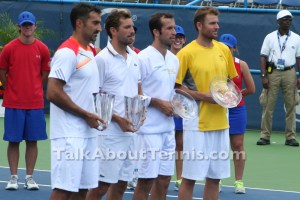
Citi Open men's doubles trophy ceremony. Photo by Mariya Konovalova.

Men’s doubles trophy ceremony. Photo by Mariya Konovalova.

On the Citi Open
It feels really great to win such a big tournament.  It’s a 500 series, but not just that: it was a very strong field—you didn’t have any easy matches here.  To return after a long break and to play this well and win the tournament without losing a set is really the best way to come back to the tour.  It was a lot of fun, I have to say, for both of us to play—we had a great time here, on the court and off.  So, hopefully this will help us for the upcoming three tournaments.

On the popularity of doubles
I think in the States, doubles is quite popular—England, too.  The biggest problem is, I think, scheduling.  The biggest problem is maybe not putting the doubles at the good times, which is before the singles.  I would compare it to a boxing match or some concerts, where you go and you want to see the best at the end.  The best here is definitely singles, no question about that.  But doubles is a lot of fun: it’s a good game, it’s something different that you don’t see in singles.  I think this is a good combination—you can use both “products,” if you can call them that, and make them popular and people can enjoy them.  Before, you had guys serving and volleying, playing that style; now, in singles, you don’t have that any more.  Still, you have it in doubles, where you have these reactions and quick points that you’re not going to see in singles.  Then again, the rallies, the running, some incredible points that you’re going to see in singles, you’re not going to see in doubles.  So, I would never compare it, but I believe that you can make tennis really popular by promoting doubles as well.

On his and Federer’s racquet changes
I changed it completely.  I’ve played with the same racquet from, I would say, 2001 and this was the first week playing with this racquet.  Usually, you don’t do this in the middle of the season, if you’re not 100% sure.  But you’re never really right when you start playing—it’s one thing in practice.  So, when you come to play, it’s always nice to have this confirmation with wins and shots that you make, that, “OK, this is it, this was a good decision.”  Then, you move on.  For me, it was a very nice transition.  It’s the same brand (Head) racquet and I think it was good for me….  I don’t know about [Roger], but I’m guessing that maybe it’s a bigger sweet spot, which is the case with my racquet, and a little bit of extra power.  This is what can make a big difference nowadays, with everybody serving big and hitting the big ground-strokes.  You want to find the best equipment that you can, with the strings, with the racquet, with the shoes—this is what’s very, very important.

On playing other doubles specialists & predominantly singles players
I want to play against the best players.  For me, it doesn’t matter if you’re a singles or doubles player.  There are singles players that are really good in doubles and there are some that are not as good.  Also, the other way around…. So, you want to play against the best and to challenge yourself as an athlete.  You want to play the best singles guys, the best doubles guys—you want to play them all.  And nowadays, it’s interesting because it’s changing a little bit, the way the guys are playing.  Some of them have decided to stay back, playing from the baseline and hitting big ground-strokes; some teams are playing traditional doubles, which is what we are doing, serve and volleying; some guys are playing I-formation.  There are a lot of tactics going on; so, as a player, you have to be adjusting to all of this, practicing to get better to face all these opponents.

On doubles formats and scheduling
Regarding no-AD scoring and match tiebreaks: I think it’s a good format.  We don’t really know, because nobody made a survey after that change, if it’s the right decision to go super tiebreaker at the end or to play a regular set with no-AD—which would take maybe five or ten minutes longer, but which I think could be a little more fair.  Then again, maybe some of the singles guys would then decide not to play….  This format where you play super tiebreaker is a little tricky because you could be the much better team for the first set and most of the second, then you end up losing the set [snap!]—and you’re in the super tiebreaker and everything happens so quick.  So, sometimes this is not fair that teams like this lose—you don’t have a chance, really, to get back in the match since the super tiebreaker’s really quick.  On the other hand, the points are very interesting: every point counts, every point is a big point, it’s a lot of fun for the crowd, and we are adjusting to it.

But the format that we’re talking about and the point about playing doubles before the singles, the best example is in the [World Tour Finals] at the end of the year in London, where all the matches are televised.  The turnout is really amazing, it’s a lot of pleasure for the players and the fans.  You have both a day session and a night session and you can watch a doubles match and a singles match with the best eight teams and best eight players in the world.  I think this is the winning combination and this is what we should aim to do as much as possible.  Sometimes, the same players will be in singles and doubles, and then you have to play doubles after; but every other time, I think you should play doubles before—maybe a little closer than what we did today [the men’s doubles and singles finals were scheduled at noon and three, respectively].  Because I think if we started at one o’clock, that would still give us time to finish the match and have the ceremony.  In any case, this is much better than to play after, in my opinion.

Regarding best-of-five set matches: As a player, if you play best-of-five, you have a lot of chances to get back in the match.  If somebody wins against you, he’s definitely the better player that day.  So, you have no excuses, really.  But, in my mind, because tennis is very physical now, I think it’s really long to play best-of-five.  I love to watch tennis—I love playing, I love watching, and for me it’s too long.  I think this format that we’re testing in doubles, which is no-AD, could be very interesting in the future in singles if they were to try to change something.  Then, you would not have these long games—same thing as what happened in volleyball, with the rule changes, same thing in table tennis.  I think those are good changes.  Maybe the only difference I would suggest in singles is that it could be the server’s choice, not the receiver’s, about where to serve….  Then, you will have quick games and the matches won’t go really long—advantage, deuce, advantage, deuce—and maybe playing best-of-five wouldn’t take such a long time.  But you would make it a special thing at the Grand Slams to play best-of-five, with no-AD—why not?  This is something that maybe we should try.  At the end of the day, the best players will be at the top no matter what rules you play—everybody will adjust…. We’ll see where tennis will go, but some changes wouldn’t be bad at all.

***

Although they lost to Colin Fleming and Andy Murray in the first round of the Coupe Rogers in Montreal, the French-Serbian pair earned enough points in Washington to be seeded at the Western and Southern Open in Cincinnati next week.  They also moved into the sixth spot in the race to London.
Citi Open Players Respond to Doping Allegations

Update: Since I posted this in August, there have been a number of developments, including the release of a decision in the Čilić case and statements from both the Troicki camp and the ITF.  Troicki will have his appeal heard at the Court of Arbitration for Sport in Lausanne next week, while the ITF is apparently considering changes to its anti-doping protocols—in response to issues “highlighted” by the Serb’s case.

***

Late last week, the tennis world was hit with two surprising and confusing stories concerning players accused of violating the International Tennis Federation’s anti-doping rules.  First came the news that Serbia’s Viktor Troicki had been suspended for eighteen months after failing to provide a blood sample “without compelling justification” in Monte Carlo this spring.  Following his second-round loss to Tommy Robredo in Umag on Thursday, a “destroyed and exhausted” Troicki shared his version of events.  By the time the ITF released a 25-page report on the decision the next morning, it was clear the circumstances of the violation were even more complicated than the initial news brief suggested.  The same day, Croatian media reported that their top player, Marin Čilić, had tested positive for a banned substance in Munich and was already serving a suspension.

  • Tennis Is Served’s Zafar offers a close reading of key aspects of the ITF report and raises important questions about their anti-doping procedures.

Those of us at the Citi Open this week have been eager to hear players’ responses to the news.  While players have ranged in terms of familiarity with the details of the two cases or how directly they were willing to address them, almost all of those asked had opinions on the larger topic of the sports’ anti-doping efforts.

The first players asked about it this week were those with close ties to Troicki.  In a Monday conversation, Nenad Zimonjić said he thought his Davis Cup teammate’s “very unusual” case “came down to a big misunderstanding” between Troicki and the Doping Control Officer and called the 18-month suspension an “extremely strict and heavy” penalty.  (My full interview with Zimonjić, in which he noted that last week’s news has been quite difficult for the whole Serbian team, was published by B92; the English translation is here.)

Unsurprisingly, Andrea Petković was also outspoken in press.

Romi Cvitković: Have you been in touch with Viktor or Marin since the doping allegations came out?

AP: I just know the Viktor story. . . and I really don’t think it’s right. Because I know it from Viktor and I know how he is and I know that he falls–how do you say…? He faints every time when they take blood. So, he was just playing a match and he wasn’t feeling well; he gave the blood sample the next day and he gave his urine—both were negative. To me, [the sanction is] ridiculous.

RC: Do you think something needs to be done with the system, that it’s not quite working well, or what?

AP: Yeah, well. . . I think it’s good that the rules are strict because obviously we all want to fight doping. I think tennis was always a clean sport, so far, and there were just very rare cases of doping. That was always really nice about it. And I’m also one that says doping doesn’t really help you in tennis, because you can be the fittest guy in the world and you can lift 200 kilos in weightlifting, but that doesn’t make you a better tennis player. It doesn’t give you the overlook of the court, it doesn’t give you the feeling, it doesn’t give you the placement. So, for me, I’m the best example: I’m not the fastest player—when I run against most of the girls, I would lose in sprinting. But I see the ball quite early and then it seems as if I’m very fast on court, but I’m really not.

I think it’s good that the rules are strict. But in cases like Viktor’s, you have to be able to look past the rules and you have to be able to make decisions that are maybe. . . personally indicated on [the individual]. And as I know Viktor, and everybody who knows him very well (we’re close friends—I’ve known him since we were ten, I think), I know that every time he gets injections he was fainting and shivering before he had to have them. So, that’s a kind of thing that’s not fair.

***

Australia’s Bernard Tomić was a bit less specific.

Ana Mitrić: There have been a couple of news stories in the last week with players having possible anti-doping violations. Is that the kind of thing that you hear about online or in the locker-room—is it on your radar, or are you mostly focused on your own game?

BT: Yeah, I did see that. I did see that. It’s very interesting—and very weird as well. It’s strange, but, you know, it’s obviously their issue. Um, I mean, I can’t say a lot about it, since it’s not my issue; but, you know, it’s pretty strange how it can happen. Being a player myself, you come to realize that things are out there… Like I said, it’s not my issue, but it’s sometimes really weird and strange to see stuff happen like that.

***

After Steve Tignor’s piece about how the Čilić case may illuminate questionable ITF procedures and Simon Cambers’ interview with Bob Brett were published on Tuesday, we could get into further detail.

Romi Cvitković: Have you been tracking any of the recent doping allegations that have been going on with Troicki…? Is there anything in the system that you feel like needs to be worked on or are they handling it the right way? Are the players talking about it at all?

Grigor Dimitrov: I’m in the loop, of course, of what’s happening. I hear here and there. For now, I haven’t had any problem with any of these things. I think as far away as you stay from the conflicts and everything is better for you. Because, at the end of the day, we are here to focus on one thing—and that’s tennis, of course. So, I think it’s kind of unfortunate what happened. But I don’t think there’s any problem with the system; or, if there might be, then people need to talk about it and that’s how you solve things.

AM: Bob Brett, Marin Čilić’s ex-coach, was interviewed for a piece in the Guardian today and he said that he felt players did not get enough education about some of these things—the policies, the rules, the procedures. I happen to know that the ITF’s document is 273 pages long, so I’m assuming you haven’t read that. But, do you have a specific memory of getting information about these policies?

GD: Yeah, I remember… [Asks ATP PR and Marketing Manager Fabrizio Sestini when he completed the ATP orientation; they guess about two years ago.] A lot of players were doing this ATP University, and there, everything is kind of compact and just the most important things. I think there is where you need to pay a lot of attention and focus on what’s been happening in the ATP throughout all the years. And they give you the exact, specific [information]—whether it’s doping or betting—a bunch of things that are really important are all listed there.

We actually have a 24-hour phone that you can call for doping. Anytime, you can call and say, “Hey, listen, I have a problem with this—do you think that’s fine if I take it?” and they give you all the banned substances and all that. So, I think there is one of the times that everyone has to pay attention and be aware of what’s been happening. I think the most information that I got was back then. Now, of course, every day there’s something—not every day, but something is coming up; so, we try to keep [informed about] all that. I understand how everyone wants to just open this thing and look at it. Of course, sometimes you fall into these errors—and that’s no fun.

***

AM: There’s been a fair bit of talk on the media side this week about doping, anti-doping violations, and so on. I’m curious how aware of that you are, if there’s been much talk in the locker-room, and also whether you feel that you have good access to information about those issues?

John Isner: Yeah, I’m aware of, I guess, two incidents currently going on and I’ve read about it; but that’s all I know. As far as talk in the locker-room, there actually hasn’t been much at all. With the Americans, it’s more just talk about fantasy baseball—and, believe it or not, how I’m in ninth place. It is what it is, I think. Those situations are unfortunate and I don’t know what to think of it.

But. . . as far as hearing that the ATP or WADA don’t educate us enough, I don’t think that’s the case. For me, in particular, any time I take something, I do check it out. I don’t try to buy many supplements outside of that. So, I think the ATP actually does a good job with informing us about what we can and cannot take. I don’t know if these players intentionally did it or not; but I would side on their side, actually. But they’re two cases that are unfortunate, so we’ll see how they play out.

Lindsay Gibbs: In that same vein, there’s been a lot of talk about doping and making tennis a cleaner sport, even though there hasn’t been a big scandal—hopefully, preventing that. Do you have any thoughts on blood tests and moving toward the biological passport?

JI: I’m a huge fan of the biological passport. I just know from the Lance Armstrong case that he sort of got into trouble because of that. So, I think that if the testing can improve, and you still have those samples, absolutely go back and test that out.

But I really do think tennis, compared to other sports and other team sports, I feel like we get tested quite a bit. We get tested a lot during competition. I know I, in particular, get tested a lot out of competition and that’s not just urine—that’s blood as well. One time, I even got tested twice in one morning, within thirty minutes of each other. So, I think tennis does a good job with their testing—just from my personal experience, I’ve been tested a lot. As a whole, I really do feel that our sport is clean. These two situations are kind of a coincidence, in my opinion. As long as the tests keep improving, I would hope that they would keep implementing that. Especially the biological passport—I think that’d be great.

***

Lindsay Gibbs: Obviously, doping’s been in the news a lot lately, with the Troicki and Čilić cases. Do you have any thoughts on that and on the direction tennis is going?

Mardy Fish: Our doping system is extremely tough, I know that. I know that I have to give an hour every single day of my life to doping. So, yeah, it’s been in the news, we’ve heard some stories. I don’t know what’s going to happen with Viktor’s thing or Čilić’s thing. I don’t know—I haven’t really looked at it. But, it’s not something I have to concern myself with; I don’t need to worry about it.

AM: Related to that, you’re obviously a veteran; so, it’s probably been a while since you did your ATP University orientation. Do you remember much about that program, particularly information that you got about things like anti-doping rules & policies? Is that the kind of thing where you get an update every now and then?

MF: I don’t remember much—ATP University was a long, long time ago. It could have been fifteen years ago now. But, we do get updates, yes. We get notifications. . . There’s things constantly coming through your e-mail: updates on player regulations, whether it’s the size of your logo for who’s sponsoring your shirt or anti-doping things [Sestini chimes in with “prohibited lists”]. We have updated versions at all times.

AM: So, if you heard, for instance, Bob Brett saying that he doesn’t think players are sufficiently educated on some of these things and that maybe there needs to be more done on that side, would that not quite jell with your experience?

MF: It wouldn’t be my experience, no. I mean, I would like to take that pretty seriously. Again, I don’t have to worry about anything. But, in Čilić’s case, he took something that maybe. . . You know, sometimes you get can really sick and it takes some sort of medication to make you feel better, and you feel extremely ill and there’s only one thing that makes you feel better, but you can’t take it, and sometimes guys take a chance, I’m sure. I don’t know—I’ve never been in that situation before, but there’s a lot of things we can’t take that we don’t really understand, but that might mask something or whatever.

But in my experience, no. In my experience, my trainer and I take it very seriously and I ask him about every single thing that goes into some sort of pill form or cream form that we’re using and make sure that something like that would never, ever happen.

***

On Wednesday, Cambers followed up with further excerpts from his conversation with Bob Brett, after which I posed related questions to a few more players.

AM: Assuming you’ve heard the news coming out of late last week about Viktor Troicki and Marin Čilić regarding possible violations of anti-doping rules, any comment on things that are going on with rules, procedures, & enforcement?

Miloš Raonić: I don’t know their situations specifically—I don’t know exactly what’s gone on with them.  But, I think as far as it goes between how we’re being tested and how often we’re being tested, sometimes, obviously, it can be frustrating.  You just lose a match and they’re asking you for time right away—so, it can be frustrating, but I don’t think there’s anything wrong with it.

***

AM: You’ve been around for a while.  Have you noticed a change or any shifts in terms of how the tennis community is talking about or dealing with doping issues and anti-doping prevention, testing, that kind of thing, in recent years?

Tommy Haas: Well, it’s always such a tough thing to talk about, really.  You know, you want to make sure everything is clean, you want to make sure this is a clean sport, and you want to be tested as much as possible—which I’m all for.  Urine, blood, whatever it is: do whatever you need to do in order to find out if I’m taking something or not; I’ve got no problem with that.  Our sport has been very clean over many, many years, in some ways.  I think it’s sort of something to look for in sports, in general—if you look at other sports, how many things are going on there.  So, it’s a tough subject to deal with and, obviously, recently we’ve heard of a couple of players; who knows what’s going on there.  I don’t know if they’re going to go to court, if lawyers are involved—who knows?  We’ve had a few issues in the past, so we’ll see what happens.

***

AM: There’s been a lot of talk about doping across different sports, with cycling, baseball, and running.  But recently, in tennis, there’s been more talk about that, with the shift to the blood passport and then last week’s news about Troicki and Čilić.  Have you been hearing much talk about that and are those policies and procedures things that you talk with your trainer about to make sure you know everything that’s going on?

Juan Martin del Potro: Yeah, well, the anti-doping are very hard with us—they’re very strict in the tests and we know everything.  But, in those two cases it’s difficult to say something.  I mean, I think Troicki’s going to appeal in the next weeks and Marin Čilić is not official yet, so we have to wait.  Of course, we talk about that in the locker-rooms, but nobody wants to say anything before the official information.

AM: Do you think it’s a sign that the ITF is trying to take things even more seriously?

JMDP: I don’t know.  We have tests during all the year, within competition—and off-court, also—and all the players know that.  It’s for all the players the same rule.  But we have to wait in these two cases [to see] what’s going to happen and then we will have more information to explain.

***

AM: Obviously, we all know you were kidding about the vials earlier [asked about Tommy Haas’s longevity and the increased number of players traveling with trainers or physiotherapists, Tursunov joked that he sees the German “carrying vials all the time”], but the topic of doping and anti-doping initiatives has been in the news a lot, especially last week, with Marin Čilić and Viktor Troicki.  So, I’m wondering what your thoughts are on ITF efforts—specifically, whether they seem to be stepping up and trying to take those things more seriously and also whether you feel you get good information about the issues (for example, updated lists) and if that’s something you and your trainer talk about as well.

Dmitry Tursunov: Well, the thing with the list is that. . . we’re aware of the list—I mean, we have all the information.  The problem is that we don’t have a portable chemical lab; we can’t take a Gatorade and see what’s contained in that.  And quite a few factories process a lot of the things that are allowed and some of the things that are not allowed; so, if that somehow gets mixed in, it’s still our responsibility.  Essentially, we would have to test everything we put into our bodies to make sure that we don’t test positive.  So, it’s our responsibility in the end.  Sometimes it happens, like in the case with Marin Čilić: from what I understood, they found that  whatever he took contained [something that] was prohibited; but, in the end, he still gets fined. . .  I mean, I understand that ITF would have to take some sort of measures, because it would be very hard to explain why they can’t take the measures, but I think it’s a tough call.  ITF has to do something about it; but, at the same time, in these cases, if a player took something by accident, he didn’t mean to take it, he wasn’t trying to take that, yet he’s still sidelined.

So, the best suggestion that we can get is, “Don’t take anything that you’re not sure about.”  But, to be honest, how sure are you that Gatorade doesn’t have anything?  And then, we go anywhere and try to get something to eat—if that has something that’s prohibited, it’s our fault.  So, it’s a tough balance of taking something just so you can survive—at least, taking a Flintstones [vitamin], but even Flintstones could potentially contain something prohibited.  It’s a tough topic.  I mean, we can’t eat organic all the time; you can’t go to Whole Foods in Umag, Croatia, so you have to just try to be smart about it.  But, at the same time, we cannot compete at this level, playing for three hours in this weather, and not take any supplements.  We cannot eat enough food or drink enough Gatorade to replenish what we’re losing.  So, we have to take something extra—and not necessarily something prohibited; a lot of times, people who test positive are not trying to do it.  If someone is doing it on purpose, then that’s another story.

A Boy and His Teacher

English: Novak Djokovic celebrates his 2011 Wi...

English: Novak Djokovic celebrates his 2011 Wimbledon semi-final win over Jo-Wilfried Tsonga. Victory meant that Djokovic successfully clinched the ATP World No. 1 ranking for the first time in his career. He also reached his first ever Wimbledon final, which he eventually won. (Photo credit: Wikipedia)

In the fall of 2011, a reunion took place between Novak Djoković and his first coach, Jelena Genčić.  For reasons that remain unclear, and despite their obvious closeness, the two hadn’t seen each other for several years.  During that time, Nole won his first few Slam trophies, led the Serbian team to a Davis Cup championship, went on a 43-match undefeated run to start the 2011 season, and became the ATP #1.  It is significant, then, that the achievement the two most joyously celebrated on this late-November day was his Wimbledon title.

In my view, Genčić was not only Novak’s most important teacher but also the first Djoković “mythologist.”  It is she who first told him that he was destined for greatness.  It was her experience, insight, and faith that gave the Djoković family confidence to put so many of their hopes for the future in the prospects of a little boy.  Hers were the words his elders repeated amongst themselves to help justify the sacrifices they were making and would continue to make.  So, understanding the relationship with Genčić, his “tennis mother,” is a route to better understanding Novak: the child he was as well as the man he’s becoming.

While the March 2012 60 Minutes feature on Djoković excerpted a few minutes of this conversation, a Serbian tv program, Agape, aired its full length, providing a significant perspective on his early development as both a player and a person. The first segment and opening part of the second are mostly in English.  I will provide translations in updates to this post.

Update:

To start at the end, with the closing montage voice-over (42:11):

  When was the last time you heard a story that encourages, inspires, and endures?

  Kopaonik, 1993: Novak Djoković meets Jelena Genčić for the first time.  He watches the training through the fence around the court.  He’s there every day, until Jeca finally asks him, “Would you like to play tennis, too, dear?”  “This whole time I’ve been waiting for you to invite me.”

  A little man with a big dream, a neat bag for practice, and a short cross-court backhand shot.  “This one is mine,” thought Jelena, and said aloud, “For you it is written.  You’ll be in the top five in the world at 17.”  The boy drank in every word.

  He beat the best of the best, stronger in body and richer in soul.  Jelena taught him that the arm doesn’t play tennis, but rather the soul which leads it.  Jeca and Nole: thousands of hours on court, hundreds of serves, slices, forehands, volleys, and smashes—as well as hundreds of poems, books, concerts: the wisdom of the ages. And even many springs and falls and winters—until there came a summer, when… [cuts from images of childhood training in Serbia to Centre Court at Wimbledon in 2011]  He becomes first… and lifts the golden trophy above his head.  Novak Djoković, world #1.

Update II:

On Monday, September 23, while also celebrating his 100 weeks at number 1 in the ATP rankings, Djoković and his girlfriend of eight years, Jelena Ristić, got engaged.  In light of this news, it seemed appropriate to share some of Novak’s observations on his important relationships (34:47).

JG: Can I ask you about something different now?

: You can.

JG: You know how it always was when we talked like this—we wandered here and there… [Therein commences an exemplary digression about a dog of their mutual acquaintance.]  Can I ask, how is Jelena?

: She’s good—excellent.

JG: Give her my best.

: I will.

JG: He may not remember (or, he does) when he brought her—where else, to see me, but the tennis courts, right?

: Jeca, what can I say, other than that I’ve always liked the name Jelena.  So…

JG: I knew it!

: That has followed me.

The interviewer chimes in (35:59): How much does this harmonious relationship with Jelena [Ristić] mean to you and what about her won you over?

: Well, we’ve been in a relationship for six years now and she is also my great support, someone I lean on a lot.  She won me over first of all with her sincerity, her intelligence— and, ultimately, we developed a great understanding, a great love…. Without this you can’t maintain any relationship.

To be honest, that balance in my private life and the equilibrium that I have between my professional and private life very much helps me be happy and emotionally fulfilled and to somehow carry everything more lightly.  People need to be dedicated to their professions, particularly one like tennis, which is the most demanding sport today as it has a longer season than any other.  So, you have to be professional and persistent, in the desire to fulfill your dreams.  But, on the other hand, your whole life can’t be reduced to work.

You need to have the right balance, to cherish and respect love—toward your family, parents, brothers, girlfriend, wife, friends.  You shouldn’t forget where you come from, from what country.  You shouldn’t forget the past: situations you’ve been through, people who helped along the way.  That’s how I was brought up and I’ve tried my whole life to surround myself with people who honestly want the best for me.  And I really believe that it’s precisely because I was around people like Jelena [tapping Genčić on the knee]—both Jelenas—as well as my family, my friends, people who truly wished the best for me, people who aren’t there because I’m a successful tennis player but who’ve really been there, with me, for a long, long time.  Of course, my parents, who were there my whole life, who raised me and believed in me and my abilities.  So, there it is.  Because of these people and their support, I’ve managed to overcome my psychological barriers and crises, and so on (problems, even in puberty, like everyone else)—and succeeded in arriving in the situation where we are now: to be #1.

JG: Bravo!

: …and to come to Jeca’s house!

A Tweet Heard ‘Round the World?

Last night’s Twitter speculation about the nature of Novak Djoković’s ankle injury, full of needless anxiety about the condition of the world’s top male tennis player, holds two tennis-media lessons for me.

First, in an ideal world, journalists should feel a similar responsibility on Twitter as they do on their official media outlet websites.  In other words, if you wouldn’t print it, why tweet it?  I realize that many sports reporters’, writers’, and pundits’ Twitter accounts are as much personal as professional.  It’s an informal medium by design.  Hence, no one is surprised or bothered by getting tweets containing photos of Brad Gilbert’s dog, Neil Harman’s musical selections, or Martina Navratilova’s political musings throughout the season (let’s leave Boris Becker out of this, shall we?).  Nevertheless, these public figures have as many followers as they do on the basis of their professional expertise, activities, and positions—and particularly due to their access to key sources of information.  If your Twitter bio states your affiliation with a media outlet, chances are people follow you as a professional, not as an interesting person (though you may well be both).  So, it stands to reason that you should keep your journalistic function and the standards of the profession in mind when on Twitter—as well as how quickly a tweet can circulate around the world.  Such is, after all, the nature of a social media network.  Twitter may seem like an unreal, impermanent sphere, but what happens in this space can have real and lasting effects.

Second, all media access is not identical.  Although all press credentials are created equal, every individual with a badge on a lanyard is not the same—which is a good thing and fundamental to the meaning of the phrase “freedom of the press.”  The press is not only free in terms of being at liberty to say what it wants without fear of reprisal from government or other powerful forces but also in the sense of being open to a variety of people and perspectives.  Each member of the media brings his or her own unique background, knowledge, interests, investments (not necessarily biases), skills, m.o., contacts, relationships, and values to the occasion.  Specifically, as the RTS interview with Djoković after hed secured his nations spot in the Davis Cup semifinals illustrates, media from a player’s home country are often able to get more—or different—information from their primary sources.  This ability, related to the comfort of both native tongue and personal familiarity, is but one reason why it’s important to have media diversity.  Sometimes, though, it’s not enough to open one’s doors (or, technically, one’s online credentials application form).  In order to have media diversity, we—both the public and the institutions of the media—must actually pursue and cultivate it. 

But how?  As individuals with technologically-enabled access to the world, we can search out new sources of information easily.  This is one of the life-changing consequences of the internet: a kid with a computer in Kazakhstan may find relevant information about a given topic before a top ESPN analyst.  Anyone can post on Twitter; anyone can upload his or her video to YouTube; anyone can start a blog (even people, like me, who aren’t entirely sure they want to!).  The professional media, however, is only as diverse as the people in charge—editors, producers, publishers, advertisers, and investors—are committed to making it.  And commitment, ultimately, means money, even more than it does values or mental and physical effort. 

As I hope will be clear, I’m speaking of only one type of diversity now: cultural.  Leaving the selection of not-so-easily-accessible Boise aside, the central media problem in the case of this Davis Cup tie wasn’t, ultimately, that the USTA may have mishandled one credential application.  It’s that Serbian media are not in an economic position to send their journalists to events abroad— which is to say, virtually all of them.  As a result, while they do send television crews to major tournaments (in fact, their TV coverage of tennis is much better than in the US because all of it is on network TV &/or a sports cable channel that practically everyone has, unlike Tennis Channel here), Serbian newspapers, websites, and radio are not able to send their sports reporters.  Thus, it falls on bloggers (often paying their own way) or members of the Yugo-diaspora living in the tournament locale to provide eyewitness coverage.  This is not, as you might imagine, an ideal situation; but given economic realities, it’s not obvious what can be done to improve it. 

A related problem is that Serbian media are largely reliant on the foreign press coverage of tennis tournaments.  This wouldn’t be such an issue if it weren’t for the immense success of Serbian players in recent years.  So we must, in a way, be grateful to be facing this challengebetter this than to have no players in the top ten or twenty, right?  Still, much of what passes for sports journalism in Serbia is copy & paste—or, rather, copy, translate, then paste—from English-language websites.  Among other things, what this situation means is that questions Serbian media might have raised, had they been at the event, don’t get asked—or, almost as significant, they don’t get asked in front of the assembled group and widely circulated thereafter.  The resulting press-conference transcript is the poorer, I think, for their absence (though it is often quite rich, both because Linda and Julie of ASAP are great at their jobs and because the largely English-speaking tennis media are very good at theirs).  Not incidentally, some of the best press conferences are those at smaller events or those in which the media are faced with something or someone new: the intimacy or novelty of such occasions brings a welcome disruption to the perfunctory aspects of the Q&A sessions with the usual suspects.

A corollary of the above-mentioned absence was in evidence last night.  Because the only Serbian media at many events are the TV production crews, who generally occupy a different space at tournaments from members of the print media, there isn’t a lot of commingling or networking between Serbian and non-Serbian press.  Even when there are a few Serbs in the main press room, they tend to stick together or, if the only one of their kind, keep to themselves.  They’re not part of the fairly exclusive fraternity of traveling tennis media and many, even most, arent part of Tennis Worlds Twitter conversation.  Further, unlike Spanish or French, German or Italian, which some Anglophones speak, BCS (the somewhat confusing acronym for the Bosnian-Croatian-Serbian language) tends not to be understood by anyone who isn’t either a former Yugoslav or a professional who works in the region.  And don’t get me started on Justin Gimelstob’s pronunciation of Ilija Bozoljac and Nenad Zimonjić: I watched Saturdays thrilling doubles match from the ITF stream and kept the volume low.

Put these different factors together and the result can look like last night: an English-speaking member of the media apparently misunderstands an exchange in Serbian (or perhaps overhears people talking in tentative English) and decides, for reasons I dont claim to understand, to tweet about it.  Because the tweet was prefaced with the words “JUST IN,” as well as sent hours after the conclusion of both match play and the subsequent press conferences, readers had every reason to believe it contained new information about the severity of Djoković’s injurySo, others re-tweet it.  Still others add their own interpretive layers and emotional responses.  Questions from the US to Serbia, from South Africa to the Philippines are asked and not answered because—guess what?—no one actually knows anything yet.

Add water and stir: we’ve got an instant controversy.

Why Novak Djoković Matters

This piece from August 2011 is the first thing I ever wrote about tennis—and it’s not even about tennis in the traditional sense.  It was addressed, initially, to a broad American audience, not necessarily tennis fans.  However, as I hope is obvious, the message is meant for anyone without ties to the former Yugoslavia.  What inspired me to post it today is Steve Tignor’s discussion of what distinguishes the fans of tennis’s “Big Three.”  Specifically, I wanted to add a few words about why Djoković’s “strong Serbian following” consists of lots of people who are either relatively new to tennis or not fans of the sport at all.  If, after reading this, you care to hear more on the subject, check out the initial post on this site or the article I wrote for the Tennis Space on what turns out to have been the last Serbia Open.

✍✍✍✍✍✍✍

Picture this: you’re flipping channels after midnight on a Tuesday.  Suddenly, you come across Jay Leno and Katie Holmes dancing a little jig with a bunch of people in funny outfits.  You pause, bemused.  What are they doing—and who’s that with them?

I can imagine the Tonight Show producers were thinking a couple of things when lining Novak Djoković up for an early August guest spot.  First, it’s the dog days of summer, so viewers will be happy not to be watching a re-run.  Second, Djoković is an attractive, charismatic guy who happens to be having an incredible year, winning his first Wimbledon title and achieving his goal of becoming the #1 men’s tennis player in the world in the same July weekend.

But let’s face it, Djoković still may not pass the “who cares?” threshold for most of Leno’s audience.  Sure, he’s an international sports star on a record-breaking run, but since when do Americans give a damn about tennis players—and foreign ones, with hard-to-pronounce names, at that?  Andy Roddick, the closest thing U.S. men’s tennis has to a household name, recently tweeted after a guy serving him in Panera innocently inquired, “Does someone in your group work for Lacoste?”

So, as a guest on Leno, Nole (pronounced “Noh-leh”), as he is known to friends & fans, faced a hurdle.  Add to the basic one—the marginal status of tennis in the US sports & entertainment industry—the fact that Djoković hails from Serbia.  The obstacle here isn’t simply that most Americans don’t know anything about this small, south-eastern European nation.  It’s that what they do know is likely extremely negative—based on nearly two decades in which Serbia, or the former Yugoslavia to which it once belonged, was associated with little more than ethnic conflict, war, and political corruption.  Before Djoković, the three most “famous” Serbs were strongman Slobodan Milošević and Bosnian Serb leaders Radovan Karadžić and Ratko Mladić (all three of whom ended up in the UN’s war crimes tribunal in the Hague)—not exactly the type of guys who get invited onto the Tonight Show.

Djoković matters—not simply to Leno’s viewers but in a larger sense—for three reasons.  This year, he’s a been a major story, both on the men’s tennis tour (where his record now stands at a remarkable 61-2) and in the world of sports more generally: a May Sports Illustrated cover banner proclaimed him the “most dominant athlete in the world.”  He’s also a big deal because he’s the first player to break the duopoly that Roger Federer and Rafael Nadal have had on the #1 spot for an incredible seven years.  In the long run, of course, it remains to be seen what kind of name Djoković will make for himself—or where he will rank in the history of men’s tennis.  For now, though, he’s on top—and showing little sign of letting up.

Ultimately, Djoković may matter most not as a tennis player but as a cultural figure: a global ambassador for a young nation with a lot to prove.  Serbia has only existed in its current form, as an independent country, since 2006—not incidentally, the same year a nineteen-year-old Djoković broke into the ATP top 20.  In the five subsequent years, Djoković (and, to a lesser degree, his 2010 championship Davis Cup teammates, all of whom were granted diplomatic passports in April) has quickly become Serbia’s top export and most reliable salesman.  While he normally represents his nation in Olympic and Davis Cup competition, you can now add late-night television to his list of venues.  There, he not only talked to Leno about tennis and his love for karaoke but also brought along a troupe of costumed Serbian folk dancers—with whom he proceeded to dance a traditional kolo (or “round”).  “The Djoker” even managed to charm both his host and Tom Cruise’s wife into joining him on the dance floor.  If nothing else, these moves should make it clear that there’s a lot more at stake here than selling a bunch of “Novak” t-shirts or US Open tickets to American consumers.

Q & A: A Few Words on “Vika-Gate”

Some of you know me from Twitter, from the handful of pieces I’ve written for the Tennis Space, or from tournaments where I occasionally impersonate an intrepid girl reporter.  All of these activities are part of my alter-ego as a tennis enthusiast and online enforcer of proper pronunciation of Serbian player’s names.  In my real life, however, I’m an English professor, a person who both interprets words for a living and spends much of my time, in classrooms or office hours, asking and answering questions as well as helping students formulate their own.  So, in what follows, I’m professing even more than usual and emphasizing some aspects of the recent controversy that caught my eye (and ear).

My primary point is pretty straightforward: how one frames & poses a question will shape, if not determine, the kind of answer one gets in return.  Here’s a brief hypothetical example before I get to the real one.  Imagine someone asking, “Was it unfair that Azarenka took such a long medical time-out (MTO)?  Do you think the rules should be better enforced?”  These questions imply a few things: that Vika took a break at her own discretion (whereas, after requesting a trainer visit during the ninety-second changeover, she received a MTO on the advice of medical professionals and by approval of the chair umpire), that it was unreasonably long (when, at approximately eight and a half minutes, its length was within the allowable time), and that her actions bent, if not broke, the rules (which is a descriptive claim or interpretation of what happened, not a fact). 

The average person being asked these questions is unlikely to respond with an analysis of them.  Rather, he or she will probably take them at face value, perhaps even be influenced by their thrust or tone, and answer accordingly.  The discussion has thus been limited in a very specific way.  Perhaps, in this case, it would have been warranted to ask some preliminary questions: “Why was Azarenka’s MTO longer than most?  Did it comply with tournament guidelines?”  The answers to these are less interesting than the discussion the earlier questions are likely to generate: it was indeed a long MTO because she was treated for two separate injuries (though it’s not clear she wanted to be); and yes, according to the ITF Rule Book, a player is allowed a maximum of two consecutive MTOs, with a “reasonable length of time” allotted for evaluation and a three-minute treatment per injury.  Further, the chair umpire, who uses a stopwatch to time everything from the five-minute warm-up and twenty seconds between points to changeovers and MTOs, did not call “time” until after Azarenka had returned from the off-court treatment area.  Conversation stopper?  Maybe notbut at least the conversation has a greater chance of heading in the right direction (assuming, of course, that you take the “right direction” to be toward discovering truth or solving problems, not provoking debate).

My central concern is with the Q&A that immediately followed Azarenka’s semi-final, as I think it shaped much of the reaction to her straight-set victory over underdog Sloane Stephens.  I hope my description of the way such exchanges generally proceed won’t strike anyone as controversial.

On-court interviews are ritual fluff designed to tie a bow on the match that just finished while also setting up the winning player’s upcoming contest.  The inevitable questions—basically, “How’d you do it?” and “What now?”—are tennis’s equivalent of the “previously on” and “stay tuned for scenes from our next episode” that begin & end tv shows.  Given these conventions, one doesn’t expect a question about a MTO in an on-court interview, as they can be sensitive subjects regardless of whether taken by the victor or her opponent.  Thus, at the 2012 US Open, CBS’s Mary Carillo didn’t ask Andy Murray about either the bathroom break he took after the fourth set (and which he later admitted helped him to regroup after dropping a two-set lead) or Novak Djoković’s fifth-set MTO, which some observers considered unsportsmanlike.  The on-court interview is not a press conference: it’s generally a feel-good moment engineered to give the spectators an opportunity to share in the players’ emotions, a sense that they’re getting to know them as people, and the victors one more round of applause after their opponents have left the court.

Keeping these fairly well-established conventions in mind, is it so surprising that Victoria Azarenka misunderstood what was happening in the on-court interview following her match on Thursday?  That the spectators in the stands and the fans at home understood what Sam Smith was asking Vika is, in part, a function of the reality that, while we weren’t with or in her body, we were privy to an awkward ten-minute discussion of it—a wait filled with images of Stephens sitting still in her chair and, for tv viewers, a noisy, one-sided debate about the legitimacy of Azarenka’s actions.  But because Vika didn’t think she’d done anything wrong by, first, asking to see the trainer during a changeover and, second, following the medical staff’s advice to get treatment off court (both of which are within the letter of the law governing such matters) and, further, since she may not have picked up on the vibe in Rod Laver Arena upon her return, she may not have grasped what she was being asked by Smith to explain.  Add to this the fact that English is not the Belarusian player’s first language and. . .  Well, you get the idea.  (Those who think Vika’s English is plenty good may never have heard Djoković, one of most articulate non-native English speakers on tour, say “simple-minded” when he intends “single-minded” or “collaborate” when he means “collapse.”  If you want the low-down on the linguistic ability and verbal tics of the players on tour, look no further than the wonderful women of ASAP Sports who transcribe the press conferences.)

So, what did Sam Smith ask Azarenka?  Not—literally—what most people think she did.  “Victoria, congratulations: you’re back in the final.  But, um, you had a few difficulties out there,” observed Smith.  “Can you tell us why you had to go off and. . . how are you?”  There was a pause in the middle of the sentence that I think it’s apt to call awkward and attribute, at least in part, to Smith’s not being in the habit of asking pointed questions on such occasions.  In fact, putting a victor on the spot might even be considered a breach of on-court-interview etiquette—not that I blame Smith, who likely had little choice in the matter.  Note the words that are missing here: injury, trainer, medical, time-out, leave, court.  Consider, too, other words or phrases that are ambiguous: difficulties, out there, go, off.  (After all, I’m going off at this very moment, aren’t I?  And I’m pretty sure players’ games go off unexpectedly at times—as, alas, do guns.)  Not least, there’s the totally vague final question “How are you?” which could mean just about anything from “How is the part of your body that got treated?” to “How do you feel to be back in the final of the Australian Open?” 

And yet, Smith’s is being represented as a “simple question” about the “supposed injury” by various journalists, with nearly all of those reporting on the incident paraphrasing rather than quoting her directly, thereby not only eliding the ambiguity but also assuming to know what Azarenka heard and understood.  It’s easy enough for us to say that what Smith asked was “Why did you leave the court to get medical treatment after failing to convert match points and when it was your opponent’s turn to serve to stay in the contest?”  But that’s not what she asked.  Nor did she ask the decidedly less long-winded but equally specific question: “Why did you request a trainer at that particular moment in the match?  Couldn’t you have waited a bit?” or even “What injury did you have treated when you left the court?”

If Azarenka had been asked one of the above questions, then I could understand the level of outrage that greeted her reply, which failed to answer the question on everyone but Sam Smith’s lips.  As it is, however, I found the response to her on-court interview not only impatient and ungenerous but even irresponsible.  What Azarenka did when she requested to see the trainer at 5-4 is controversial enough.  Like others, I’m pretty comfortable with the charges of poor timing and questionable sportsmanship against Azarenka and I, too, wondered about the severity of the injury she was suffering (a locked rib, she told the media in the press conference that followed) or the degree to which it, rather than nerves, were the cause of her chest pains and difficulty breathing.  Still, to suggest that she brazenly confessed to gamesmanship on court, that she indicated she had been treated for mentally choking (a “panic attack,” some were calling it), that there are major inconsistencies between her on-court responses and subsequent explanations, or, worse, that she’s a liar and a cheat seems both excessive and inaccurate.  She did something that almost all of us wish she hadn’t (and that many other players arguably wouldn’t)— something that may have compromised her opponent’s opportunity to try to hold serve, stay in the match, and perhaps even take the set.  That’s pretty bad.  Why make it worse by assuming she heard the words we did and by putting other words in her mouth?

Novak Djoković and the Burden of Serbia

English: Novak Djokovic was interviewed after ...

Novak Djoković after winning a mixed doubles match with Ana Ivanović in the 2011 Hopman Cup (Photo credit: Wikipedia).

Preface:
This essay was written over several days last week, in response to a new-media dustup that followed a tweet by Sports Illustrated writer Jon Wertheim: “Have been debating whether to tweet this, but here comes quite an indictment of #djokovic http://tinyurl.com/l46nnbg; happy to link a rebuttal.”

My response to Wertheim began its life as a tweet, grew into a note, and graduated as a long letter, which I sent to him over e-mail.  Though there are a variety of reasons I chose him, rather than the blogger, as my primary—my first, if not my most important—interlocutor, I’ll name just one: these issues are contentious enough without making them personal.  No individual is responsible for creating the messy political situation that still exists in the Balkans; and no individual is alone in having incomplete, uninformed, &/or problematic views on the subject.  To me, this is not a time for the type of debate in which the main goal is to score points—to win—rather than to work, collectively, toward understanding.  Neither I nor the original blogger, Jon Wertheim, anyone reading this, or Novak Djoković himself is in a position to single-handedly solve a problem as complex as the conflict over Kosovo’s independence.  Together, however, there are a few things we can do—and keep doing.  Those include thinking, reading, writing, sharing our views, and engaging in civilized (and, yes, I use that word advisedly) conversation with others.

First and foremost, then, I am interested in dialogue.  However, this priority doesn’t mean that I’m not making an argument here.  Rather, it’s meant to emphasize my firm belief that there’s a big difference between making an argument and having one.  And, to the extent that I am writing to make an argument (and not to have one with either Wertheim or any individual blogger), part of my point is about argument itself.  Who’s already guessed that I’m a teacher?  Come on, raise your hands. . .  Good.  I’ll make a point of toasting you the next time I have something other than Earl Grey in my cup.

To give credit where credit is due, I want to acknowledge some of my own teachers.  To that end, I’ve scattered a handful of references to true experts on the subjects I discuss here.  Also, I should note that my views on writing have taken shape over approximately 30 years of being—alternately and simultaneously—a student and teacher, a reader and writer.  One huge influence on my thinking about both writing and the teaching of writing was Greg Colomb, director of the Writing Program at the University of Virginia, who sadly passed away a few months ago.  If anyone is looking for a great book on the subject, I would highly recommend his and Joseph Williams’ The Craft of Argument (of which there are several editions).

On the off, off chance that it’s not obvious merely from the number of words here, let me make it so: I take both the form and the content of this argument very seriously.  This is not only—or even mostly—because I take myself seriously.  Of course, I do that, too: it’s an occupational hazard of being a professor, I’m afraid.  (Though I’m also glad to laugh at myself: for instance, at the fact that I haven’t showered or changed out of my bathrobe for three days because I’ve been too busy writing this.)  I take what I’m saying here seriously because this is a very, very difficult subject about which to have substantive discussion.  Here’s another thing that likely goes without saying: while I certainly don’t expect anyone to read this entire piece or to take it as seriously as I do (other than my family, who loves me!), I hope that anyone who decides to read and comment will keep the sensitivity of the issues we’re discussing in mind.

Given this sensitivity, I want to put the following caveat up front: I am no apologist for a single one of the many horrific crimes committed—by any group—in the former Yugoslavia or the current Republic of Serbia over the past two decades.  There is no denying that these things happened and no number of apologies that could undo their damage after the fact (which is not to say that no one should make apologies).  Nor, because I am half-Serbian, do I feel any particular need or desire to defend or diminish criminal, unethical, or even morally & politically ambiguous acts by any Serb—any more than I would, because I am a US citizen by birth, defend an act by my own government or a group of Americans which I not only disagreed with but also found destabilizing of my faith in humanity.  (If you doubt this, I’d be glad to send you video footage of the fights that took place in my parents’ home during the 1990s.  Actually, and perhaps unfortunately for my current purposes, no such documentation exists.  But if you’re still uncertain about whether to take my word that plenty of Serbs had and have disagreements on these issues, I invite you to attend a dinner party in virtually any home in the Yugoslav diaspora, to raise the issue in a Belgrade café, or, indeed, to read the article linked at the very end of this missive.)  Thus, what follows should by no means be taken as an attempt to defend Novak Djoković from legitimate criticism.  Everyone is open to that; nobody is free from the consequences of his or her words or deeds.  But not everyone—in fact, not a single Serb—is as clearly in the public eye, and as obvious a target of criticism, as is Djoković.  For that reason, and even though I don’t believe for a second that this debate is really about the world’s top-ranked tennis player, I will begin by acknowledging and responding to one of the blogger’s central claims about him.
Continue reading